[OutRun Novel Episode 7] Where Only the Music Remains

Where Only the Music Remains

From a distance, the checkpoint gate always seems late. You feel as if you're almost there, yet those two pillars refuse to grow any larger. Other things arrive first: the long shadow laid across the road, the face of a sign flashing once at the bottom of the downhill and disappearing, the thin metallic ring of the melody filling the car. The wind was already carrying the smell of the destination, but at his fingertips there was still only the faint tremor in the steering wheel.

The numbers on the dashboard were ticking down. It was enough. Not barely enough, either - by now it was nearly certain. And somehow that certainty did nothing to lighten his foot. He kept the accelerator in that in-between place, neither pressing harder nor letting up, holding it there for a long time. The red car gave a low murmur, like an animal catching its breath.

The woman in the passenger seat was looking straight ahead. The sea had dropped below the level of the road now, showing itself only in thin slivers between the trees and the guardrail. Until a moment ago, time had been the problem. Now the strange fact that they had some to spare made the space between them go quiet.

"Looks like we'll make it now."

She said it first.
It could have been relief. It could have been a check for confirmation.

He didn't answer right away. The grain of light across the windshield shifted once. The road bent just slightly, and at last the checkpoint gate took on a clear shape: white pillars, a sign connecting them above, and beneath it the invisible layers of wind left behind by all the cars that had passed through before. Once they crossed under it, the numbers would come back to life. The road would continue without breaking. That was how the rules always worked.

She glanced over at him.

"What's wrong?"

"Nothing."

"That face doesn't look like nothing."

He didn't smile. He only rubbed the leather of the steering wheel once with his right thumb, over the smooth patch worn down by long use. The music was moving into the chorus. To someone hearing it for the first time, it might have sounded light, even cheerful, but if you listened to it for long enough on the same stretch of road, there was something in it that tugged backward. At the end of each phrase came the briefest hesitation before the next one arrived. The car kept going forward, but the music seemed to glance behind itself.

There was a small car in the lane ahead. It wasn't slow, exactly, but it was definitely slower than they were. The opposite lane was clear. He could pass. Under ordinary circumstances, he wouldn't even have needed to think about it. He eased a little toward the center line - then brought the car back.
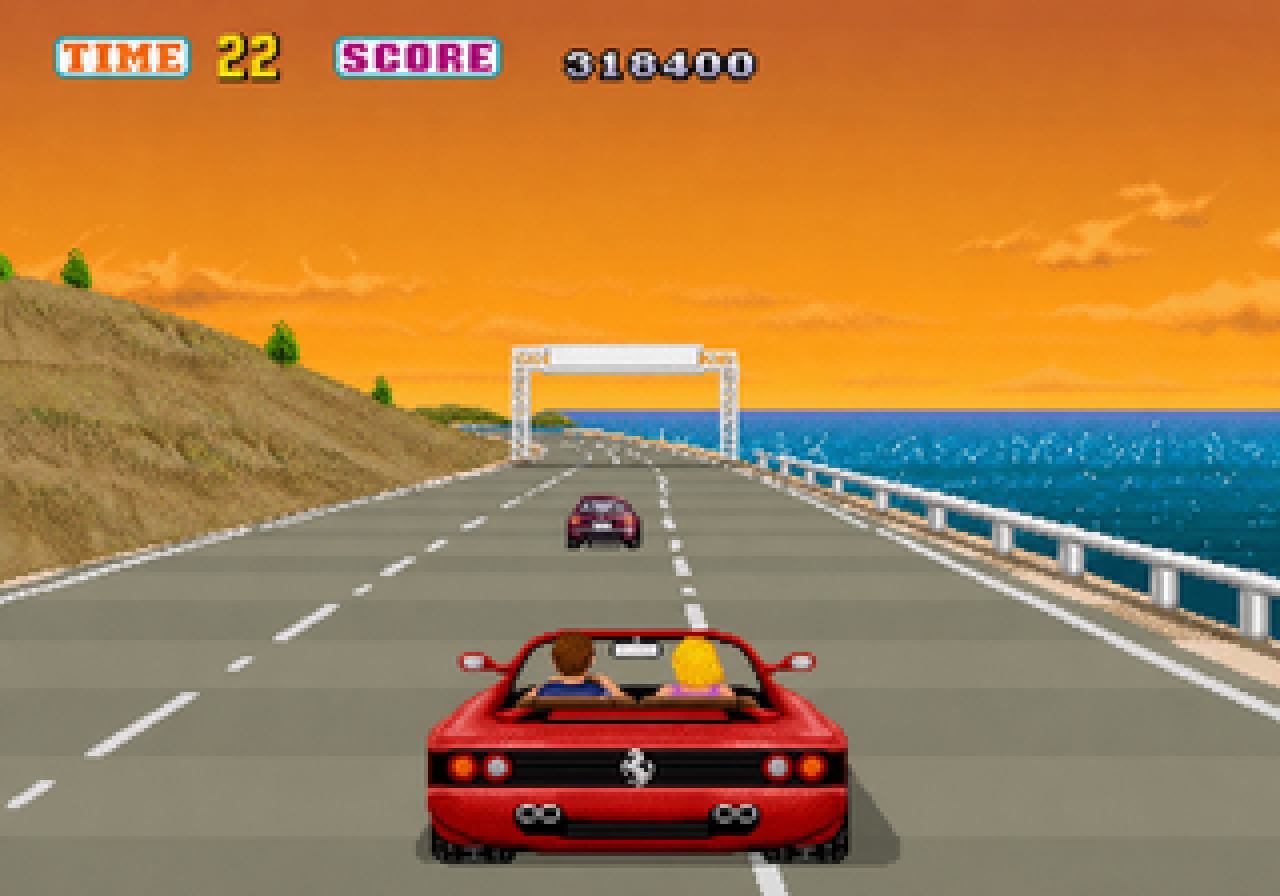
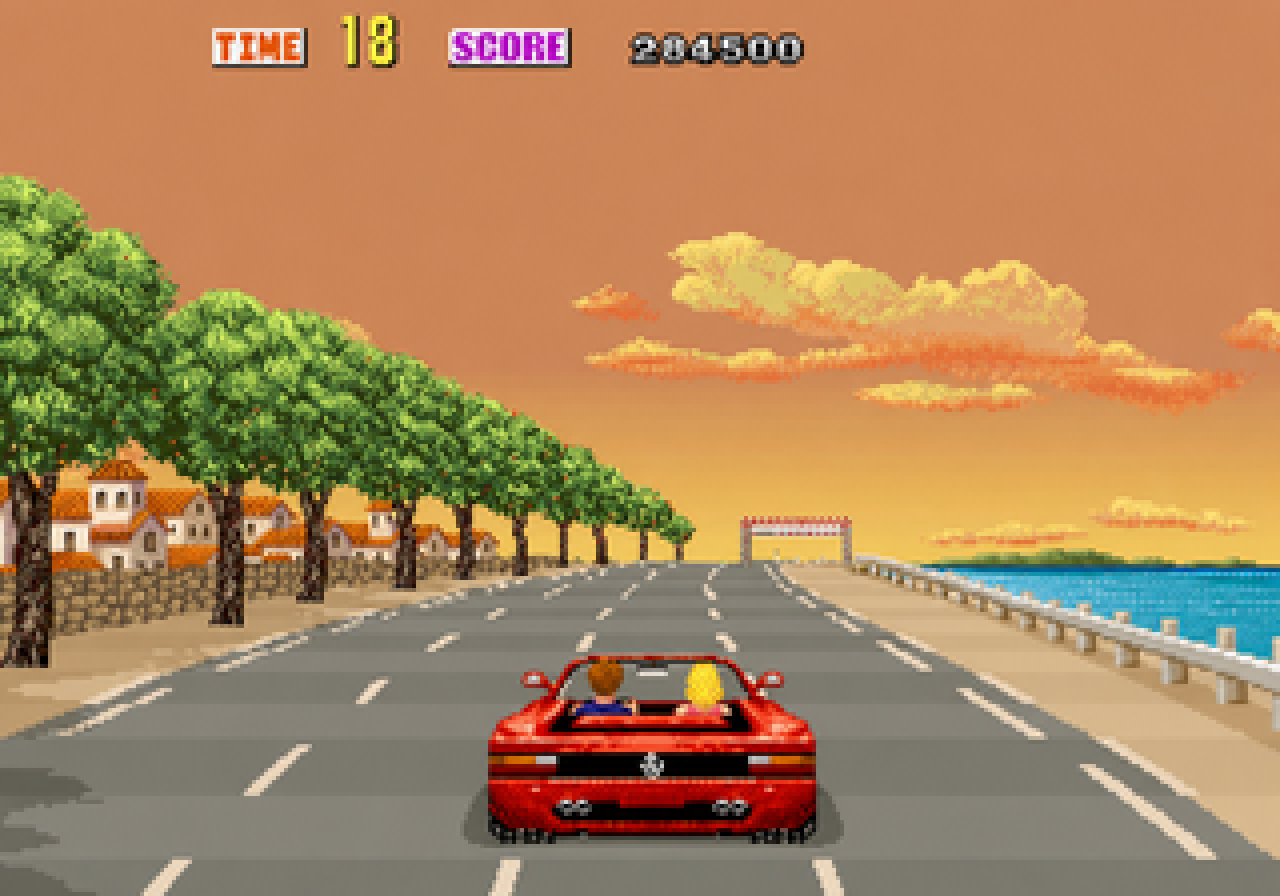
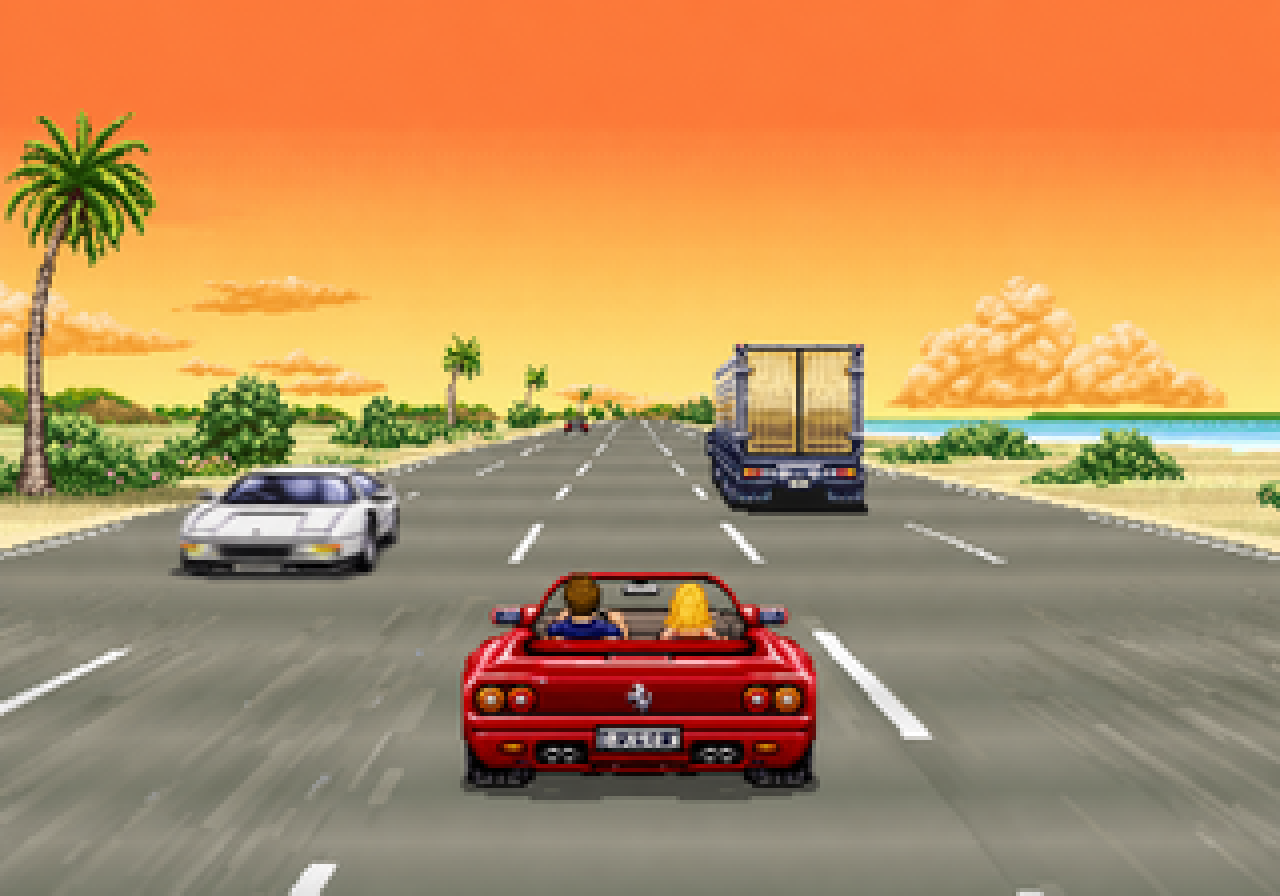
A coastal road leading to the checkpoint, with the driver choosing not to pass the smaller car ahead

The woman must have felt the movement, because she said,

"You can go by."

"Yeah."

"But you're not."

"Don't need to."

This time she didn't reply. Instead she slowly curled and uncurled the fingers resting on the window frame. Sunlight brushed across the back of her hand. The closer they got to arrival, the more her attention drifted away from the scenery outside and toward the things inside the car: the way his wrist bent when he shifted gears, the line of his jaw tightening for a moment in a curve, the tiny pocket of silence before the music changed tracks. Those things didn't rush past the way the road did.

Tucking in behind the small car lowered their pace by a shade. The sound of the wind changed. So did the engine note, the motion of her hair, everything. As one layer of strain peeled away - the strain that had been pushing them downhill without pause - the world around them somehow came into sharper focus. Off to the right, below the road, water opened wide under the late sun. On the slope to the left, dry grasses bent and shivered. Far ahead, beyond the checkpoint, the marker for the next section floated faintly in view. There was still road left to take.

She parted her lips, then closed them again. Knowing how hard it was to bring back a sentence once it had passed, she said it anyway.

"When I asked you to slow down a little..."

"Yeah."

"It wasn't just because I was scared."
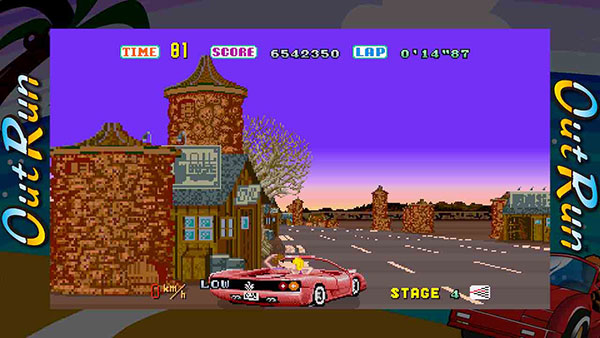
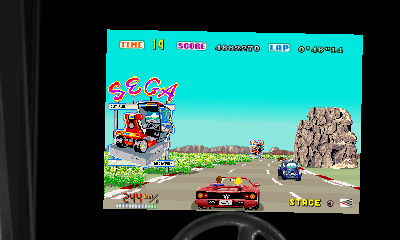
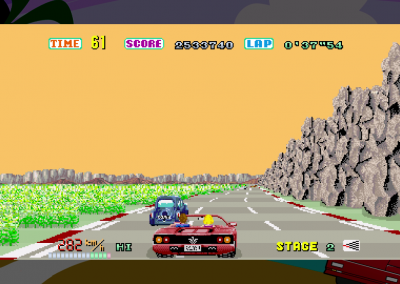
7. Official SEGA AGES OutRun screenshot - a drive under time pressure

This time he didn't look at her immediately. Instead he watched the car ahead drift very slightly left and opened the distance a little more.

"I know."

"You do?"

"You didn't have the face of someone who was only scared."

She let out a small breath.
It was hard to tell whether it was a laugh or a sigh.

"Then why did you keep driving like that?"

The question was gentle, but everything that had been held back until now was inside it. To avoid being late. To avoid missing something. Or maybe just because he couldn't stand hearing the word late. Instead of searching for an answer, he dropped down a gear. The engine rose for a moment, then settled again.

"I thought if I stopped, it would be over."

"Who said that?"

"I don't even know."

After that, she went quiet for a while. The wind lifted the ends of her hair and let them fall. The checkpoint gate was close now, close enough that one more push would get them there in no time. Even so, he stayed behind the smaller car. Not the slowness of someone gritting his teeth and resisting impatience, but the slowness of someone choosing his speed for the first time.

Then the car ahead peeled off to the right, and the road opened.

No one was blocking them now. The opposite lane was empty. A short, straight stretch remained between them and the gate. It was exactly the kind of finish the red car did best. The music was entering the last part of the chorus. One more repetition, and they'd probably already be through.

She said,

"Your call."

It didn't sound like permission. It didn't sound like a test, either. It was simply the choice, returned to him. On this road, right now, what came first for him: the numbers, the passing time, or something else entirely.

He stepped on the accelerator.

The car leapt forward. The engine shed its low voice and climbed into something bright and sharp. The wind rushed deeper into the cabin in an instant. Her shoulders tipped back. The checkpoint gate swelled fast in the windshield. The hesitation of a moment ago suddenly seemed absurdly brief.

And then, right in front of the gate, he stopped accelerating.

He didn't slam the brakes. He just didn't ask for any more. The car was still fast, but he refused that final scrap of excess. Not the fastest possible crossing - almost as if he were choosing the longest possible last moment. The gate filled the windshield, then in an instant passed overhead.

The shadows of the pillars swept once across the body of the car.

The numbers came alive again. Time stretched back out. A tiny electronic chime skimmed through the cabin like an old promise.

She laughed before she knew she was doing it. Whether from relief, disbelief, or both, she couldn't have said.

"So we made it after all."

He nodded.
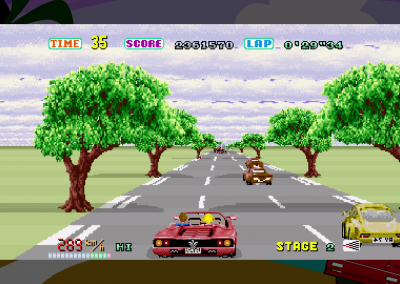
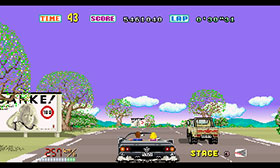
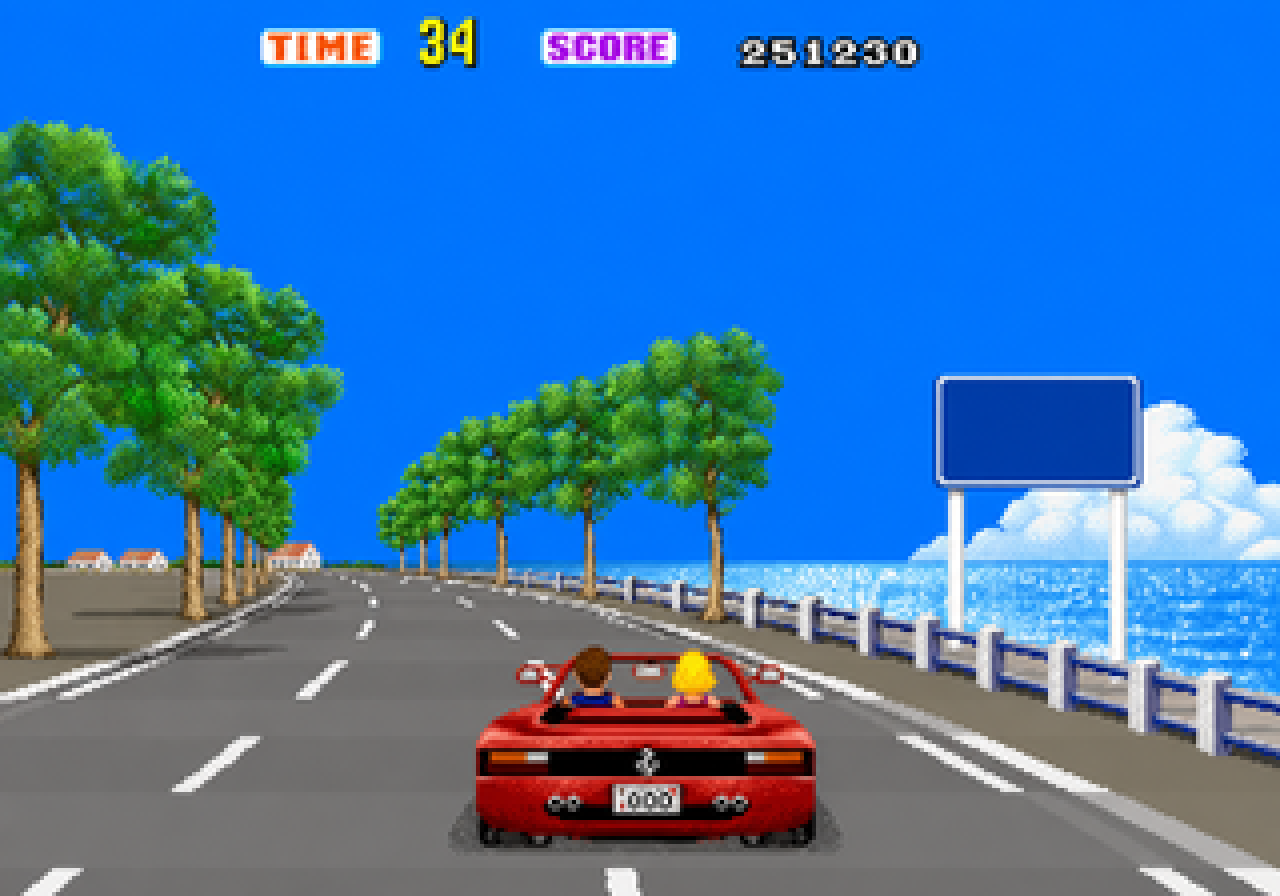
15. Official OutRun screenshot - climbing between stone pillars

"Yeah."

"But why'd you do that at the end?"

This time he thought for a moment before answering.

"If you finish too perfectly, it feels like it's really over."

She didn't repeat it back to him. She just looked ahead again. The road beyond the checkpoint resembled the last section and yet had already put on a different face. It was preparing to split again. Even from a distance, the signs hinted at two different directions. One side looked brighter, wider. The other entered shadow first. They weren't close enough to choose yet, but the air of the two roads was already different.

He let the speed rise a little, then leveled it off again. There was plenty of time now. Really plenty. And somehow that made the choice harder, not easier, because now the numbers weren't forcing it.

The music was heading toward its end. When a familiar melody enters its final repetition, you hear it differently - more sharply than you did at the beginning. Even if you know the song by heart, there's always something you only catch at the end: a thin keyboard line tucked behind everything else, a drum coming in a beat late, a connecting tone so brief you missed it the first time. For a while they said nothing, just listened to that ending.

She placed a hand on the dashboard. Her fingertips moved with the rhythm for a second, then stopped.

"You said it at the start," she said.

"Said what?"

"That the road doesn't really begin until after you've chosen the music."

He moved one shoulder slightly.
It could have been agreement. It could have been embarrassment.

"I did."

"I think I get it now. A little."

He didn't smile, but the corner of his mouth loosened a fraction.

"Only a little?"

"A little more than a little."

"And how much is that?"

"Enough that I'll still be hearing it for a while after I get out."

A brief silence followed, and he couldn't brush it away lightly. After I get out. The words summoned the time after arrival before they had even arrived. They were still driving together, and yet she was already speaking about the air after she was no longer in the car. A destination never ends with arrival alone. You pass the gate, slow down, come to a stop, take your hands off the wheel, turn the music off - or turn it way down - and then something remains. He had never been in the habit of thinking about that part. It was always the next gate, the next branch, the next section first.

"Once you get out," he said, "you won't hear the music anymore."

"Something stays anyway."

He didn't answer.

The road was gradually leaning toward the next fork. The colors of the signs sharpened. Direction arrows cast long shadows over the pavement. Either way, the road would continue. Only the scenery would change. That difference was almost the whole trip.

She asked,
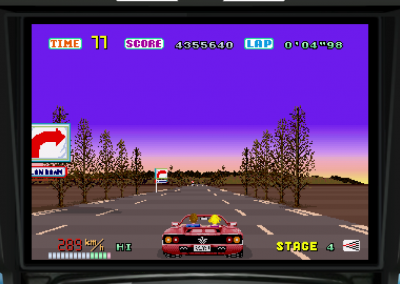
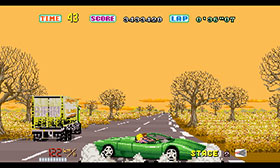
16. Official 3D OutRun screenshot - passing through a stone arch section

"This time, do you want to choose first, or should I?"

"You."

"Why?"

"Because before, you told me to decide."

She laughed softly. The sound blurred into the wind almost at once.

"Then the one where we get the sea a little longer."

He looked back at the sign. There wasn't much distance left to make the call. The right side opened into more light. The left dipped under the trees. Which road would keep the sea beside them longer - he knew almost by instinct. All those accumulated landscapes had taught his sense of direction before his hands ever had.

The car changed lanes smoothly.

The dividing line of the fork vanished beneath the tires.

She said nothing, just looked out the window. Sometimes a choice is more precise than words. He had chosen her road, and she didn't need him to confirm it. Instead she turned her face slightly toward the wind. Her hair swept back, exposing one ear. That small movement spoke of a crossing more clearly than the gate they had just passed.

The music ended.

A short silence settled inside the car. Only the engine, the wind, and the fine vibration of the road coming up through the tires remained. He could have reached out and skipped to the next track. Just like at the beginning, he could have chosen another one and kept the road going that way.

But he didn't touch it.

The silence lasted longer than expected. It wasn't empty silence. It was the kind that leaves what was just there suspended in sharp outline. She didn't say anything either, as if both of them felt it would be a waste to break it.

The road opened back out toward the sea. Far off, the late light on the water shone like a sheet of thin metal. Guardrails passed in steady intervals. Palm shadows crossed the asphalt. The red car no longer looked like something being chased. But it wasn't stopped, either. It was simply moving at its own speed.

On impulse, he looked not at the gauges but at the reflection of her hand below the windshield. Her fingers, resting on the dashboard, were no longer keeping time. Even so, he could still see the beat of the song that had just ended in the tips of them. Sometimes what is gone remains more vividly in front of your eyes.

A little later, she said very softly,

"The next song..."

Without looking at her, he asked,

"Yeah?"

"Let's wait a bit."

Instead of answering, he nodded.

The car kept going along the road they had chosen. Behind them, the gate they had just passed was already gone from sight. Ahead, there was still a light that had no name yet. For a while the sea ran beside the road, and the wind moved in and out of the car without rest. In the place where the music had stopped, strangely, nothing felt lacking.

The red car carried that silence with it and kept driving, unchanged, until the next sign came close enough to read.
References

[OutRun 소설 7화] 음악만 남는 곳

음악만 남는 곳

체크포인트의 문은 멀리서 보면 늘 늦는다. 거의 다 온 것 같은데도, 그 두 기둥은 좀처럼 커지지 않았다. 대신 먼저 다가오는 것이 있었다. 길 위에 길게 드리운 그림자, 내리막 끝에서 한 번 반짝이고 사라지는 표지판의 면, 그리고 차 안을 채운 멜로디의 얇은 금속성 울림. 바람은 이미 목적지 쪽 냄새를 싣고 있었지만, 손끝에 닿는 것은 아직 핸들의 미세한 떨림뿐이었다.

계기판의 숫자는 줄어들고 있었다. 충분했다. 간신히가 아니라, 이제는 거의 확실했다. 그 사실이 오히려 발끝을 가볍게 만들지 못했다. 그는 가속 페달을 더 밟지 않고, 그렇다고 떼지도 않은 채 그 중간 어딘가를 오래 유지했다. 붉은 차는 스스로 숨을 고르는 짐승처럼 낮게 울었다.

조수석의 여자는 앞을 보고 있었다. 바다 쪽은 이제 도로보다 아래로 내려가 있었고, 물빛은 나무 사이와 가드레일 틈으로만 얇게 보였다. 방금 전까지는 시간이 문제였는데, 이제는 시간이 남는다는 사실이 이상하게 둘 사이를 조용하게 만들었다.

“이제는 되겠네.”

그녀가 먼저 말했다. 안도처럼 들리기도 했고, 확인처럼 들리기도 했다.

그는 바로 대답하지 않았다. 앞유리를 가로지르는 빛의 결이 한 번 바뀌었다. 도로가 아주 조금 휘고, 체크포인트의 문이 그제야 분명한 형태를 갖췄다. 흰색의 기둥, 위를 잇는 간판, 그 아래를 지나간 차들이 남겼을 법한 보이지 않는 바람의 층. 그 문을 통과하면 숫자는 다시 살아날 것이다. 길은 끊기지 않고 이어질 것이다. 규칙은 늘 그래 왔다.

그녀가 그를 힐끗 보았다.

“왜 그래.”

“아무것도.”

“그 표정이 아무것도는 아닌데.”

그는 웃지 않았다. 다만 오른손 엄지로 핸들의 가죽을 한 번 문질렀다. 오래 쥔 데서만 생기는 매끈한 자리였다. 음악은 후렴으로 들어가고 있었다. 처음 듣는 사람에게는 밝게 들릴지도 모를 가벼운 리듬이었지만, 같은 길 위에서 오래 들으면 그 안에 묘하게 뒤를 끄는 부분이 있었다. 한 소절이 끝날 때마다 다음 소절이 오기 전에 아주 짧은 망설임이 생겼다. 차는 앞으로 가는데, 음악만 잠깐 뒤를 돌아보는 것 같았다.

앞쪽 차선에 작은 차 하나가 보였다. 속도는 느리지 않았지만, 지금의 그들보다는 분명히 느렸다. 맞은편은 비어 있었다. 추월할 수 있었다. 해 오던 대로라면 생각할 것도 없었다. 그는 차를 중앙선 쪽으로 조금 붙였다가, 다시 원래 자리로 가져왔다.

작은 차를 추월하지 않고 체크포인트를 향하는 해안 도로

여자가 그 움직임을 느꼈는지 말했다.

“지나갈 수 있잖아.”

“응.”

“그런데 안 가네.”

“안 가도 되니까.”

이번에는 그녀가 대답하지 않았다. 대신 창틀 위에 올린 손가락을 천천히 접었다 폈다. 손등에 햇빛이 스쳐 지나갔다. 도착이 가까워질수록, 그녀는 자꾸 차 바깥보다 차 안의 것들을 보게 되었다. 기어를 바꿀 때 그의 손목이 꺾이는 모양, 커브에서 잠깐 굳어지는 턱선, 음악이 바뀌기 전 아주 짧게 생기는 정적. 그런 것들은 길처럼 빠르게 지나가지 않았다.

작은 차 뒤에 잠시 붙자 속도가 한 톤 낮아졌다. 바람 소리도, 엔진의 울림도, 그녀의 머리카락이 흔들리는 모양도 조금씩 달라졌다. 내리막 끝에서 계속 밀어붙이던 긴장이 한 겹 벗겨지자, 오히려 주변이 더 잘 보였다. 길 오른쪽 아래로는 늦은 햇빛을 받은 물이 넓게 열려 있었고, 왼쪽 사면에는 건조한 풀들이 눕듯 흔들렸다. 저 멀리, 체크포인트 너머로 이어지는 다음 구간의 표식이 희미하게 떠 있었다. 갈 수 있는 길은 아직 남아 있었다.

그녀가 입술을 열었다가 닫았다. 한 번 지나간 말은 다시 꺼내기 어렵다는 걸 알면서도, 결국 꺼냈다.

“조금만 천천히 가자고 했을 때.”

“응.”

“그건 겁나서만은 아니었어.”

7. 시간 제한 속 드라이브를 담은 SEGA AGES OutRun 공식 게임 화면 · SEGA

그는 이번에는 바로 그녀를 보지 않았다. 대신 앞차가 왼쪽으로 아주 약하게 흔들리는 것을 확인하고, 거리를 조금 더 벌렸다.

“알아.”

“정말?”

“겁나서만은 아닌 얼굴이었으니까.”

그녀는 작게 숨을 내쉬었다. 웃은 건지, 한숨인지 구분하기 어려웠다.

“그럼 왜 계속 그렇게 달렸어?”

질문은 부드러웠지만, 그 안에는 지금껏 밀려 있던 것들이 들어 있었다. 늦지 않기 위해서. 놓치지 않기 위해서. 혹은, 늦는다는 말을 듣기 싫어서. 그는 대답을 찾는 대신 기어를 한 단 내렸다. 엔진 소리가 잠깐 올라왔다가 다시 가라앉았다.

“멈추면 끝나는 줄 알았어.”

“누가?”

“나도 모르지.”

그녀는 그 말을 듣고 한동안 잠잠했다. 바람이 그녀의 머리카락 끝을 들어 올렸다가 놓았다. 체크포인트의 문은 이제 충분히 가까웠다. 조금 더 밟으면 금방 닿을 거리였다. 그런데도 그는 작은 차 뒤에 붙은 채로 갔다. 조급함을 참는 사람의 느림이 아니라, 처음으로 속도를 고르는 사람의 느림이었다.

바로 그때 앞차가 오른쪽으로 빠지며, 길이 열렸다.

아무도 막지 않았다. 맞은편도 비어 있었다. 문까지는 짧고 곧은 길이 남아 있었다. 붉은 차가 가장 잘하는 방식으로 끝낼 수 있는 거리였다. 음악은 후렴의 마지막 부분으로 접어들고 있었다. 한 번 더 반복되면, 아마 문을 통과한 뒤일 것이다.

그녀가 말했다.

“이제 네가 정해.”

그 말은 허락처럼도, 시험처럼도 들리지 않았다. 다만 정말로 그에게 돌려주는 말이었다. 지금 이 길에서 무엇을 먼저 두는지, 숫자인지, 지나가는 시간인지, 혹은 둘 다 아닌 다른 무엇인지.

그는 액셀을 밟았다.

차가 앞으로 튀었다. 엔진이 낮은 목소리를 벗고 밝고 날카로운 음으로 치솟았다. 바람이 한순간에 차 안으로 더 깊이 밀려들었다. 그녀의 어깨가 뒤로 젖혀졌다. 체크포인트의 문이 빠르게 커졌다. 방금 전까지의 망설임이 거짓말처럼 짧아졌다.

그리고 문 바로 앞에서, 그는 가속을 멈췄다.

브레이크를 세게 밟은 것은 아니었다. 다만 더 밟지 않았다. 차는 여전히 빨랐지만, 마지막 한 조각의 무리만은 하지 않았다. 가장 빠른 통과가 아니라, 가장 긴 마지막을 택하듯. 문이 앞유리를 가득 채웠다가, 순식간에 위로 넘어갔다.

기둥 그림자가 차체를 한 번 훑고 지나갔다.

숫자는 살아났다. 시간이 다시 늘어났다. 아주 짧은 전자음이, 오래된 약속처럼 차 안을 스쳤다.

그녀는 자신도 모르게 웃었다. 안도해서인지, 어이없어서인지, 둘 다인지 알 수 없었다.

“결국 들어왔네.”

그는 고개를 끄덕였다.

15. 돌기둥 사이의 오르막을 달리는 OutRun 공식 게임 화면 · SEGA

“응.”

“그런데 마지막에 왜 그랬어?”

그는 이번엔 조금 생각한 뒤 말했다.

“끝을 너무 잘하면, 진짜 끝나는 것 같아서.”

그녀는 그 말을 되풀이하지 않았다. 대신 다시 앞을 보았다. 체크포인트를 지난 뒤의 길은 이전 구간과 닮아 있으면서도 이미 다른 얼굴을 하고 있었다. 도로는 다시 갈라질 준비를 하고 있었고, 표지판은 멀리서도 방향의 차이를 암시했다. 한쪽은 더 밝고 넓어 보였고, 다른 쪽은 그림자 속으로 먼저 들어갔다. 아직 가까워지지 않았는데도 둘의 공기가 달랐다.

그는 속도를 조금 올렸다가, 다시 일정하게 맞췄다. 시간은 충분했다. 이제는 정말로 선택이 숫자에 쫓기지 않았다. 그 사실이 오히려 더 어렵게 만들었다.

음악은 끝을 향해 가고 있었다. 익숙한 멜로디가 마지막 반복에 들어서면, 사람은 이상하게도 처음보다 더 잘 듣게 된다. 이미 다 아는 곡인데도, 마지막에는 그제야 들리는 부분이 있다. 뒤에 숨어 있던 얇은 건반 소리, 드럼이 한 박 늦게 들어오는 자리, 너무 짧아서 놓쳤던 연결음. 그들은 한동안 아무 말 없이 그 마지막을 들었다.

그녀가 대시보드 위에 손을 올렸다. 손가락 끝이 리듬을 타는 듯하다가 멈췄다.

“처음에 네가 그랬지.”

“뭐를.”

“음악을 고르고 나서야 길이 시작된다고.”

그는 어깨를 조금 움직였다. 인정인지, 민망함인지 모를 동작이었다.

“그랬지.”

“이제는 조금 알 것 같아.”

그는 웃지 않았지만, 입가가 아주 조금 풀렸다.

“조금만?”

“조금 이상.”

“그건 어느 정도지.”

“내가 내리고 나서도 한동안 들릴 정도.”

그 말 뒤에 잠깐 침묵이 왔다. 그는 그 침묵을 가볍게 넘기지 못했다. 내리고 나서도. 그 말은 도착 뒤의 시간을 먼저 불러왔다. 지금은 아직 함께 달리고 있는데, 그녀는 벌써 차에서 떨어져 나간 뒤의 공기를 말하고 있었다. 목적지는 늘 도착만으로 끝나지 않는다. 문을 지나고, 속도를 줄이고, 차가 멈추고, 손이 핸들에서 떨어지고, 음악이 꺼지거나 아주 작아지고, 그 뒤에 남는 것이 있다. 그는 그 뒤를 생각하는 버릇이 없었다. 늘 다음 문, 다음 분기, 다음 구간이 먼저였다.

“내리면,” 그가 말했다. “음악은 안 들릴 텐데.”

“그래도 남는 건 있잖아.”

그는 대답하지 않았다.

길은 서서히 분기점 쪽으로 기울고 있었다. 표지판의 색이 분명해지고, 방향 화살표가 도로 위에 길게 그림자를 드리웠다. 둘 중 어느 쪽을 가도 길은 이어질 것이다. 다만 풍경이 달라질 뿐이다. 그 차이가 이 여행의 거의 전부였다.

그녀가 물었다.

16. 석조 아치 구간을 통과하는 3D OutRun 공식 게임 화면 · SEGA

“이번엔 네가 먼저 고를래, 내가 고를래?”

“네가.”

“왜.”

“아까 네가 나한테 정하라고 했으니까.”

그녀는 잠깐 웃었다. 바람에 섞여 금방 흐려지는 웃음이었다.

“그럼 바다가 더 오래 보이는 쪽.”

그는 표지판을 다시 봤다. 아주 짧은 거리 안에 판단이 필요했다. 오른쪽은 빛이 더 열려 있었고, 왼쪽은 나무 그림자 아래로 내려갔다. 바다를 더 오래 보는 길이 어느 쪽인지, 그는 거의 본능적으로 알 수 있었다. 그동안 쌓인 풍경의 감각이 손보다 먼저 방향을 기억하고 있었다.

차는 부드럽게 차선을 옮겼다.

분기점의 선이 타이어 아래로 사라졌다.

그녀는 별말 없이 창밖을 보았다. 선택이 말보다 정확할 때가 있었다. 그가 고른 것은 그녀의 쪽이었고, 그녀는 그것을 굳이 확인받지 않았다. 대신 바람 쪽으로 얼굴을 조금 돌렸다. 머리카락이 뒤로 쓸려가며 귀가 드러났다. 그 작은 동작이, 방금 지나온 문보다 더 또렷하게 어떤 통과를 말하는 것 같았다.

음악은 끝났다.

짧은 정적이 차 안에 내려앉았다. 엔진 소리, 바람, 노면이 타이어를 타고 올라오는 미세한 진동만 남았다. 그는 손을 뻗어 다음 곡으로 넘길 수 있었다. 처음 출발할 때처럼, 다시 하나를 고르면 되었다. 이 길은 그렇게 계속 이어질 수도 있었다.

하지만 그는 손을 대지 않았다.

정적은 생각보다 오래 버텼다. 비어 있는 것이 아니라, 방금까지 있던 것을 또렷하게 남기는 정적이었다. 그녀도 아무 말 하지 않았다. 둘 다 그 침묵을 깨는 것이 아깝다는 듯이.

도로는 다시 바다 쪽으로 열렸다. 늦은 빛을 받은 수면이 멀리서 한 장의 얇은 금속판처럼 빛났다. 가드레일이 규칙적으로 지나가고, 야자수 그림자가 길 위를 건너갔다. 붉은 차는 더 이상 쫓기는 모양이 아니었다. 그렇다고 멈춘 것도 아니었다. 그저 자기 속도를 가진 채 흘렀다.

그는 문득 계기판 대신 앞유리 아래에 비친 그녀의 손을 보았다. 대시보드 위에 올려둔 손가락이 이제 리듬을 타지 않고 가만히 있었다. 그런데도 그는 방금 끝난 곡의 박자를 그 손끝에서 계속 보았다. 실제로는 사라진 것이, 눈앞에는 남아 있는 순간이 있었다.

조금 뒤 그녀가 아주 작게 말했다.

“다음 곡은.”

그는 그녀를 보지 않은 채 물었다.

“응.”

“조금 있다가.”

그는 대답 대신 고개를 끄덕였다.

차는 선택한 길 위를 계속 갔다. 뒤에서는 방금 지난 문이 이미 보이지 않았다. 앞에는 아직 이름 붙일 수 없는 빛이 남아 있었다. 바다는 한동안 도로와 나란히 갔고, 바람은 쉬지 않고 차 안을 드나들었다. 음악이 멈춘 자리에는, 이상하게도 아무 부족함이 없었다.

붉은 차는 그 정적을 싣고, 다음 표지판이 읽힐 만큼 가까워질 때까지 그대로 달렸다.

참고자료

[OutRun Novel, Episode 6] A Heart Running Slightly Behind the Clock

A Heart Running Slightly Behind the Clock

Even without a second hand, the first thing to disappear was always the sound.

Each time the remaining time on one side of the dashboard shaved itself down, the music inside the car seemed to come through more clearly. A few short, bright notes tapped at the windshield first, then a lower rhythm rose up beneath them. As they crested the hill, light spilled over everything at once. The shadow that had been pressing down on them a moment ago slid away behind, and the road looked as if it had suddenly widened. But that was mostly a trick of the scenery. What had really opened up was the sky. On the pavement ahead, the same slow cars still strung themselves out in broken intervals.

At the top, the red car went light for an instant, almost floating, and then immediately gathered the speed of the downhill. Wind swept long across the windshield. The woman in the passenger seat pressed her hair down with the back of her hand. On the climb she had kept her lips shut and stared straight ahead; only once they started descending did she finally let out a breath.

“Did we make some time?”

He didn’t answer. He just glanced at the instruments. The numbers hadn’t improved so much as stopped getting worse. Right now, that tiny distinction meant everything.

“Or,” the woman said, “does it just look that way?”

Instead of laughing, he nudged the wheel a fraction. The line he’d been tracing behind the car ahead slipped gently aside. A headlight from the oncoming lane flashed at the edge of daylight. Not yet. He tucked back in. The engine note stretched out, held tight and low.

The scenery on either side was changing again. The rough rock and dry grass from the hilltop gave way below to neatly spaced trees. Their branch tips shook in the wind, but their trunks didn’t move. Far off, a bright strip of water appeared now and then. Sea or river, it was hard to tell—just a blue sheen with no clear boundary. The road seemed to be heading for it, then turned away at the last moment, wasting time. The closer the destination got, the less honest the road became.

Ahead were a small sedan and a truck loaded with cargo. The gap between them wasn’t wide, and in the opposite lane a silver car was coming on with slow, unquestioning certainty. He pressed the accelerator, then eased off again. The woman beside him felt the decision before it happened. Her toes braced once against the floor. Her hand searched along the top of the door.

“Not now, right?”

“Not yet.”

“‘Not yet’ never lasts very long.”

Instead of answering, he watched the back of the truck. Sunlight caught on a metal edge and kicked away in a brief spark. The shadow under the cargo bed trembled across the road. The silver car passed, and behind it a stretch of empty lane opened for a moment. He held his breath as if measuring that instant. The rhythm of the music landed right on top of it. One drum hit, the melody leapt upward, and the red car crossed the line.

As he skimmed alongside the truck, the whole world suddenly closed in. Tire noise, wind noise, the engine’s vibration, the narrow distance where metal seemed aware of other metal. The woman in the passenger seat said nothing. She kept staring forward, as if one word too early might make the car sway after it. The moment he cleared the truck’s nose, he folded the wheel inward again. As soon as the red car slipped back into its lane, a white car rushed past from the opposite direction, low and fast. Wind slapped the bodywork.

Only then did she breathe out.

“A second ago you said not yet.”

7. The red convertible returns to its lane after passing the truck

“A second ago, it wasn’t.”

“That sentence is the dangerous part.”

He smiled, but only for an instant. The car was already running up behind the next vehicle. The little bit of space he’d made was being swallowed almost immediately by the other speeds on the road. The downhill still hadn’t ended, and time hadn’t stopped either. The remaining numbers kept shrinking. There was something strange about the way they did it. From far away, they always looked plentiful; up close, they vanished all at once. Destinations were usually like that. They acted as if they didn’t exist until they came into view, and the moment they did, they started pressing you.

The music looped back to a familiar phrase. It should have felt routine by now, but somehow this time it sounded like he was hearing it for the first time. Same melody, same instruments—yet the meaning had changed because the backdrop had changed. On the coast, it had sounded like the road opening ahead. In the white town, it had sounded like slipping between walls. Here, it no longer sounded like music carrying them toward somewhere. It sounded like something holding them back from getting there too quickly.

The woman looked out the window.

“Look.”

Without taking his eyes off the road, he asked, “At what?”

“Not the road.”

Only then did he glance sideways. Between the trees, the water opened wide. Light skimmed thinly over the surface, and a few small white specks floated there. Boats, maybe. Or just sunlight playing tricks. It was hard to tell. But distant things were always a little beautiful.

Because you couldn’t get close to them.

“Nice,” he said.

“You really can just say ‘nice’ and drive past it.”

“If I don’t drive past it, we’re late.”

“That’s always what you say.”

Even so, she couldn’t pull her gaze away. The car kept moving, and the scenery never waited for anyone looking at it. Some views stay with you longer when you can’t quite hold them. She probably knew that. So did he. That was why they could be looking at the same thing and still choose differently. One chose what she wanted to keep looking at. The other chose what he couldn’t afford to miss.

15. A coastal road opens beside a blue sign and glittering water

Ahead, a blue sign appeared, small at first. The words weren’t readable yet, but the shape alone was enough. For anyone measuring the road by what remained, a blue sign always carried promise and threat together. The closer it got, the less reassuring it felt. You only had to make it that far. If you couldn’t even make it that far, it was over. Both thoughts entered the car at once.

He pressed the accelerator a little harder. The engine rose from somewhere low and filled the cabin. The woman turned to look at him.

“Again?”

“This time I have to.”

“If all you ever do is what you have to, sometimes there’s nothing left when you finally arrive.”

It didn’t sound like a jab. If anything, it sounded like someone saying aloud something she’d been thinking for a long time. He didn’t answer right away. He watched the movement of the car ahead and waited for the next opening. But her words didn’t pass through the car like wind. They stayed.

Sometimes there’s nothing left when you finally arrive.

He understood what she meant. On the road there was always a next section, a next sign, a next view. Some things ended the instant you reached them. A destination gained a name, but in exchange it took away a lot of what the road had been holding. That was why some people wanted to arrive, and some wanted not to arrive quite so completely. It was only the slightest difference, but it was enough for time to move differently even inside the same car.

The car ahead drifted a little to the right. The small sedan behind the truck was hesitating. He didn’t miss that movement. Before a gap opens on the road, there’s a moment when a gap opens in someone’s mind. He had spent a long time learning to recognize it. The red car slipped outward again.

This one lasted longer. To clear both the small car and the truck in one move, he had to hold the speed. The opposing lane was empty, but far off there was a dot. Those dots always grew faster than you thought they would. This time the woman didn’t grab the handle. Instead, she clasped her hands tightly in her lap. By now she knew in her body the difference between when he could make it back in and when he couldn’t. That made it worse in a different way. Reckless danger passed quickly. Calculated danger stayed with you.

The truck’s side stretched on and on. The red car’s shadow clung to the metal, then fell away. The dot ahead was beginning to take the shape of a car. He still didn’t move back in. He had to go farther. As he cleared the truck’s front, the road ahead tipped downward once. At the end of that slope, the blue sign looked much larger. And beneath it, the road was already beginning to hint at a split left and right. The junction was still some distance away, but the road had already taken on the shape of a choice.

Only then did he come back inside. The oncoming car swept past and rocked the body. The woman shut her eyes, opened them again, and said,

“That one was too long.”

“I know.”

“You know, and you still do it.”

“If I don’t, we lose more time.”

She fell silent. It was the silence of admitting he wasn’t wrong. But just because something was true didn’t mean the heart went along with it. She looked back out the window. The water between the trees was almost gone now. In its place ran a roadside guardrail, and beyond it a few low roofs appeared in the distance. It should have meant ordinary life, someone living somewhere. Instead it only made the scene lonelier. To someone passing through, even rooftops were just another color for a second.

16. Low rooftops and a checkpoint wait along the evening road

The music moved into its refrain. The melody, so light on the surface, now sounded faintly wistful. She glanced at the dashboard. There was still time left, but not enough to call generous. He kept his eyes forward like someone refusing to look at the numbers. There were moments when looking at them too often made your resolve shrink first.

“Hey,” she said.

“Yeah.”

“Can’t we go just a little slower?”

He didn’t pretend not to hear. He just didn’t answer at once. The road ahead was briefly empty, and that emptiness made the question ring more clearly. Slower. It was a simple word, but on this road it sounded almost impossible. It was hardly different from asking him to give up the clock. And yet there was no childish insistence in her voice. She was simply asking whether, just this once, it might be possible.

“Why?”

“I don’t know,” she said. “Today I keep feeling like it’s a shame to arrive too soon.”

Only then did he look at her. It was just a glance, but a great deal passed through it: the light on the coast, the shadows on the white walls, the shade on the hill, the flash of water they had just passed. Up to now all of it had been just the in-between on the way to somewhere else. For her, it had already become most of the day. What felt precious was always what had already gone by.

He turned back to the road. The blue sign was growing larger. The letters were starting to come into focus, and beneath them the distance had begun to feel countable. The last stretch before a checkpoint usually looked shortest and felt longest. The road always acted as if it were about to end, then tested you one last time.

“If we slow down,” he said, “we might not make it.”

“I know.”

“Then?”

“I still wanted to ask.”

Instead of answering, he held the speed where it was. He didn’t press harder, didn’t let off. That ambiguous choice was almost everything he had to give. A pace that didn’t surrender completely to time, but didn’t hand the whole road over either. But that kind of speed never lasted. Another car appeared ahead, and the remaining time once again showed its face as a number.

The road curved long beneath the sign. Beyond the outside edge was a low guardrail and light dropping away below it. He tapped the brake once and released it immediately. The car followed the line with a slight shiver. The woman leaned toward the door and then came back upright. As they came out of the corner, the checkpoint structure appeared in the distance. A simple gate spanning the road. Once they passed under it, time would be given back, at least for a while. But because of that very fact, her words grew sharper in his mind. It’s a shame to arrive.

17. Official 3D OutRun screenshot racing between rocky hills and a truck - SEGA

Most people would have felt relief at the sight of the checkpoint. What he felt instead was a strange reluctance. The first thing he thought was that this section was ending. A moment ago there hadn’t been enough time; now he was thinking about all the things that had been good precisely because there wasn’t enough of it. Not being able to look at the sea longer. Not being able to drift slowly through the shadows of the white town. Not turning around one more time at the top of the hill. The road always opened forward. Regret always stayed behind.

“There it is,” the woman said first. In her voice were relief and disappointment at once. Opposite feelings, somehow sounding from the same place.

“Yeah.”

“We’ll make it.”

“We will.”

She nodded. But she didn’t look happy. Watching the guardrail and the light flick past outside, she smiled very faintly.

“Funny, isn’t it?”

“What is?”

“We raced this hard because we were afraid of being late, and now that we’re almost there, it feels like being a little late would be fine.”

Again, he couldn’t answer right away. Because the same feeling had reached his own foot on the pedal. He could just press down more. Then they’d pass through the gate faster, more safely, more certainly. But his foot didn’t go any deeper. The music filled the car. The familiar melody was nearing its end now, and the closer it came to the end, the clearer it became. Some songs only show their true face in the final bars.

The checkpoint drew near. Its shadow stretched long across the road. Once they entered it, the numbers would probably come alive again. Another road. Another view. Another choice. As always. Yet now, the few seconds before that next thing arrived felt strangely long. He didn’t want to lose them.

Beyond the windshield, the road flashed. The light beyond the guardrail opened wide one last time, then closed again. The woman said nothing. She had the look of someone who knew that, just now, the music was saying it more accurately than words could. The wind still rushed by at speed, but inside the car a different time seemed to be flowing. A time in which arrival and reluctance advanced at the same pace.

He adjusted the pressure of his foot by the smallest degree. In that uncertain instant—not speeding up, not truly slowing down—the final phrase of the music began. The melody no longer urged the road onward. If anything, it seemed intent on fully sounding itself before the road ran out, continuing with a clean, lucid grace.

Just before the checkpoint’s shadow touched the front bumper, the woman said quietly,

“For once, I hope the road wins.”

He heard her, but didn’t turn his head. Only the tension in his fingers loosened a fraction. The red car still ran straight toward the gate. There was time left, and arrival was almost within reach. But in those last few seconds, the music stood out more clearly than the numbers.

And for a moment, it really did sound as if music was the only thing that would remain in the end.

References

[OutRun 소설 6화] 시간보다 조금 늦은 마음

시간보다 조금 늦은 마음

초침은 없는데도, 줄어드는 것은 늘 소리부터였다.

계기판 한쪽에서 남은 시간이 깎여 나갈 때마다, 차 안의 음악은 오히려 더 또렷해졌다. 짧고 맑은 음 몇 개가 먼저 앞유리를 두드리고, 그 뒤를 낮은 리듬이 받쳤다. 언덕의 끝을 넘자 빛이 한 번에 쏟아졌다. 방금 전까지 그들을 눌러오던 그늘은 뒤로 미끄러졌고, 도로는 갑자기 넓어진 것처럼 보였다. 하지만 그것은 풍경이 주는 착각에 가까웠다. 실제로 넓어진 것은 하늘뿐이었고, 길 위에는 여전히 느린 차들이 간격을 흐트러뜨린 채 이어져 있었다.

붉은 차는 정상에서 잠깐 떠오르듯 가벼워졌다가, 곧바로 내리막의 속도를 얻었다. 바람이 앞유리 위를 길게 쓸고 지나갔다. 조수석의 여자는 손등으로 머리카락을 눌렀다. 언덕을 오를 때는 입술을 다문 채 앞만 보더니, 내려가기 시작하자 그제야 한 번 숨을 놓았다.

“조금 벌었어?”

그는 대답하지 않고 계기판을 한 번 봤다. 숫자는 벌었다기보다, 덜 잃고 있었다. 그 미묘한 차이가 지금은 전부였다.

“아니면,” 여자가 말했다. “그렇게 보이게만 하는 거야?”

그가 웃는 대신 핸들을 아주 조금 꺾었다. 앞차의 뒤를 따라가던 선이 부드럽게 비켜났다. 맞은편에서 오는 차의 헤드라이트가 낮의 끝자락에 짧게 번뜩였다. 아직 들어갈 틈은 아니었다. 그는 다시 제자리로 붙었다. 엔진 소리가 억눌린 채 길게 당겨졌다.

도로 양옆의 풍경이 또 바뀌고 있었다. 언덕 위의 거친 바위와 마른 풀 대신, 아래쪽에는 잘 정리된 나무들이 간격을 두고 서 있었다. 가지 끝은 바람에 흔들렸지만, 줄기는 흔들리지 않았다. 멀리서는 밝은 물빛이 잠깐씩 보였다. 바다인지 강인지, 그 경계가 분명하지 않은 푸른 빛이었다. 길은 그 물가를 향해 가는 듯하다가도, 어느 순간 다시 돌아서며 시간을 낭비했다. 목적지가 가까워질수록 길은 늘 솔직하지 않았다.

앞에는 작은 승용차 하나와 짐을 실은 트럭 하나가 있었다. 둘 사이 간격은 넓지 않았고, 맞은편 차선에서는 은색 차가 느린 확신으로 다가오고 있었다. 그는 가속을 올렸다가, 다시 조금 놓았다. 조수석의 여자는 그 움직임을 몸으로 먼저 알아챘다. 발끝이 바닥을 한 번 짚고, 손이 문짝 위를 더듬었다.

“지금은 아니지?”

“아직.”

“아직이라는 말은 늘 금방 끝나더라.”

그는 대답 대신 트럭의 뒤쪽을 보았다. 햇빛이 금속 모서리에 걸려 짧게 튀었다. 짐칸의 그림자가 도로 위에서 떨렸다. 맞은편의 은색 차가 지나가고, 그 뒤에 비어 있는 구간이 잠깐 열렸다. 그는 그 순간을 재듯 숨을 멈췄다. 음악의 리듬이 마침 그 짧은 틈과 맞물렸다. 드럼이 한 번 치고, 멜로디가 위로 튀는 사이, 붉은 차가 차선을 넘어갔다.

트럭 옆을 스치는 동안 세상은 갑자기 가까워졌다. 바퀴 소리, 바람 소리, 엔진의 떨림, 금속과 금속이 서로를 의식하는 좁은 거리. 조수석의 여자는 아무 말도 하지 않았다. 말이 먼저 나오면 차가 그 말을 따라 흔들릴 것처럼, 그대로 앞만 봤다. 트럭의 앞머리를 넘는 순간, 그는 다시 핸들을 안쪽으로 접었다. 붉은 차가 제 차선으로 돌아오자마자 맞은편에서 흰 차 한 대가 낮게 스쳐 지나갔다. 바람이 차체를 때렸다.

그제야 여자가 숨을 내쉬며 말했다.

“조금 전엔 아니라고 했잖아.”

7. 트럭 추월 뒤 차선으로 복귀하는 붉은 차

“조금 전엔 아니었지.”

“그 한마디가 제일 위험해.”

그는 웃었지만, 이번에는 아주 짧았다. 차는 이미 다음 차량의 뒤를 향해 달리고 있었다. 방금 만든 여유는 금세 길 위의 다른 속도들에 잡아먹혔다. 내리막은 끝나지 않았고, 시간도 멈추지 않았다. 남은 숫자는 줄고 있었다. 그 숫자가 줄어드는 방식에는 이상한 점이 있었다. 멀리 있을 때는 아직 많아 보이는데, 가까워지면 갑자기 다 써버린 것처럼 느껴졌다. 목적지란 대개 그런 식이었다. 눈앞에 보이기 전까지는 존재하지 않는 것처럼 굴다가, 보이는 순간 사람을 몰아세웠다.

음악이 한 구절을 반복했다. 익숙해질 법한 타이밍인데도, 이상하게 이번에는 처음 듣는 것처럼 들렸다. 같은 멜로디가 같은 악기로 돌아오는데, 배경이 달라져서인지 의미가 달랐다. 해안에서 들을 때는 길이 열리는 소리였고, 흰 마을에서는 벽 사이를 빠져나가는 소리였다. 지금은 어딘가를 향해 가는 소리라기보다, 어딘가에 너무 빨리 닿지 않게 붙들어 두는 소리처럼 들렸다.

여자가 창밖을 보며 말했다.

“저기 봐.”

그가 시선을 돌리지 않은 채 물었다.

“뭘.”

“길 말고.”

그는 그제야 아주 잠깐 옆을 봤다. 나무들 사이로 물빛이 넓게 열렸다. 빛이 표면 위를 얇게 미끄러졌고, 그 위에 작은 흰 점 몇 개가 떠 있었다. 배인지, 햇빛이 남긴 눈속임인지 분간하기 어려웠다. 하지만 멀리 있는 것은 늘 조금 아름다웠다. 가까이 갈 수 없기 때문에.

“좋네.” 그가 말했다.

“좋네, 하고 지나가네.”

“안 지나가면 늦어.”

“늘 그 말이지.”

그녀는 그렇게 말해놓고도 시선을 거두지 못했다. 차는 계속 달리고 있었고, 풍경은 보는 사람을 기다려주지 않았다. 어떤 장면들은 손에 잡히지 않을 때 더 오래 남는다. 그녀는 아마 그걸 알고 있었고, 그도 알고 있었다. 그래서 둘은 같은 것을 보면서도 다른 쪽을 택하고 있었다. 하나는 오래 보고 싶은 쪽을, 하나는 놓치지 않아야 하는 쪽을.

앞쪽에서 파란 표지판이 작게 나타났다. 아직 글자는 읽히지 않았지만, 그 모양만으로도 알 수 있었다. 남은 길을 재는 사람에게 파란 표지판은 늘 약속과 협박을 함께 들고 왔다. 가까워질수록 안심이 아니라 긴장이 생겼다. 저기까지 닿으면 된다, 라는 생각과 저기까지도 못 가면 끝난다, 라는 생각이 동시에 차 안으로 들어왔다.

15. 파란 표지판과 바다가 함께 열리는 해안 도로

그는 액셀을 조금 더 밟았다. 엔진음이 낮은 곳에서 올라와 차 안을 채웠다. 조수석의 여자가 그를 돌아봤다.

“또?”

“이번엔 해야 해.”

“해야 하는 일만 하다 보면, 도착한 다음엔 아무것도 안 남을 때가 있어.”

그 말은 핀잔처럼 들리지 않았다. 오히려 오래 생각해 둔 것을 아무렇지 않게 꺼낸 사람의 목소리였다. 그는 바로 대답하지 않았다. 앞차의 움직임을 보며, 다음 틈이 열릴 때를 기다렸다. 하지만 그녀의 말은 바람처럼 지나가지 않고 차 안 어딘가에 머물렀다.

도착한 다음엔 아무것도 안 남을 때가 있다.

그는 그 말을 이해할 수 있었다. 길 위에서는 늘 다음 구간이 있었고, 다음 표지판이 있었고, 다음 풍경이 있었다. 닿는 순간 끝나는 것들이 있었다. 목적지는 이름을 갖는 대신, 길이 가지고 있던 많은 것을 빼앗아 갔다. 그래서 어떤 사람은 닿고 싶어 했고, 어떤 사람은 조금 덜 닿고 싶어 했다. 아주 미세한 차이였지만, 그 차이 때문에 같은 차 안에서도 다른 시간이 흘렀다.

앞차가 오른쪽으로 아주 조금 흔들렸다. 트럭 뒤에 붙어 있던 작은 차가 망설이는 모양이었다. 그는 그 흔들림을 놓치지 않았다. 차선을 넘어갈 공간이 열리기 전에, 먼저 마음이 열리는 순간이 있다. 그는 그 순간을 오래 배워왔다. 붉은 차가 다시 바깥으로 미끄러져 나갔다.

이번에는 더 길었다. 작은 차와 트럭을 한 번에 넘기려면 속도를 오래 유지해야 했다. 맞은편 도로는 비어 있었지만, 저 멀리 점 하나가 있었다. 그 점은 늘 생각보다 빨리 커졌다. 조수석의 여자는 이번엔 손잡이를 잡지 않았다. 대신 무릎 위에 올린 손을 꼭 쥐었다. 그녀는 이제 그가 언제 들어가고 언제 못 들어가는지, 그 차이를 몸으로 알고 있었다. 그래서 더 무서운 것도 있었다. 무작정 위험한 것보다, 계산된 위험이 더 오래 사람을 긴장하게 만들었다.

트럭의 옆면이 길게 이어졌다. 붉은 차의 그림자가 금속에 붙었다가 떨어졌다. 점 하나가 점점 차의 형태를 갖추기 시작했다. 그는 아직 들어가지 않았다. 더 가야 했다. 트럭 앞을 넘는 순간, 앞쪽 도로가 한 번 아래로 기울었다. 그 경사 끝에서 파란 표지판이 훨씬 크게 보였다. 그리고 그 아래, 도로가 좌우로 갈리는 기색이 아주 멀리서부터 드러났다. 아직 분기점까지는 남았지만, 길은 벌써 선택의 모양을 하고 있었다.

그는 그제야 안쪽으로 들어왔다. 맞은편 차가 지나가며 차체를 흔들어 놓고 갔다. 여자가 눈을 감았다 뜨고 말했다.

“이번엔 너무 길었어.”

“알아.”

“알면서 하네.”

“안 하면 더 늦으니까.”

그녀는 입을 다물었다. 그 말이 틀리지 않다는 걸 인정하는 침묵이었다. 하지만 맞는 말이라고 해서 마음이 따라오는 것은 아니었다. 그녀는 다시 창밖을 봤다. 나무들 사이의 물빛은 이제 거의 보이지 않았다. 대신 길가의 난간이 이어졌고, 그 너머로 낮은 지붕 몇 개가 멀리 나타났다. 누군가의 생활이 있다는 뜻인데도, 그 풍경은 이상하게 더 쓸쓸했다. 지나가는 사람에게는 지붕도 한순간의 색일 뿐이었다.

차 안의 음악이 후렴으로 들어갔다. 가벼워 보이던 선율이 이번에는 조금 애틋하게 들렸다. 여자는 계기판을 보았다. 남은 시간은 아직 남아 있었지만, 넉넉하다고 부를 수는 없었다. 그는 그 숫자를 보지 않으려는 사람처럼 앞만 보았다. 숫자를 자주 보면 마음이 먼저 줄어드는 때가 있었다.

16. 낮은 지붕과 체크포인트가 보이는 저녁 도로

“있잖아.”

그녀가 말했다.

“응.”

“조금만 천천히 가면 안 돼?”

그는 못 들은 척하지 않았다. 다만 바로 대답하지 않았을 뿐이었다. 앞쪽 도로는 잠시 비어 있었고, 그 빈 길이 오히려 질문을 더 또렷하게 만들었다. 천천히. 그 말은 단순했지만, 이 길에서는 거의 불가능한 부탁처럼 들렸다. 시간을 포기하라는 말과 크게 다르지 않았다. 그런데도 그녀의 목소리에는 떼를 쓰는 기색이 없었다. 그냥 정말로, 그렇게 해볼 수 없느냐는 질문이었다.

“왜?”

“모르겠어.” 그녀가 말했다. “오늘은 자꾸 도착하기 아까워.”

그는 그제야 그녀를 봤다. 아주 잠깐이었지만, 그 짧은 시선 안에 많은 것이 지나갔다. 해안의 빛, 흰 벽의 그림자, 언덕의 그늘, 방금 스쳐 지나간 물빛. 그 모든 것이 지금까지는 목적지로 가는 중간 단계였는데, 그녀에게는 이미 하루의 대부분이 되어 있었다. 아까운 것은 늘 지나간 쪽에 있었다.

그는 다시 앞을 봤다. 파란 표지판은 점점 커지고 있었다. 글자가 읽히기 시작했고, 그 아래 숫자처럼 짧은 거리감이 생겼다. 체크포인트까지의 마지막 구간은 대개 가장 짧아 보이면서 가장 멀었다. 길은 곧 끝날 것처럼 말해놓고, 마지막에 꼭 한 번 사람을 시험했다.

“천천히 가면,” 그가 말했다. “못 닿을 수도 있어.”

“알아.”

“그럼?”

“그래도 묻고 싶었어.”

그는 대답 대신 속도를 유지했다. 더 밟지도, 놓지도 않았다. 그 애매한 선택이야말로 지금 그가 줄 수 있는 거의 전부였다. 시간에게 완전히 지지 않으면서, 길에게도 전부 양보하지 않는 속도. 하지만 그런 속도는 오래 유지되지 않았다. 곧 앞에 또 다른 차가 나타났고, 남은 시간은 다시 숫자의 얼굴을 드러냈다.

표지판 아래로 도로가 길게 휘었다. 그 바깥쪽에는 낮은 난간과, 그 아래로 떨어지는 빛이 있었다. 그는 브레이크를 짧게 밟고, 곧바로 풀었다. 차가 휘청이듯 선을 따라갔다. 여자는 몸을 문 쪽으로 기울였다가 다시 돌아왔다. 코너를 빠져나오자 체크포인트의 구조물이 멀리 보였다. 길 위에 걸쳐 선 단순한 문. 저것을 지나면 일단 시간은 다시 주어질 것이다. 하지만 바로 그 사실 때문에, 그녀의 말이 더 선명해졌다. 도착하기 아깝다.

체크포인트가 보이자 대부분의 사람은 안도했을 것이다. 그는 안도 대신 이상한 아쉬움을 느꼈다. 이 구간이 끝난다는 생각이 먼저 왔다. 방금 전까지는 시간이 모자랐는데, 이제는 시간이 모자라서 좋았던 것들까지 생각났다. 바다를 더 오래 보지 못한 것, 흰 마을의 그림자를 천천히 지나지 못한 것, 언덕 정상에서 한 번 더 뒤를 돌아보지 못한 것. 길은 늘 앞으로만 열렸고, 아쉬움은 늘 뒤에 남았다.

17. 바위 언덕과 트럭 사이를 달리는 3D OutRun 공식 게임 화면 · SEGA

“저기야.”

여자가 먼저 말했다. 그녀의 목소리에는 안심과 서운함이 함께 있었다. 서로 반대되는 감정인데도, 이상하게 같은 자리에서 들렸다.

“응.”

“닿겠네.”

“닿아.”

그녀는 고개를 끄덕였다. 그런데도 기뻐하지는 않았다. 창밖으로 스쳐 지나가는 난간과 빛을 보며, 아주 작게 웃었다.

“이상하지.”

“뭐가.”

“늦을까 봐 그렇게 달렸는데, 막상 닿기 직전엔 조금 늦어도 될 것 같아.”

그는 이번에도 바로 대답하지 못했다. 왜냐하면 그 말이 지금 그의 손끝에도 와 있었기 때문이다. 액셀을 더 밟으면 된다. 그러면 더 확실하게, 더 빨리 문을 통과할 수 있다. 하지만 발은 그만큼 깊이 내려가지 않았다. 음악이 차 안을 가득 채우고 있었다. 익숙한 멜로디는 이제 거의 끝을 향해 가고 있었고, 끝으로 갈수록 더 선명해졌다. 어떤 곡들은 마지막에야 비로소 자기 얼굴을 보여준다.

체크포인트가 가까워졌다. 문 아래의 그림자가 도로 위에 길게 드리워져 있었다. 그 그림자 안으로 들어가면, 아마 숫자는 다시 살아날 것이다. 다음 길, 다음 풍경, 다음 선택. 늘 그랬던 것처럼. 그런데 지금은 그 다음이 오기 전의 몇 초가 이상할 만큼 길었다. 그는 그 몇 초를 놓치고 싶지 않았다.

앞유리 너머로 길이 반짝였다. 난간 너머의 빛이 마지막으로 크게 열렸다가, 다시 닫혔다. 조수석의 여자는 아무 말도 하지 않았다. 그녀도 지금은 말보다 음악이 더 정확하다는 걸 아는 얼굴이었다. 바람은 여전히 빠르게 지나갔지만, 차 안에서는 다른 시간이 흐르는 것 같았다. 도착과 미련이 같은 속도로 다가오는 시간.

그는 아주 미세하게 발의 힘을 조절했다. 빨라지지도, 완전히 느려지지도 않는 그 애매한 순간에, 음악의 마지막 구절이 시작됐다. 멜로디는 더 이상 길을 재촉하지 않았다. 오히려 길이 끝나기 전에 자기 자신을 다 들려주려는 것처럼, 맑고 단정하게 이어졌다.

체크포인트의 그림자가 앞범퍼에 닿기 직전, 여자가 낮게 말했다.

“지금은 길이 이기면 좋겠어.”

그는 그 말을 듣고도 고개를 돌리지 않았다. 다만 손가락에 들어간 힘이 아주 조금 풀렸다. 붉은 차는 여전히 문을 향해 달리고 있었다. 시간은 남아 있었고, 도착도 거의 손에 잡혔다. 그런데 그 마지막 몇 초 동안만은, 숫자보다 음악이 더 또렷했다.

그리고 정말로, 마지막에 남은 것은 음악뿐인 것처럼 들렸다.

참고자료

[OutRun Novel, Episode 5] The Hill Where Shadow Arrives First

The Hill Where the Shadow Arrives First

The crest of the hill never quite came into view. What arrived first was the shade.

Sunlight stretched once, long and bright, across the red car’s windshield. Then, in the next instant, it folded away as if someone had covered the sky with a palm. The road that had been glaring white a moment ago, bouncing light off stucco walls, changed temperature as the car climbed. The village behind them still shone in full sun; ahead, the colors had already dropped by a tone. A low stone wall ran along the roadside in broken lengths, and beyond it the shadows of trees lay diagonally across the pavement. The shadows rounded the bend before the car did, and the car followed them in.

He did not lift off the accelerator. Only the angle of his ankle changed, just slightly. One hand rested lightly at the top of the wheel, and the light on his knuckles appeared and vanished with each curve. The woman in the passenger seat sat with one arm propped against the door, watching the tree trunks slide past outside. Through the whitewashed village there had been walls, windows, laundry lines—things the eye could fix on. Up here there was none of that. Instead there were things that refused neat boundaries, places where you couldn’t tell at a glance where the road ended and the drop began.

The engine note on the climb turned lower, firmer. The music still floated over it in a thin layer, but it no longer filled the cabin the way it had at the start. The melody was there, unmistakably, yet the road reached the ear first. Each seam in the asphalt sent up a brief tremor through the tires. Each lean into the inside of a bend nudged the leather seat against their bodies. The woman felt the seat belt tug once across her shoulder; she touched the edge of the strap with her fingertips, then let it go.

“No sea from here.”

When she said it, he answered by tipping his chin toward the right side of the windshield. Through a brief opening in the trees, a line of water showed itself far away—a metallic glint on the horizon. The next bend cut it off at once.

“That doesn’t count,” she said. “If you only see it for a second, it doesn’t count.”

Instead of laughing, he dropped a gear. The engine gave a short growl and the car crouched into the hill. Ahead of them, another car was climbing in the same direction. Its dark body looked almost black in the shade, then recovered its color whenever it stepped back into the sun. It wasn’t far ahead, but on this road the straights were short. To pass, you had to read one corner and already know where the next one would close.

The woman watched the back of that car, then let her eyes drift down toward the dash. The numbers were steadily falling. It was the same pace at which the easy looseness she had felt when they left the village was tightening again. Time always diminished with the same expression on its face; the road changed its mood from section to section. On the coast there had been wind and trucks. In town there had been walls and buses. Here there was something she still couldn’t name. The unseen next view. The feeling that time knew what waited beyond the hill before they did.

OutRun traffic on a tree-lined uphill road - SEGA

“Going around?”

He didn’t answer—not even with a wait. He just took in the car ahead, the open space beyond it, and the tree shadows slanting out over the outside of the curve, all in one sweep. His right foot pressed a little harder, then eased. The red car tucked up close behind the other one. Its rear bumper swelled in the windshield. The other car’s exhaust note layered itself over their music.

The shade deepened once more. This time it wasn’t from the trees on the left side of the road. It was the hill’s own shadow. On a short stretch where the road wrapped around the mountain’s shoulder, the sunlight had been pushed entirely to the far side. While their eyes adjusted to the dimness, the taillights of the car ahead flared red for a moment. Brakes.

His foot moved at once. The car dipped its nose lightly. Then another slow vehicle appeared around the inside of the bend ahead. The lead car had braked for that. In an instant, three vehicles had become a single file. The hill road suddenly looked narrower. It wasn’t actually narrower, but roads always seem to shrink when the car ahead, the car behind, and the drop at the edge all enter your vision at once.

The woman looked out the window. Below the stone wall there was grass and dry earth, and below that the slope fell away sharply. Wind was rising up from beneath them. It didn’t smell like the wind off the sea. This was warm dirt, leaves rubbing together. The air had cooled not only because the sun was blocked. They were gaining altitude.

The slow vehicle ahead was a small truck carrying cargo. A tarp had been pulled tight over the bed, and it quivered weakly in the wind. Every time one corner of the tarp fluttered, it bothered her for no clear reason. Not because she thought it might come loose. More because anything that wavered on the road seemed to steal time.

He checked the left mirror, the center, then the road ahead again. The oncoming lane was empty for now. But on a road like this, emptiness was never a thing you could trust for long. One bend and the whole situation could change. While he delayed the pass, the numbers on the dash dropped one by one. She tried not to look at them, but her eyes kept going back. Only the numbers were shrinking, and yet people always laid other things over them: room to breathe, room to choose, the distance to the next fork.

“Not now, right?” she asked.

“Now I can see it.”

OutRun climbing a winding road at dusk - SEGA

“Seeing it and making it aren’t the same thing.”

That finally got a short laugh out of him. “That’s why I haven’t done it.”

The car ahead moved first. It edged halfway into the oncoming lane, then slipped right back in. A gray sedan was coming downhill from behind the bend. As the two cars skimmed past each other, the hill’s shadow seemed darker still. The descending car carried the sunlight on its back for a split second, its outline sharpened by the glare, then it was gone.

He tapped the steering wheel once with his fingers. Two short knocks, out of time with the music. The woman heard it and knew he was calculating again. When he got impatient, he actually spoke less. While he was reading the road, he had no spare breath for reassurance—not for her, not for himself. The silence wasn’t indifference. It came from having no room left for anything else.

The hill seemed to ease for a moment, then bent again. In a stretch where the trees thinned, the sky opened wide. When the light returned all at once, both of them narrowed their eyes. And then they saw it: farther ahead, the road laid out along the mountainside. Several bends overlapped in the distance, and above them stood a small blue sign. Too far away to read, but near enough in color that they both knew what it was.

“There.”

She said it first.

He answered by accelerating.

It was the moment when the gap between the car ahead and the truck opened by just a fraction. The red car slid out to the left. The engine note opened up and wind slapped the side of the car. The truck bed passed beside them, blocking the view for an instant. The corner of the tarp shivered right in front of her eyes. Then came the flank of the other car. Sunlight flashed across its dark body and flew backward. The woman drew in a breath but made no sound. Far down the oncoming lane, there was still nothing. Still.

He didn’t take them both in one move. The moment he cleared the first car, he slipped back inside. Not behind it, not all the way past the truck, but into the short pocket of empty road just ahead of the truck’s cab, as if slotting the red car into a space cut exactly to its shape. When the car settled back into its lane, the suspension compressed once and released. Only then did she breathe out.

OutRun threading through traffic beside rocky cliffs - SEGA

“I thought you were taking both.”

“The road’s short.”

“So is the time.”

He didn’t smile at that. He glanced once at the dash, then back to the truck ahead. The blue sign was definitely getting closer, but on a hill road, seeing a sign never meant reaching it soon. The road wound more tightly than it looked, and even the stretches that seemed straight turned out, once you were in them, to tilt and curve in subtle ways.

The few seconds spent following the truck stretched long. The woman watched the pattern of sunlight along the top edge of the window. As the trees thickened again, the light broke into fragments. Leaf shadows passed over her face and knees. They trembled like reflections on water, but not like the glitter of the sea. This movement was closer, and more uneasy. Maybe because you couldn’t see what lay below the hill. Anything hidden always left room for imagination.

“There are fewer cars than before, but it feels more cramped,” she said, almost to herself.

“Because you can’t see ahead.”

“If you can’t see ahead, shouldn’t you go slower?”

“That’s why everyone does.”

He edged the car slightly right behind the truck, then brought it back to center. The front tires crossed alternating bands of bright pavement and dark. If you threw your gaze outward, you could see another road far below—a thin white line. It was hard to tell whether it belonged to the town they had already left or some section still waiting ahead. Each time that line appeared and vanished, the hill felt less like a single hill and more like a connector wedged between landscapes: sea, town, mountain road, and something not yet arrived.

3D OutRun climbing toward a bend marker - SEGA

The blue sign grew a little larger. Large enough now to make out the direction of the arrow. But the sign pointed to roads, not to scenery. It couldn’t tell them what would appear if they turned right, or what would stretch on if they chose left. He wasn’t looking at the sign anyway. He was looking at the road leading up to it. Not asking which way was faster, but which way would ask this car to give up less of its speed. She knew that look in him, but this time she didn’t like the calculation. The last time, asking for the route with the longer view of the sea had been a first for her. Now she wasn’t even sure of that. From a distance, the roads on the hill all looked alike. One seemed as if it would go deeper into shadow, one as if it would break out into light—but on roads like these, one corner was enough to reverse an impression.

The truck slowed sharply. A tight bend just before the sign. Its rear wheels struck a rut in the pavement and the cargo bed lurched once, hard. He moved out at once. This time the hesitation was brief. The instant he confirmed there was no oncoming car, the red car sprang left past the truck. The engine climbed, and the wind pushed into the cabin. As they flashed by the truck’s window, the woman didn’t catch the driver’s face. She only saw one arm draped over the sill. That brief human outline made the whole hill feel stranger somehow. It made too plain, all at once, the fact that different cars were passing under the same dwindling time toward different destinations.

Beyond the truck, the road split in two.

The blue sign whipped overhead. The arrows forked, and the words beneath them were gone before they could be read. He was already leaning the car into the turn. Right. The car skimmed over the white lines of the junction and slipped into the new lane. Bracing against the pull with her shoulder, the woman looked back once at the left-hand road falling away behind them. For a moment it seemed brighter. Then trees and terrain cut it from sight.

“Why this way?”

He answered after a beat.

“The hill bends less.”

“You can tell that?”

“A little.”

She turned back to the window. The choice was already gone. Signs always become clearer in retrospect, but the road never gives you long to look back. For the first few seconds the right-hand branch seemed wider, then it too curled back along the body of the mountain. What it gave them instead was height, more quickly won. Openings to the outside came more often. Fragments of the world below revealed themselves: houses like white dots, roads laid down like lines, water glinting in the distance. But each was granted only for a moment. The road showed them, then wrapped them away again.

3D OutRun collision risk on an autumn hillside - SEGA

The numbers on the dash were still falling.

The checkpoint was still some distance away. The fact that the blue arch was nowhere in sight made the time seem to wear away faster. There was clearly road in front of them, but no clue where it would finally let them breathe. He pushed the speed up again. The surface on this new stretch was rougher. The vibration coming up through the chassis had changed. A fine tremor ran into the hands on the steering wheel. The woman folded her hands together on her knees.

“The town felt easier,” she said.

“You can see walls.”

“There’s too much here you can’t see.”

He didn’t argue. Looking into the long curve ahead, he let the car drift outward, then cut it in deep toward the inside. The stone wall came close, then fell away. The tires brushed the inner line. The car came through cleanly, stable, but her eyes kept fixing on the space beyond the bend. There was always something there that had not yet arrived. A descending car. A slower vehicle. A sudden long straight. In the one way that mattered, all three were alike: you couldn’t know.

The wind strengthened. As they entered a more exposed stretch high on the hill, the car took one shove from the side. He corrected it with a movement so small it was nearly invisible. That tiny adjustment unsettled her more than anything larger would have. Anyone recognizes obvious danger. But this kind of fine correction meant the car was already sharing space with it.

A short horn sounded somewhere in the distance. Not ahead. It might have been another car following them onto this branch after the split, or it might have come from some lower road. On mountain routes, sound often lied about direction. It bounced, arrived late. She almost turned to look behind them, then stopped herself. It felt as if looking back would only make the road ahead more unfamiliar.

A small roadside marker flashed by like lightning: a black arrow bent sharply on a white field. Hairpin ahead. His foot was already resting on the brake. As the car scrubbed off a little speed, the music returned to her ears. The melody that had seemed to vanish came back with sudden clarity under braking, then receded again as he accelerated. She had a strange thought then: maybe the music never disappeared at all. Maybe the road only allowed you to hear it at certain moments.

3D OutRun avoiding an airborne truck - SEGA

The hairpin cut deeper than expected. It burrowed into the mountain’s inner side, then flung them back outward. The inside wall was rough and dark; the outside opened all at once. As the car exited the turn, the view broke wide. Layered roads below, pale water lying farther off, little bridge-like spans tying one piece of land to another—it all came into sight at once. The woman caught her breath. Not because it was beautiful, exactly. Because it was too much to see all at once. When everything hidden a moment ago suddenly reveals itself, your sense of direction falters.

At the very front of that opened view, a blue structure floated over the road in the far distance.

The checkpoint.

So far away that merely seeing it brought no comfort.

“I see it,” she said. There was more calculation than joy in her voice.

He saw it too. His expression didn’t change. Once the checkpoint came into view, the remaining distance became more real, not less. This was the stretch where reaching it or failing to reach it began to divide into numbers and road length. No longer a question of hope. A question of measure.

The numbers on the dash offered little kindness to that measure.

The road ahead began to fall away again. The climb ended, and before relief could arrive, the car was being drawn into the speed of the descent. Downhill might win back time, but on a mountain road like this it demanded faster decisions in return. The curves looked sharper. The guardrails came in broken stretches. The blue gate of the checkpoint hung in the distance as if it were not getting any closer at all.

He chose his gear and laid the car into the rhythm of the descent. The low hum of engine braking supported the chassis. The woman kept her hands folded and looked ahead. By now she wasn’t thinking about which route might hold the sea in view longer. The unease that had been growing since the hill began had changed shape. It was no longer the vague dread of not knowing the next landscape. It was the dread that time might close before they could reach the thing they already knew was there.

And the red car kept slipping faster and faster toward the place where that dread was waiting first.

References

[OutRun 소설 5화] 그늘이 먼저 오는 언덕

그늘이 먼저 오는 언덕

언덕의 꼭대기는 끝내 보이지 않았고, 먼저 온 것은 그늘이었다.

붉은 차의 앞유리 위로 햇빛이 한 번 길게 번졌다가, 다음 순간 누군가 손바닥으로 하늘을 덮은 것처럼 빛이 접혔다. 방금까지 흰 벽에 튕겨 눈부시던 길이, 언덕을 타고 오르며 갑자기 온도를 바꿨다. 뒤에 두고 온 마을은 아직도 환했는데, 앞은 이미 색이 한 톤 가라앉아 있었다. 도로 가장자리의 낮은 돌담이 짧게 이어지고, 그 너머로는 나무 그림자가 길 위에 비스듬히 누워 있었다. 그림자는 차보다 먼저 커브를 돌았고, 차는 그 뒤를 따라 들어갔다.

그는 가속 페달에서 발을 떼지 않았다. 다만 발목의 각도가 아주 조금 달라졌다. 손은 스티어링 휠의 윗부분을 가볍게 쥔 채였고, 손등에 닿는 빛이 커브마다 나타났다 사라졌다. 조수석의 여자는 한쪽 팔을 문에 기대고 앉아 있다가, 창밖으로 미끄러지는 나무의 줄기들을 바라보았다. 흰 마을을 지날 때까지는 벽과 창문과 빨랫줄 같은 것들이 눈에 들어왔는데, 여기서는 그런 것이 없었다. 대신 같은 간격으로 서 있지 않은 것들, 어디까지가 길이고 어디부터가 떨어지는 비탈인지 한눈에 다 잡히지 않는 것들이 있었다.

엔진 소리는 오르막에서 조금 더 낮고 단단해졌다. 음악은 그 위에 얇게 깔려 있었지만, 처음 출발할 때처럼 차 안을 가득 채우지는 못했다. 음은 분명히 흐르고 있었는데, 길이 그보다 먼저 귀에 들어왔다. 타이어가 노면의 이음새를 밟을 때마다 짧은 진동이 올라왔고, 커브의 안쪽으로 몸이 쏠릴 때마다 좌석의 가죽이 미세하게 밀렸다. 여자는 안전띠가 어깨를 당기는 감각을 한 번 느끼고, 손끝으로 벨트 가장자리를 만졌다가 놓았다.

“여긴 바다가 안 보이네.”

그녀가 그렇게 말했을 때, 그는 대답 대신 앞유리 오른편을 턱으로 가리켰다. 나무 사이가 잠깐 벌어진 틈으로, 아주 멀리 물빛이 한 줄 보였다. 금속처럼 반짝이는 선이었다. 그러나 다음 커브가 오자 그것도 바로 끊겼다.

“저렇게 잠깐 보이는 건 본 걸로 안 쳐.” 그녀가 말했다.

그는 웃는 대신 기어를 한 단 내렸다. 엔진이 짧게 울리고 차가 몸을 낮춘 채 언덕을 붙들었다. 앞에는 같은 방향으로 오르는 차 한 대가 있었다. 짙은 색 차체가 그늘 속에 들어가면 거의 검게 보였고, 햇빛을 밟으면 다시 원래 색을 찾았다. 거리는 그리 멀지 않았지만, 이 길에서는 직선이 짧았다. 추월을 하려면 커브 하나를 읽고, 그 다음 커브가 어디서 닫히는지 먼저 알아야 했다.

여자는 앞차의 뒤를 보다가 계기판 쪽으로 시선을 내렸다. 숫자는 꾸준히 줄고 있었다. 아까 마을을 빠져나오며 잠깐 느슨해졌던 마음이 다시 조여 오는 속도였다. 시간은 늘 같은 얼굴로 줄어드는데, 길은 구간마다 다른 표정을 하고 있었다. 해안에서는 바람과 트럭이 있었고, 마을에서는 벽과 버스가 있었다. 여기서는 아직 이름을 붙일 수 없는 것이 있었다. 보이지 않는 다음 풍경. 언덕 너머에 무엇이 기다리는지 모르는데, 시간만 먼저 알고 있는 듯한 느낌.

나무가 늘어선 오르막에서 앞차를 추월하는 OutRun 공식 게임 화면 · SEGA

“앞질러?”

그녀가 묻자 그는 잠깐만, 하고 말하지도 않았다. 다만 앞차와 그 앞의 빈 공간과, 커브 바깥으로 기울어진 나무 그림자를 한 번에 훑었다. 오른발에 힘이 조금 더 실렸다가, 다시 빠졌다. 붉은 차는 앞차에 바짝 붙었다. 뒤 범퍼가 커졌다. 그 차의 배기음이 이쪽 음악 위로 겹쳐졌다.

그늘이 한 번 더 깊어졌다. 이번에는 길 왼편의 나무가 아니라, 언덕이 자체로 만든 그늘이었다. 도로가 산의 어깨를 감고 도는 짧은 구간에서, 햇빛은 아예 다른 쪽으로 밀려나 있었다. 눈이 어둠에 적응하는 사이, 앞차의 테일램프가 잠깐 붉게 살아났다. 브레이크였다.

그도 바로 발을 옮겼다. 차가 가볍게 고개를 숙였다. 바로 앞 커브의 안쪽에서 느린 차 한 대가 더 나타났다. 앞차는 그것을 보고 속도를 줄인 것이었다. 순식간에 세 대가 한 줄이 되었다. 언덕길은 갑자기 좁아 보였다. 실제로 좁아진 것은 아니었지만, 앞과 뒤와 바깥쪽 낭떠러지가 동시에 눈에 들어오면 길은 늘 조금씩 줄어드는 법이었다.

여자는 창밖을 보았다. 돌담 아래로는 풀과 마른 흙이 있었고, 그 아래는 경사가 급했다. 바람이 올라오고 있었다. 바다에서 불어오는 바람과는 다른 냄새였다. 따뜻한 흙 냄새와 잎이 비벼지는 냄새. 길 위의 공기가 식은 것은 햇빛이 가려져서만은 아닌 것 같았다. 고도가 조금씩 올라가고 있었다.

앞의 느린 차는 짐을 실은 작은 트럭이었다. 적재함 위에 눌러 씌운 천이 바람에 약하게 떨렸다. 그 천의 모서리가 펄럭일 때마다 여자는 이유 없이 신경이 쓰였다. 저게 풀리면 어떡하지, 같은 생각이 아니라, 길 위에서 흔들리는 것은 다 시간을 가져간다는 생각 때문에.

그는 왼쪽 거울을 보고, 중앙을 보고, 다시 앞을 봤다. 반대편 차선은 지금 비어 있었다. 그러나 이 길의 비어 있음은 오래 믿을 수 있는 종류가 아니었다. 커브 하나만 돌아도 상황은 바뀌었다. 그가 추월을 미루는 동안 계기판의 숫자가 한 칸씩 떨어졌다. 여자는 그 숫자를 보지 않으려 했지만 이상하게도 눈이 자꾸 그쪽으로 갔다. 줄어드는 것은 숫자뿐인데, 사람은 거기에 다른 것까지 겹쳐 보게 된다. 여유, 선택, 다음 분기까지의 거리 같은 것들.

“지금은 아니지?” 그녀가 물었다.

“지금은 보여.”

“보이는 거랑 되는 거랑은 다르잖아.”

해 질 무렵 굽은 언덕길을 오르는 OutRun 공식 게임 화면 · SEGA

그는 그제야 짧게 웃었다. “그래서 아직 안 했지.”

앞차가 먼저 움직였다. 반대 차선으로 반쯤 몸을 내밀었다가, 곧장 다시 들어왔다. 커브 뒤에서 회색 승용차 한 대가 내려오고 있었다. 두 차가 스치며 지나가는 동안, 언덕의 그늘은 더 짙어 보였다. 내려오는 차는 짧은 순간 햇빛을 등에 지고 있었고, 그 빛 때문에 차체 윤곽이 날카로워졌다가 이내 사라졌다.

그는 손가락으로 스티어링 휠을 한 번 두드렸다. 음악의 박자와 맞지 않는 두 번의 짧은 탁탁 소리였다. 여자는 그 소리를 듣고 그가 계산을 다시 시작했다는 걸 알았다. 그는 조급할 때 오히려 말을 줄였다. 길을 읽는 동안에는 상대를 안심시키는 말도, 자신을 다독이는 말도 하지 않았다. 그 침묵은 무심해서가 아니라, 다른 데 쓸 틈이 없어서 생기는 것이었다.

언덕은 한 번 완만해지는가 싶더니 곧 다시 꺾였다. 나무가 적어지는 구간에서 하늘이 넓게 열렸다. 빛이 갑자기 돌아오자 둘은 동시에 눈을 약간 찡그렸다. 그리고 바로 보였다. 앞쪽 멀리, 도로가 산허리를 따라 길게 누운 모습. 몇 번의 커브가 겹쳐 보였고, 그 위로 파란 표지판이 아주 작게 서 있었다. 아직 읽을 수는 없었지만, 색만으로도 그것이 무엇인지 알 수 있었다.

“저기.”

여자가 먼저 말했다.

그는 대답 대신 가속했다.

앞차와 트럭 사이의 거리가 아주 조금 벌어진 순간이었다. 붉은 차가 왼쪽으로 미끄러지듯 나갔다. 엔진 소리가 열리고 바람이 차 옆면을 때렸다. 트럭의 적재함이 옆으로 지나가며 시야를 잠깐 가렸다. 천 모서리가 바로 눈앞에서 떨렸다. 그 다음은 앞차의 옆면이었다. 짙은 색 차체에 햇빛이 번쩍 붙었다가 뒤로 날아갔다. 여자는 숨을 들이켰지만 소리를 내지는 않았다. 반대편 차선 저 멀리는 아직 비어 있었다. 아직은.

그는 한 번에 둘을 넘기지 않았다. 앞차를 지나자마자 차를 다시 안쪽으로 넣었다. 트럭 앞, 앞차 뒤도 아닌, 트럭 앞쪽의 짧은 빈칸에 차체를 꽂아 넣듯 들어갔다. 붉은 차가 제자리로 돌아오자 서스펜션이 한 번 눌렸다가 풀렸다. 여자는 그때서야 숨을 내쉬었다.

“둘 다 갈 줄 알았어.”

바위 절벽 옆에서 차량 사이를 파고드는 OutRun 공식 게임 화면 · SEGA

“길이 짧아.”

“시간도 짧고.”

그는 이번에는 웃지 않았다. 대신 시선을 계기판으로 한 번 내렸다가, 다시 앞의 트럭으로 돌렸다. 파란 표지판은 분명히 가까워지고 있었지만, 언덕길은 표지판이 보인다고 해서 곧장 닿는 법이 없었다. 보이는 것보다 더 많이 감겨 있었고, 직선처럼 보이는 구간도 막상 들어가면 미묘하게 기울고 휘어 있었다.

트럭 뒤를 따라가는 몇 초가 길게 늘어졌다. 여자는 차창 위쪽에 붙은 햇빛의 모양을 보았다. 나무가 다시 늘어나며 빛이 잘게 쪼개졌다. 얼굴과 무릎 위로 잎 그림자가 지나갔다. 그 그림자는 물결처럼 흔들렸지만, 바다의 반짝임과는 달랐다. 여기의 흔들림은 더 가까웠고, 더 불안했다. 언덕 아래가 보이지 않는 탓인지도 몰랐다. 보이지 않는 것은 늘 상상할 자리를 남겼다.

“아까보다 차가 적은데 더 답답해.”

그녀가 혼잣말처럼 말했다.

“앞이 안 보여서.”

“앞이 안 보이면 느려야 하는 거 아냐?”

“그래서 다 느려.”

그는 트럭 뒤에서 차를 살짝 오른쪽으로 붙였다가 다시 중앙으로 돌렸다. 앞바퀴가 노면의 밝은 부분과 어두운 부분을 번갈아 밟았다. 바깥쪽으로 시선을 던져 보면, 저 아래 멀리 다른 도로가 보였다. 아주 가늘고 하얀 선처럼. 방금 지나온 마을인지, 아직 가야 할 다른 구간인지 분간하기 어려운 거리였다. 그 선이 보였다 사라질 때마다, 이 언덕이 단지 하나의 언덕이 아니라 여러 풍경 사이에 끼인 접속부처럼 느껴졌다. 바다와 마을과 산길과, 아직 오지 않은 무언가 사이의.

표지판 앞 완만한 오르막을 달리는 3D OutRun 공식 게임 화면 · SEGA

파란 표지판이 조금 더 커졌다. 화살표의 방향 정도는 읽힐 만큼. 그러나 그 표지판이 가리키는 것은 길이지 풍경이 아니었다. 오른쪽으로 꺾으면 무엇이 나오는지, 왼쪽으로 가면 무엇이 오래 이어지는지, 그런 것은 이 거리에서 알 수 없었다. 그는 표지판을 보는 대신 그 앞의 도로를 봤다. 어느 쪽이 더 빠를까가 아니라, 어느 쪽이 지금 이 차의 속도를 덜 꺾게 할까를 계산하는 눈이었다. 여자는 그것을 알고 있었지만, 이번에는 그 계산이 마음에 들지 않았다. 바다가 더 오래 보이는 쪽을 말했던 건 지난번이 처음이었고, 이번에는 그조차 확신이 없었다. 언덕 위의 길은, 멀리서 보기엔 다 비슷해 보였다. 하나는 그늘 속으로 더 깊이 들어갈 것 같고, 하나는 빛으로 나갈 것 같았지만, 그런 인상은 커브 하나면 뒤집혔다.

트럭이 갑자기 속도를 더 늦췄다. 표지판 직전의 급한 굽이였다. 뒤쪽 바퀴가 노면의 패인 곳을 밟으며 적재함이 한 번 크게 흔들렸다. 그는 바로 바깥으로 차를 내밀었다. 이번에는 망설임이 짧았다. 반대편에서 오는 차가 없다는 것을 확인한 순간, 붉은 차는 트럭의 왼편으로 튀어나갔다. 엔진이 높게 울고, 바람이 차 안으로 파고들었다. 트럭 운전석 창문이 스치는 순간, 여자는 그 안의 사람 얼굴을 보지 못했다. 다만 팔 하나가 창틀에 걸쳐져 있었던 것만 보였다. 그 짧은 인간의 형체가 이상하게도 이 언덕 전체를 더 낯설게 만들었다. 저마다 다른 목적지로 가는 차들이 같은 시간 아래를 지나고 있다는 사실이, 갑자기 너무 분명해졌기 때문이었다.

트럭을 넘긴 뒤 길은 바로 두 갈래로 갈라졌다.

파란 표지판이 머리 위를 스쳤다. 화살표가 둘로 갈라져 있었고, 각 방향 아래에 적힌 글자는 너무 짧은 순간에 지나가 버렸다. 그는 이미 차를 기울이고 있었다. 오른쪽이었다. 차가 분기점의 흰 선을 타고 미끄러지듯 넘어가며 새로운 차선으로 들어섰다. 여자는 몸이 바깥으로 쏠리는 것을 어깨로 버티며, 뒤로 멀어지는 왼쪽 길을 한 번 돌아보았다. 그쪽은 잠깐 더 밝아 보였다. 그러나 바로 다음 순간 나무와 지형이 시야를 가렸다.

“왜 이쪽이야?”

그녀가 묻자 그는 조금 늦게 대답했다.

“언덕이 덜 꺾여.”

“그게 보여?”

“조금.”

그녀는 창밖을 다시 보았다. 선택은 이미 지나갔다. 지나간 표지판은 늘 뒤에서 더 또렷해지는 법인데, 뒤를 볼 시간은 길게 주어지지 않았다. 오른쪽 길은 처음 몇 초 동안만 넓어 보였고, 곧 다시 산의 몸체를 따라 감겼다. 대신 높이가 더 빨리 붙었다. 바깥쪽으로 시야가 트이는 순간이 늘어났다. 아래쪽 풍경이 한 조각씩 보였다. 흰 점 같은 집들, 실선처럼 누운 도로, 멀리 물빛. 그러나 그 모든 것은 잠깐씩만 허락되었다. 길은 보여 주고, 바로 감췄다.

가을빛 언덕길에서 다른 차량과 엉킨 3D OutRun 공식 게임 화면 · SEGA

계기판의 숫자는 여전히 줄고 있었다.

체크포인트까지는 아직 남아 있었다. 파란 아치가 보이지 않는다는 사실이 오히려 시간을 더 빨리 닳게 했다. 눈앞에는 분명히 길이 있는데, 그 길이 어디서 숨을 돌려 줄지 알 수 없었다. 그는 속도를 더 올렸다. 새로 들어선 길은 노면이 조금 거칠었다. 차체 아래에서 올라오는 진동이 달라졌다. 스티어링 휠을 잡은 손에 잔잔한 떨림이 붙었다. 여자는 무릎 위에 올려둔 손을 포개 쥐었다.

“아까 마을이 더 쉬웠던 것 같아.”

그녀가 말했다.

“벽은 보여.”

“여긴 안 보이는 게 너무 많아.”

그는 이번에도 반박하지 않았다. 앞에 나타난 긴 커브를 보며 차를 바깥으로 붙였다가, 안쪽으로 깊게 잘라 넣었다. 돌담이 가까워졌다가 멀어졌다. 타이어가 안쪽 선을 스치듯 지나갔다. 차는 안정적으로 돌아 나갔지만, 여자의 시선은 자꾸 커브 너머에 멈췄다. 거기에는 늘 아직 오지 않은 것이 있었다. 내려오는 차일 수도 있고, 더 느린 차량일 수도 있고, 갑자기 열리는 긴 직선일 수도 있었다. 알 수 없다는 점에서 셋은 비슷했다.

바람이 세졌다. 언덕 위쪽으로 열린 구간에 들어서자, 차는 옆에서 미는 힘을 한 번 받았다. 그는 거의 보이지 않을 만큼 스티어링을 바로잡았다. 여자는 그 작은 수정이 더 긴장되었다. 큰 위험은 누구나 알지만, 이런 식의 미세한 대응은 차가 이미 위험과 같은 공간을 달리고 있다는 뜻이기도 했으므로.

멀리서 짧은 경적 소리가 들렸다. 앞쪽은 아니었다. 뒤에서 다른 차가 분기 이후 같은 길로 따라붙고 있는 것인지, 아래쪽 다른 도로에서 울린 것인지 알 수 없었다. 산길에서는 소리의 방향이 자주 틀렸다. 한 번 튕겨서 오고, 늦게 도착했다. 여자는 잠깐 뒤를 돌아보려다가 그만두었다. 뒤를 보는 순간 앞이 더 낯설어질 것 같았다.

길가에 세워진 작은 표식 하나가 번개처럼 지나갔다. 검은 화살표가 흰 바탕 위에 꺾여 있었다. 급커브 예고였다. 그는 이미 브레이크에 발을 얹고 있었다. 차가 짧게 속도를 줄이자, 음악이 다시 귀에 들어왔다. 지금까지 사라진 줄 알았던 멜로디가 브레이크와 함께 선명해졌다가, 다시 가속과 함께 멀어졌다. 여자는 그 순간 이상한 생각을 했다. 음악은 사라지는 것이 아니라, 길이 허락할 때만 들리는 것인지도 모른다고.

트럭이 튀어오른 도로에서 급히 피하는 3D OutRun 공식 게임 화면 · SEGA

급커브는 생각보다 깊었다. 산의 안쪽을 파고들었다가, 다시 바깥으로 던져 내는 형태였다. 안쪽 벽은 거칠고 어두웠고, 바깥은 갑자기 탁 트여 있었다. 차가 커브를 빠져나오자 시야가 한 번에 열렸다. 아래로 겹겹이 깔린 도로와, 더 멀리 엷게 누운 물빛, 그리고 그 사이를 잇는 작은 다리 같은 것들이 한눈에 들어왔다. 여자는 무심코 숨을 삼켰다. 아름다웠기 때문이 아니라, 너무 많이 보여서였다. 방금 전까지 하나도 보이지 않던 것들이 한꺼번에 드러나면, 사람은 잠시 방향 감각을 잃는다.

그 열린 시야의 맨 앞, 도로 위로 파란 구조물이 아주 멀리 떠 있었다.

체크포인트였다.

멀어도 너무 멀었다. 보인다는 사실이 안심이 되지 않을 만큼.

“보여.” 그녀가 말했다. 목소리에 기쁨보다 계산이 먼저 섞였다.

그도 봤다. 하지만 표정은 바뀌지 않았다. 체크포인트가 보이면 그때부터는 오히려 남은 거리가 실감났다. 닿을 수 있는지 아닌지가 숫자와 도로의 길이로 나뉘기 시작하는 구간. 희망이 아니라 측정의 문제로 바뀌는 구간.

계기판의 숫자는 그 측정에 친절하지 않았다.

앞길은 다시 아래로 떨어지기 시작했다. 오르막이 끝나자마자 안도할 틈도 없이, 차는 내리막의 속도 쪽으로 밀려 들어갔다. 내리막은 시간을 벌어 줄 수도 있었지만, 이런 산길에서는 그만큼 더 많은 결정을 빨리 요구했다. 커브는 더 날카로워 보였고, 가드레일은 드문드문 끊겨 있었다. 체크포인트의 파란 문은 멀리서 조금도 가까워지지 않는 것처럼 떠 있었다.

그는 기어를 맞추고, 차를 내리막의 리듬에 얹었다. 엔진 브레이크의 낮은 울림이 차체를 받쳤다. 여자는 손을 포갠 채 앞을 보았다. 이제는 바다를 오래 보는 쪽 같은 것은 생각나지 않았다. 언덕 위에서부터 커져 온 불안이 모양을 바꾸고 있었다. 다음 풍경을 모른다는 막연한 불안이 아니라, 알고 있는 것에 닿기 전에 시간이 먼저 닫힐지도 모른다는 종류의 불안.

붉은 차는 그 불안이 먼저 기다리고 있는 쪽으로, 점점 더 빨리 미끄러져 들어갔다.

참고자료

[OutRun Novel, Episode 4] The Village of White Walls

The blue fork sign dropped behind them sooner than expected.

2. OutRun arcade cabinet - Wikimedia Commons / 空練

One direction held the nameless blue suggestion of a sea that might have stayed beside them a little longer. The other was a brighter road, throwing the sun straight back in their faces. He said nothing until the last instant. His hands rested lightly on the wheel, somewhere between ten and two, and his foot moved with the certainty of someone who had already decided. The red car leaned once, briefly, then slipped toward the side with more light.

The woman looked out the window, then at him.

“So not the one with more ocean.”

He didn’t smile. He kept his eyes on the road stretching away beyond the windshield.

“Give it a minute. You’ll see something else.”

“Should I trust that?”

“Too late not to.”

The character of the road changed the moment he said it.

On the coast, the wind had streamed sideways—brushing the bodywork, stirring her hair, filling the empty spaces in the music. Here it came head-on. It shoved heat at the windshield and dragged a thin veil of pale dust across the glass. The road wasn’t wide. There were still two lanes, but the margins had vanished. First came low walls, then rows of white facades that seemed to swallow sunlight whole. They stood close—so close it felt as if one more notch of speed would smear the car’s red paint across them.

From a distance, it would have looked like a postcard: white walls, little windows, shadows hanging from stone, houses stacked along the slope. But once they were inside it, the beauty showed another face. The road refused to run straight. It kept folding in on itself between the walls, and sightlines ended at the next corner. The roof of a car ahead would appear, then disappear; the blunt rear of a truck would suddenly burst out from behind a wall.

The numbers on the dash still measured speed, but speed itself wasn’t the real problem here. The real problem was where speed could be put.

He kept his foot down, easing off only for the briefest moment. The car seemed to take one breath, then surged again. The music was still playing, but it no longer spread out the way it had on the coast. The drums hit the walls and came back shorter. The bass seemed trapped under the floorboards. The melody, if anything, turned sharper. On a road this enclosed, sound had nowhere to escape.

He didn’t force the first pass. The small car ahead lost momentum in a bend, and he moved half a beat early toward the center line, slipping by in one clean brush of motion. The woman tightened her grip on the top of the door. Sunlight spilled over the back of her hand.

“More walls than sea here.”

“There’s still a road.”

“I can see that.”

“It’s not narrower than it looks.”

She let out a small breath at that—something between a laugh and disbelief.

“That’s the kind of thing only a driver would say.”

He didn’t answer. He read the next corner instead: the length of the wall’s shadow, the wobble of the car ahead, the sudden flash of headlights from the opposite lane. The road moved faster than conversation.

The village wasn’t made of white alone. Dust had stained the lower parts of the walls. Window frames were painted blue or green, as if they hadn’t entirely forgotten the sea. Through the occasional open window came a fleeting glimpse of dark interiors. There were alleys where laundry hung low, places where palm fronds swayed above a wall. But all of it lasted only a second. Once the car had passed, what remained was white wall, narrow road, and sunlight blocking the next turn.

A truck appeared ahead. It looked bigger than the ones they had seen on the coast—not because it was, but because this road was that much tighter. Its square cargo bed filled more than half the lane as it climbed slowly upward. Once they tucked in behind it, almost everything vanished from view. All that remained was the strip of asphalt beneath it and the way its left tire kept brushing the yellow line.

The woman spoke first.

“No way this time, right?”

He measured the gap between the truck’s left edge and the wall. The oncoming lane was empty for the moment, but in this village an empty lane guaranteed nothing. There was no telling what might come flying out from behind the next bend.

“Not now.”

“Not now?”

“Not now.”

She seemed to like that answer. She turned back to the window. The car slowed behind the truck, and even that short lift felt expensive. They couldn’t see the timer anywhere, but both of them knew the sensation of seconds being shaved away. On this road, a few seconds were as precious as a few feet of width.

The truck was slow. Slow, and still not easy to pass. Corner followed corner, wall followed wall, uphill followed uphill. Twice, three times, he edged toward the center line and slipped back in. The car tossed its nose like an impatient animal. The woman said nothing. It felt like one misplaced word might throw off the timing.

Then, for a heartbeat, the road opened.

The wall on the left fell away, revealing a little plaza-like pocket of space, and beyond it a flash of blue from below the village. So the sea was still there after all. It just didn’t stay long. He noticed the short straight beside the truck before he noticed the water.

The engine dipped low, then climbed hard. The red car crossed the line. The truck’s flank slid past inches away. Sunlight ricocheted off the white walls and nearly blinded them. At the far end of the opposite lane, a small car rounded the corner into view. There was still distance between them, but on a road this narrow, distance closed fast.

The woman’s hand came up onto the dashboard.

He nudged the wheel a fraction farther left, then the instant he cleared the truck’s nose, he folded the car back right. The body gave one quick shiver. The tires scraped the asphalt, and the sound bounced off the walls twice. The oncoming car—white—shot by only after they were back in place. For one instant, both side mirrors caught the same sun.

Only then did the woman let out the breath she’d been holding.

“So much for ‘not now.’”

“It wasn’t now before.”

“That’s a nice little trick with words.”

“If it helps us stay alive, I’ll take it.”

She looked at him, and in the end she laughed—a short, sharp laugh. It didn’t last. The road folded shut again.

The deeper they went into the village, the higher the walls grew. In places the sky narrowed to a thin blue ribbon overhead. Where the sun couldn’t reach, the air turned suddenly cool, and every time they crossed from shadow back into light, the red of the car deepened and brightened again. Even the pavement changed under them. Smooth asphalt gave way here and there to old patched sections, faintly uneven, and the small tremors climbed the steering wheel into his palms.

He spoke less and less. The silence of someone driving isn’t usually indifference; it’s concentration. His eyes were on the road, but not only on the road. He was reading wall corners, reflections in windows, the depth of shadow inside a bend, the chance of the car ahead braking, the sound of an engine coming the other way. All of it arrived at once, and if he read even one thing too late, the road would close without warning.

The woman seemed to understand that kind of silence. She stopped trying to fill it. Instead she pinned down the end of her scarf with one hand and rested the other on her knee. Sometimes she watched the street outside. Sometimes the gauges. Sometimes the line of his profile. The wind still came into the car, but unlike the sea breeze, this wind carried scents only in passing: the hot chalky smell rebounding from white walls, a brief trace of flowers from somewhere unseen, the cool dusty breath of a side alley.

Even when the checkpoint sign appeared in the distance, he didn’t ease up. If anything, the most dangerous stretch came right before it. Cars were stacked along a narrow straight through what felt like the center of town: two small cars, a truck, then another small car. The road looked straight, but it didn’t show its whole length. It kinked slightly in the middle, and beyond that bend there was only white wall. Too long to clear in one go with confidence, too tightly packed to split into neat passes.

The woman spotted the sign first.

“There.”

He didn’t even nod. He had already seen it: the blue posts, the checkered pattern, the opening into the next section beneath. But the traffic clogged the approach. Time wasn’t going to wait, and the road wasn’t going to widen.

The engine note dropped again. He settled in behind the line as if matching its rhythm. Sunlight flashed on the rear glass of the small car ahead. Watching the angle of that flicker, he seemed to read the driver’s hesitation—whether this was someone quick to brake, someone afraid of corners, someone content to hide behind a truck. After that brief study, he decided.

The red car darted left.

There was room enough clearing the first small car. There wasn’t with the second. The moment he drew alongside the truck, the road seemed to constrict all at once: gray metal on the right, white wall on the left, the tail of the last small car still hanging ahead. He could not be certain no one was coming the other way. The road didn’t let him see far enough for certainty. So he trusted timing instead.

As they passed the height of the truck’s cab, shadow washed over the car for an instant. Then sunlight again. He skimmed past the left rear of the final small car and snapped the wheel back in. The moment the car settled into its lane, the checkpoint was right there. Blue filled the windshield, then vanished behind them.

That familiar little release came at once—the feeling of time being replenished, of finally breathing in after holding it too long. But this village gave them no room to enjoy even that. Just beyond the checkpoint, the road bent uphill again, and the white walls did not retreat by an inch.

The woman let out a sound that was half laugh, half sigh.

“Do you really have to drive like this?”

This time his answer came a beat late.

“That’s how this place is built.”

“The road?”

“Yeah. Pretty to look at. Doesn’t give an inch.”

She looked at the wall outside. The white held the sunlight beautifully. Too beautifully, almost—so flawless it seemed to leave no opening anywhere. A surface that looked as if it might crumble at a touch, yet if you hit it, you knew you’d be the first thing to break. She tapped her fingertips lightly against the top of the door.

“At first it looked like a postcard.”

“And now?”

“The inside of an envelope.”

At that, he smiled a little. Just the corner of his mouth moving, nothing more, but she seemed to catch it.

As they climbed toward the highest part of the village, the sea appeared more often. Not in sweeping views—only in cutout fragments between houses, between walls, in the instant a corner loosened its grip. Every time one of those blue shards appeared, her eyes flicked toward it. But the car was always faster. The blue slipped backward, and white walls filled the road again.

Palm leaves drooped over high walls and cast moving shadows. Each time those shadows swept across the windshield, the expressions inside the car changed with them—bright, then dark, then bright again. His jaw looked harder in shade. Her eyes seemed to look farther in the sun.

Then, gradually, the houses began to thin.

The gaps between walls widened, and low stone barriers appeared by the roadside. The white remained, but the sense of enclosure weakened. In its place the slope announced itself more clearly. The road wound upward around the hill, showing nothing of what came next, only climbing. The crest stayed out of sight. Whether the road would open there or tighten once more, they couldn’t yet know.

The woman felt the change first, or seemed to. She leaned forward slightly.

“Is this the end of it?”

He looked up the hill. All he could see was sky. The road kept its secrets to the last.

“Almost the end of the village.”

“Almost?”

“No idea what’s over the top.”

This time she didn’t answer.

The car kept climbing. The engine sang a note higher than before, and the wind opened out a little again. But there were fewer words between them now. Maybe they had passed through too much at once between those narrow lanes and white walls. It had been too busy to call beautiful, too far behind them already to call dangerous. What remained was only the fact that they still hadn’t seen what waited beyond the hill.

She tucked her hair behind one ear. The wind immediately pulled it loose again. He didn’t fix it. Neither did she.

The red car brushed past the last white wall of the village and went on climbing toward the unseen next stretch. Nothing was coming down from the crest yet. On a road like this, seeing nothing at all only made the silence last longer.

References