[OutRun Novel, Episode 5] The Hill Where Shadow Arrives First
The Hill Where the Shadow Arrives First
The crest of the hill never quite came into view. What arrived first was the shade.
Sunlight stretched once, long and bright, across the red car’s windshield. Then, in the next instant, it folded away as if someone had covered the sky with a palm. The road that had been glaring white a moment ago, bouncing light off stucco walls, changed temperature as the car climbed. The village behind them still shone in full sun; ahead, the colors had already dropped by a tone. A low stone wall ran along the roadside in broken lengths, and beyond it the shadows of trees lay diagonally across the pavement. The shadows rounded the bend before the car did, and the car followed them in.
He did not lift off the accelerator. Only the angle of his ankle changed, just slightly. One hand rested lightly at the top of the wheel, and the light on his knuckles appeared and vanished with each curve. The woman in the passenger seat sat with one arm propped against the door, watching the tree trunks slide past outside. Through the whitewashed village there had been walls, windows, laundry lines—things the eye could fix on. Up here there was none of that. Instead there were things that refused neat boundaries, places where you couldn’t tell at a glance where the road ended and the drop began.
The engine note on the climb turned lower, firmer. The music still floated over it in a thin layer, but it no longer filled the cabin the way it had at the start. The melody was there, unmistakably, yet the road reached the ear first. Each seam in the asphalt sent up a brief tremor through the tires. Each lean into the inside of a bend nudged the leather seat against their bodies. The woman felt the seat belt tug once across her shoulder; she touched the edge of the strap with her fingertips, then let it go.
“No sea from here.”
When she said it, he answered by tipping his chin toward the right side of the windshield. Through a brief opening in the trees, a line of water showed itself far away—a metallic glint on the horizon. The next bend cut it off at once.
“That doesn’t count,” she said. “If you only see it for a second, it doesn’t count.”
Instead of laughing, he dropped a gear. The engine gave a short growl and the car crouched into the hill. Ahead of them, another car was climbing in the same direction. Its dark body looked almost black in the shade, then recovered its color whenever it stepped back into the sun. It wasn’t far ahead, but on this road the straights were short. To pass, you had to read one corner and already know where the next one would close.
The woman watched the back of that car, then let her eyes drift down toward the dash. The numbers were steadily falling. It was the same pace at which the easy looseness she had felt when they left the village was tightening again. Time always diminished with the same expression on its face; the road changed its mood from section to section. On the coast there had been wind and trucks. In town there had been walls and buses. Here there was something she still couldn’t name. The unseen next view. The feeling that time knew what waited beyond the hill before they did.
“Going around?”
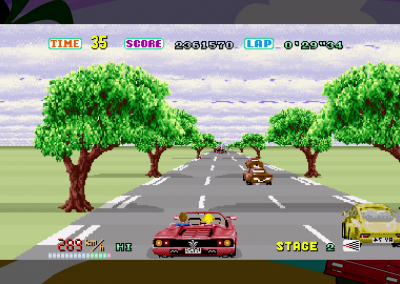
He didn’t answer—not even with a wait. He just took in the car ahead, the open space beyond it, and the tree shadows slanting out over the outside of the curve, all in one sweep. His right foot pressed a little harder, then eased. The red car tucked up close behind the other one. Its rear bumper swelled in the windshield. The other car’s exhaust note layered itself over their music.
The shade deepened once more. This time it wasn’t from the trees on the left side of the road. It was the hill’s own shadow. On a short stretch where the road wrapped around the mountain’s shoulder, the sunlight had been pushed entirely to the far side. While their eyes adjusted to the dimness, the taillights of the car ahead flared red for a moment. Brakes.
His foot moved at once. The car dipped its nose lightly. Then another slow vehicle appeared around the inside of the bend ahead. The lead car had braked for that. In an instant, three vehicles had become a single file. The hill road suddenly looked narrower. It wasn’t actually narrower, but roads always seem to shrink when the car ahead, the car behind, and the drop at the edge all enter your vision at once.
The woman looked out the window. Below the stone wall there was grass and dry earth, and below that the slope fell away sharply. Wind was rising up from beneath them. It didn’t smell like the wind off the sea. This was warm dirt, leaves rubbing together. The air had cooled not only because the sun was blocked. They were gaining altitude.
The slow vehicle ahead was a small truck carrying cargo. A tarp had been pulled tight over the bed, and it quivered weakly in the wind. Every time one corner of the tarp fluttered, it bothered her for no clear reason. Not because she thought it might come loose. More because anything that wavered on the road seemed to steal time.
He checked the left mirror, the center, then the road ahead again. The oncoming lane was empty for now. But on a road like this, emptiness was never a thing you could trust for long. One bend and the whole situation could change. While he delayed the pass, the numbers on the dash dropped one by one. She tried not to look at them, but her eyes kept going back. Only the numbers were shrinking, and yet people always laid other things over them: room to breathe, room to choose, the distance to the next fork.
“Not now, right?” she asked.
“Now I can see it.”
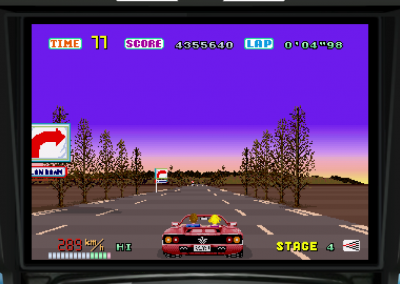
“Seeing it and making it aren’t the same thing.”
That finally got a short laugh out of him. “That’s why I haven’t done it.”
The car ahead moved first. It edged halfway into the oncoming lane, then slipped right back in. A gray sedan was coming downhill from behind the bend. As the two cars skimmed past each other, the hill’s shadow seemed darker still. The descending car carried the sunlight on its back for a split second, its outline sharpened by the glare, then it was gone.
He tapped the steering wheel once with his fingers. Two short knocks, out of time with the music. The woman heard it and knew he was calculating again. When he got impatient, he actually spoke less. While he was reading the road, he had no spare breath for reassurance—not for her, not for himself. The silence wasn’t indifference. It came from having no room left for anything else.
The hill seemed to ease for a moment, then bent again. In a stretch where the trees thinned, the sky opened wide. When the light returned all at once, both of them narrowed their eyes. And then they saw it: farther ahead, the road laid out along the mountainside. Several bends overlapped in the distance, and above them stood a small blue sign. Too far away to read, but near enough in color that they both knew what it was.
“There.”
She said it first.
He answered by accelerating.
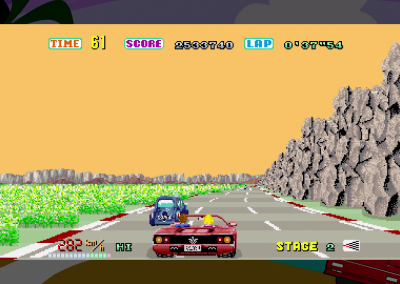
It was the moment when the gap between the car ahead and the truck opened by just a fraction. The red car slid out to the left. The engine note opened up and wind slapped the side of the car. The truck bed passed beside them, blocking the view for an instant. The corner of the tarp shivered right in front of her eyes. Then came the flank of the other car. Sunlight flashed across its dark body and flew backward. The woman drew in a breath but made no sound. Far down the oncoming lane, there was still nothing. Still.
He didn’t take them both in one move. The moment he cleared the first car, he slipped back inside. Not behind it, not all the way past the truck, but into the short pocket of empty road just ahead of the truck’s cab, as if slotting the red car into a space cut exactly to its shape. When the car settled back into its lane, the suspension compressed once and released. Only then did she breathe out.
“I thought you were taking both.”
“The road’s short.”
“So is the time.”
He didn’t smile at that. He glanced once at the dash, then back to the truck ahead. The blue sign was definitely getting closer, but on a hill road, seeing a sign never meant reaching it soon. The road wound more tightly than it looked, and even the stretches that seemed straight turned out, once you were in them, to tilt and curve in subtle ways.
The few seconds spent following the truck stretched long. The woman watched the pattern of sunlight along the top edge of the window. As the trees thickened again, the light broke into fragments. Leaf shadows passed over her face and knees. They trembled like reflections on water, but not like the glitter of the sea. This movement was closer, and more uneasy. Maybe because you couldn’t see what lay below the hill. Anything hidden always left room for imagination.
“There are fewer cars than before, but it feels more cramped,” she said, almost to herself.
“Because you can’t see ahead.”
“If you can’t see ahead, shouldn’t you go slower?”
“That’s why everyone does.”
He edged the car slightly right behind the truck, then brought it back to center. The front tires crossed alternating bands of bright pavement and dark. If you threw your gaze outward, you could see another road far below—a thin white line. It was hard to tell whether it belonged to the town they had already left or some section still waiting ahead. Each time that line appeared and vanished, the hill felt less like a single hill and more like a connector wedged between landscapes: sea, town, mountain road, and something not yet arrived.
The blue sign grew a little larger. Large enough now to make out the direction of the arrow. But the sign pointed to roads, not to scenery. It couldn’t tell them what would appear if they turned right, or what would stretch on if they chose left. He wasn’t looking at the sign anyway. He was looking at the road leading up to it. Not asking which way was faster, but which way would ask this car to give up less of its speed. She knew that look in him, but this time she didn’t like the calculation. The last time, asking for the route with the longer view of the sea had been a first for her. Now she wasn’t even sure of that. From a distance, the roads on the hill all looked alike. One seemed as if it would go deeper into shadow, one as if it would break out into light—but on roads like these, one corner was enough to reverse an impression.
The truck slowed sharply. A tight bend just before the sign. Its rear wheels struck a rut in the pavement and the cargo bed lurched once, hard. He moved out at once. This time the hesitation was brief. The instant he confirmed there was no oncoming car, the red car sprang left past the truck. The engine climbed, and the wind pushed into the cabin. As they flashed by the truck’s window, the woman didn’t catch the driver’s face. She only saw one arm draped over the sill. That brief human outline made the whole hill feel stranger somehow. It made too plain, all at once, the fact that different cars were passing under the same dwindling time toward different destinations.
Beyond the truck, the road split in two.
The blue sign whipped overhead. The arrows forked, and the words beneath them were gone before they could be read. He was already leaning the car into the turn. Right. The car skimmed over the white lines of the junction and slipped into the new lane. Bracing against the pull with her shoulder, the woman looked back once at the left-hand road falling away behind them. For a moment it seemed brighter. Then trees and terrain cut it from sight.
“Why this way?”
He answered after a beat.
“The hill bends less.”
“You can tell that?”
“A little.”
She turned back to the window. The choice was already gone. Signs always become clearer in retrospect, but the road never gives you long to look back. For the first few seconds the right-hand branch seemed wider, then it too curled back along the body of the mountain. What it gave them instead was height, more quickly won. Openings to the outside came more often. Fragments of the world below revealed themselves: houses like white dots, roads laid down like lines, water glinting in the distance. But each was granted only for a moment. The road showed them, then wrapped them away again.
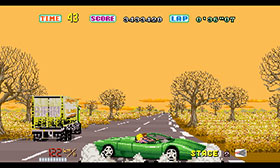
The numbers on the dash were still falling.
The checkpoint was still some distance away. The fact that the blue arch was nowhere in sight made the time seem to wear away faster. There was clearly road in front of them, but no clue where it would finally let them breathe. He pushed the speed up again. The surface on this new stretch was rougher. The vibration coming up through the chassis had changed. A fine tremor ran into the hands on the steering wheel. The woman folded her hands together on her knees.
“The town felt easier,” she said.
“You can see walls.”
“There’s too much here you can’t see.”
He didn’t argue. Looking into the long curve ahead, he let the car drift outward, then cut it in deep toward the inside. The stone wall came close, then fell away. The tires brushed the inner line. The car came through cleanly, stable, but her eyes kept fixing on the space beyond the bend. There was always something there that had not yet arrived. A descending car. A slower vehicle. A sudden long straight. In the one way that mattered, all three were alike: you couldn’t know.
The wind strengthened. As they entered a more exposed stretch high on the hill, the car took one shove from the side. He corrected it with a movement so small it was nearly invisible. That tiny adjustment unsettled her more than anything larger would have. Anyone recognizes obvious danger. But this kind of fine correction meant the car was already sharing space with it.
A short horn sounded somewhere in the distance. Not ahead. It might have been another car following them onto this branch after the split, or it might have come from some lower road. On mountain routes, sound often lied about direction. It bounced, arrived late. She almost turned to look behind them, then stopped herself. It felt as if looking back would only make the road ahead more unfamiliar.
A small roadside marker flashed by like lightning: a black arrow bent sharply on a white field. Hairpin ahead. His foot was already resting on the brake. As the car scrubbed off a little speed, the music returned to her ears. The melody that had seemed to vanish came back with sudden clarity under braking, then receded again as he accelerated. She had a strange thought then: maybe the music never disappeared at all. Maybe the road only allowed you to hear it at certain moments.
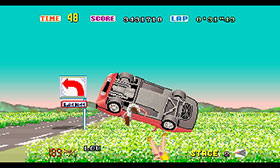
The hairpin cut deeper than expected. It burrowed into the mountain’s inner side, then flung them back outward. The inside wall was rough and dark; the outside opened all at once. As the car exited the turn, the view broke wide. Layered roads below, pale water lying farther off, little bridge-like spans tying one piece of land to another—it all came into sight at once. The woman caught her breath. Not because it was beautiful, exactly. Because it was too much to see all at once. When everything hidden a moment ago suddenly reveals itself, your sense of direction falters.
At the very front of that opened view, a blue structure floated over the road in the far distance.
The checkpoint.
So far away that merely seeing it brought no comfort.
“I see it,” she said. There was more calculation than joy in her voice.
He saw it too. His expression didn’t change. Once the checkpoint came into view, the remaining distance became more real, not less. This was the stretch where reaching it or failing to reach it began to divide into numbers and road length. No longer a question of hope. A question of measure.
The numbers on the dash offered little kindness to that measure.
The road ahead began to fall away again. The climb ended, and before relief could arrive, the car was being drawn into the speed of the descent. Downhill might win back time, but on a mountain road like this it demanded faster decisions in return. The curves looked sharper. The guardrails came in broken stretches. The blue gate of the checkpoint hung in the distance as if it were not getting any closer at all.
He chose his gear and laid the car into the rhythm of the descent. The low hum of engine braking supported the chassis. The woman kept her hands folded and looked ahead. By now she wasn’t thinking about which route might hold the sea in view longer. The unease that had been growing since the hill began had changed shape. It was no longer the vague dread of not knowing the next landscape. It was the dread that time might close before they could reach the thing they already knew was there.
And the red car kept slipping faster and faster toward the place where that dread was waiting first.
댓글
댓글 쓰기