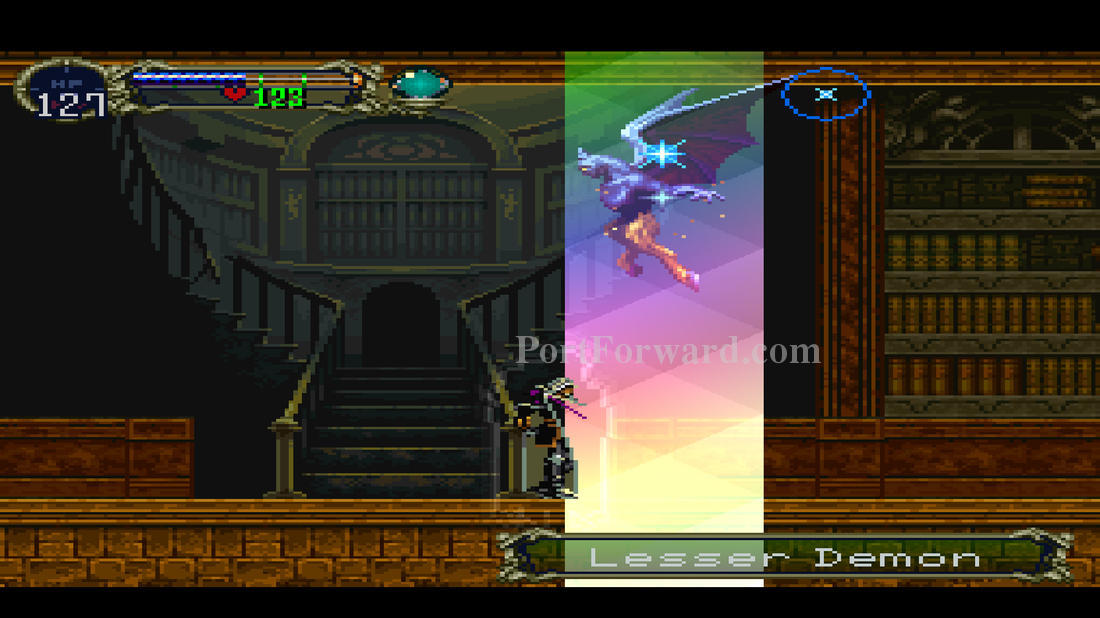
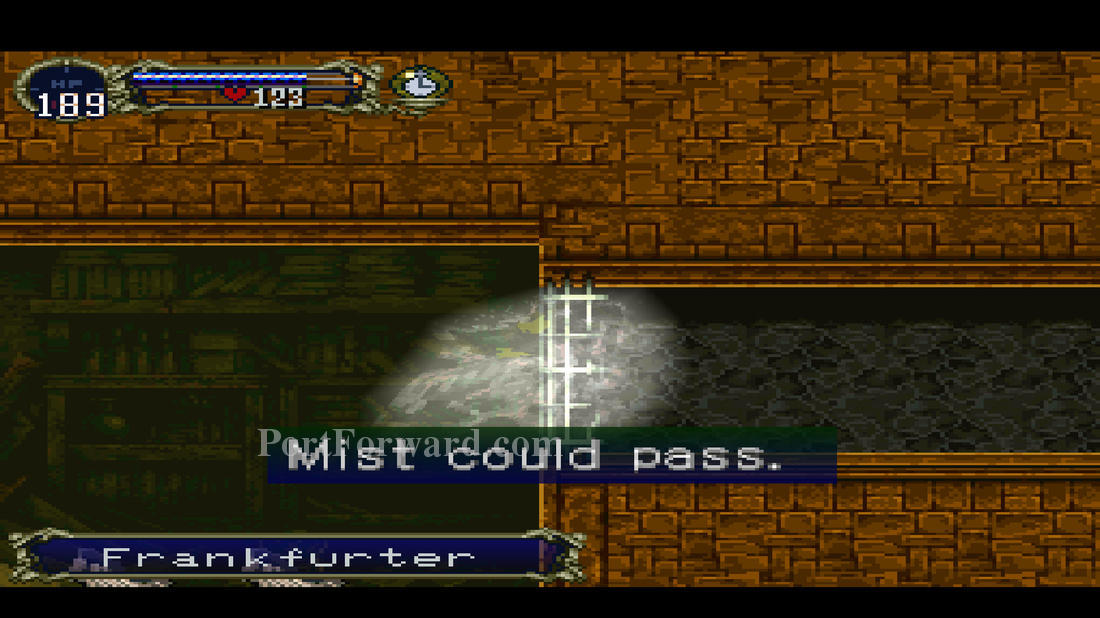
[Castlevania: Symphony of the Night Novel Episode 8] Where the Water Strangles First

A drop of water fell onto the blade.

Only one. Yet the sound cut through the music of the marble gallery and made Alucard’s wrist stiffen by the smallest measure. He lowered the tip of his sword and looked down at the floor. Black water was seeping up through the gaps between the stones. It was not leaking from above. It was rising from below. Each time the castle drew breath, something long trapped in its depths seemed to be forced back up through its throat.

He paused before the door. The blue seal was gone now, and the door no longer resisted him. For something that had remained locked for so long, it opened far too easily. When his palm pushed against its surface, cold air flowed out from within. The smells of marble, candle wax, and old incense retreated, replaced by wet stone and ancient moss.

Alucard folded the edge of his cloak once and drew it behind his left arm. The stairway was narrow. In wet places, cloth was the first thing to be seized. Before setting his foot down, he held his sword-hand slightly farther from his body. Too close to the wall, and the blade would catch. Walk the center, and the drop below could not be seen. Choice was always made somewhere between the two.

The first step was wet.

He touched it only with the toe of his boot. The sole scraped lightly against the stone. The water was still shallow, but its surface was strangely dark. Even when candlelight touched it, it gave nothing back. It looked as if another night had been laid beneath black glass. The stairs bent several times and continued downward. The music above did not fade away. It changed, instead, as though submerged, and followed him in muffled tones. As the notes blurred, the sound of water between the stones grew clearer.

Halfway down, a spearhead shot out from a wall niche.

Alucard tilted his head back. The spear passed in front of his throat, cutting a few strands of hair that dropped into the water. The armor inside the niche was rusted, but its arm still moved well enough. A boneless hand thrust the shaft forward, then drew it back. A lengthening spear. A weapon that lied about distance in the dark.

He did not rush in. He waited once more.

The shadow inside the niche moved. The spearhead came again, this time low, aiming for his knee. Alucard drew his left foot back and struck downward with his blade. Metal bit metal. The shaft twisted aside, and in that opening he stepped in half a pace. Before his elbow could strike the wall, he turned his wrist and cut. The helmet split at an angle, and black dust spilled from within into the water.

He did not move on at once. The fallen armor’s arm twitched one last time beneath the surface. In this castle, the dead often pretended to die again.

The second enemy could not be seen. What came first was the low sound of a bowstring drawn tight. Alucard lowered his body. A bone arrow passed above his head and buried itself in the wall. Though the stone was damp, the arrowhead sank deep. Across the lower landing, a skeleton archer was setting a second arrow to its bow. A slanted angle. Wet stairs. A narrow space to evade, and one slip would send him tumbling down.

He did not leap. He descended one step and raised his shield. The arrow struck it. Dry bone scraped metal, the impact traveling through his wrist. He used that recoil to turn and stepped onto the edge of the landing with only his toes. The Leap Stone awakened quietly inside his body. At the peak of the first jump, he stepped once more upon the air. Damp air tore beneath his foot. His body rose close to the low ceiling, and the empty sockets of the skeleton archer came directly before him.

The blade passed before the bowstring could.

The skeleton scattered over the edge. Bones struck the stairs several times before sinking into the water. Alucard landed with one knee slightly bent. Water splashed around his ankle. In that instant, pain tightened sharply through his skin.

He pulled his foot back at once.

Steam rose faintly from where the water had touched him. There was no wound, but the pain was too keen to belong to cold water. Water harmful to the living. No, water that recognized the blood flowing inside him. Alucard looked down at the back of his hand. The mark on his skin soon faded, but the pain withdrew slowly.

“I see.”

The words were not spoken to the water, nor to the castle. They were a brief note made to himself. Down here, the ground beneath his feet was also an enemy.

The staircase ended suddenly. What opened before him was less a room than a deep well. A vast vertical chamber had been carved through the stone. On one side, broken platforms descended along the wall; on the other, almost empty darkness fell away. From below came the sound of a waterfall. Water shattered somewhere in unseen depths. A faint mist rose upward, wetting the stone pillars.

Alucard stood at the edge of the nearest platform. Below was black. Yet not completely dark. Through the water mist, blue light glimmered from time to time. Not a natural light, but something water might have made after feeding on nightmares for too long.

He chose the path to the left. Narrow, but there were footholds. The right was too deep and too straight. When this castle offered a straight path, it usually demanded payment from below.

Spearmen appeared again. Two, then three. In a wide space, they would not have been formidable. The problem was where they stood. One at the edge of a platform, one halfway down the stairs, another below with its spear pointed upward. If Alucard jumped, spearpoints waited. If he stopped, the skeleton archer above would shoot. The battlefield had been arranged by the castle before the enemies ever moved.

The first spear extended. He did not bend backward; he leaned forward. As the spear passed above his shoulder, he lifted the shaft with the back of his sword. His foot was already on the next stone outcropping. In narrow places, the floor would win before the enemy did. He reduced the number of cuts. One block, one push, one passage through. In this corridor, passing mattered more than killing.

But the last spearman did not yield. Light flashed twice beneath its rusted helmet. The shaft trembled briefly, then changed length without warning. Alucard misread the timing. The spearhead came later than expected and farther than expected, grazing his side. Cloth tore. Cold pain scraped beneath his ribs.

His eyes narrowed.

He did not retreat. Instead, he entered inside the spear’s reach. He denied it the space to extend a second time. The moment his left hand seized the shaft, rust tore at his palm. Had he been holding the shield, he would have been too late. With the shield slung across his back, he cut short with his sword. The center of the headless armor split open. Black water poured out from within and ran down the platform.

That blood did not mix with the water. It floated briefly on the surface, then broke apart like burnt paper.

The deeper he descended, the colder the air became. The sound of water, however, grew louder. At last, the waterfall revealed itself. A great white sheet was being torn endlessly through the dark. The torrent struck the ground with a roar, and beside it an old passage continued, half-hidden. Alucard did not approach the waterfall. Even the spray stung his skin.
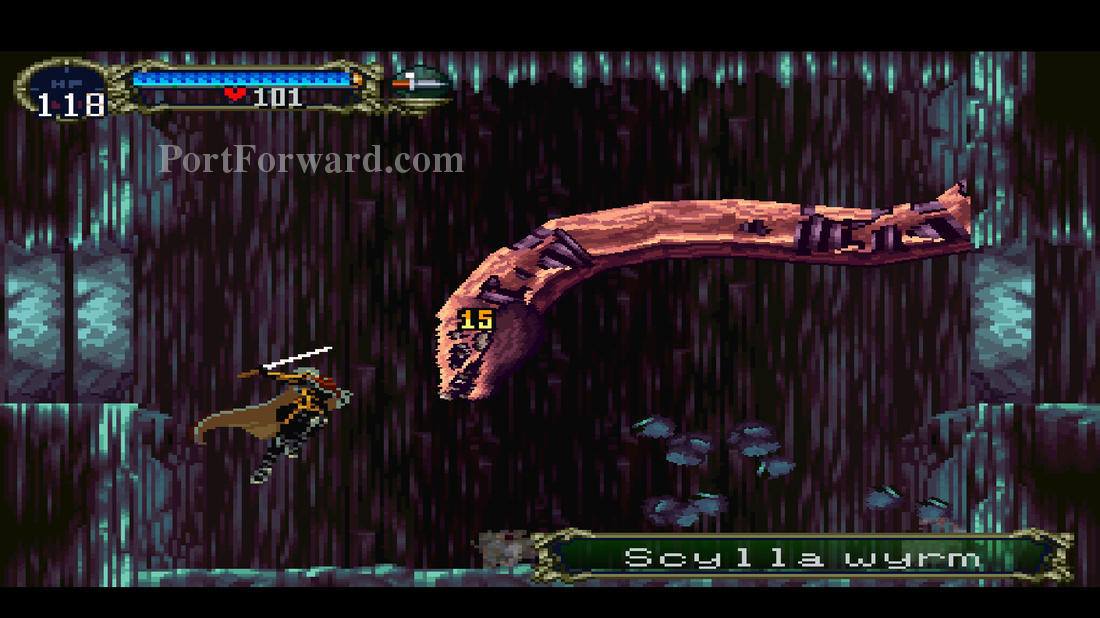
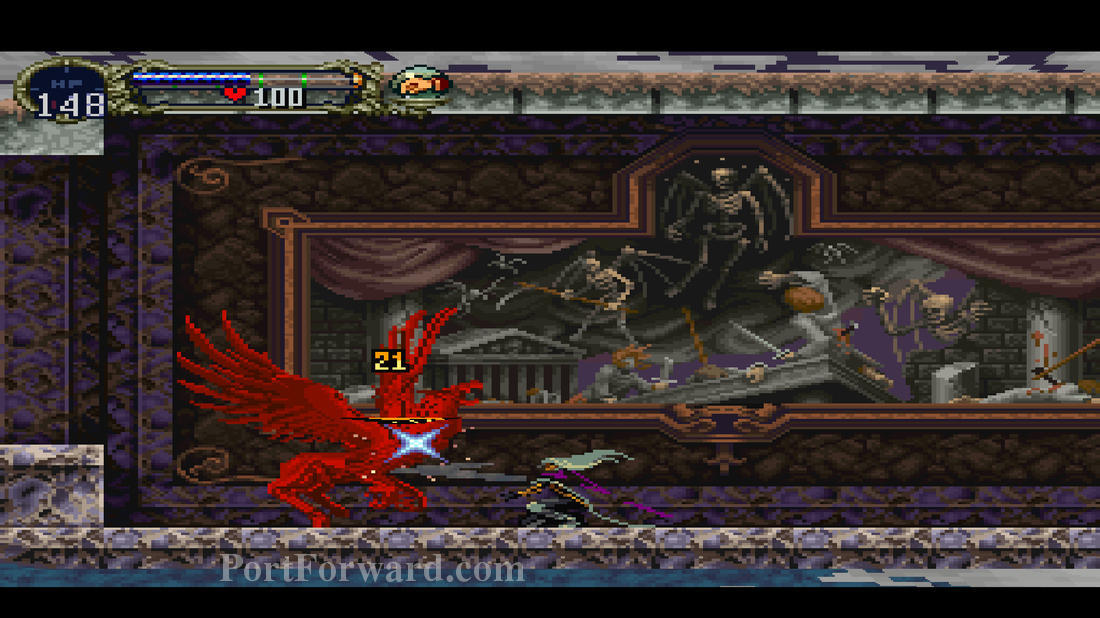
Alucard faces the Scylla Wyrm in the Underground Caverns - PortForward

He looked toward the deep tunnel to the right.

There was no door there. Instead, an opening gaped naturally in the stone. It looked as if water had carved it over time, but the edges were too smooth. Something had passed through often. On the floor were long dragging marks. Not the tracks of a beast’s feet. Something had scraped through on its belly. Many times, in the same direction.

Alucard lowered the point of his sword. He did not step on the trail, but walked beside it. Each puddle held a faint ripple. Not from the wind. From deeper inside the passage, a very low breath was pushing between the stones.

The ceiling suddenly dropped.

He bent his knees and passed beneath it. His cloak brushed stone. His fingers closed again around the sword hilt of their own accord. In narrow spaces, a long blade was a disadvantage. But there was no time here to change weapons. He held the sword close to his side, the tip drawn slightly behind him. Not a posture for striking forward, but for cutting what came in.

The passage ended in a small chamber.

It was too tall to be a room, too enclosed to be a hall. The walls were wet, and shallow water pooled at the center of the floor. Bone fragments floated on the surface. Some were the bones of small animals; others looked like human finger bones. Alucard took one step inside and stopped.

Behind him, stone closed.

He turned quickly, but too late. The entrance through which he had come was blocked by a stone door rising from below. Water leaked through the seam. Slowly, but without pause.

Something moved beneath the surface.

At first, it was only a shadow. A long, thick shape circled beneath the shallow water. Its size and the depth of the room did not agree. If the water was shallow, its body should have shown. But it did not. The water itself was lying about its depth.

Alucard drew his left foot back.

Then the water burst open.

A huge serpent-like head surged upward. It had no eyes, only a mouth. The jaws opened wide, and rows of teeth gleamed inside like wet glass. Water struck the ceiling. Alucard rolled aside. The jaws bit into the place where he had been standing. The stone floor cracked. The creature’s neck was thick enough to fill the chamber, water and slime running between its scales.

He cut as soon as he landed. The blade scraped across the scales. Not deep. The surface was slick and tough. The creature responded less to injury than to contact. It coiled its neck and swept across the room. Alucard leaped. One jump was not enough. His second jump carried him close to the ceiling. Below him, the massive body passed, shoving the water aside.

As he fell, the creature’s head shot upward.

A mistake. He had judged the upper air to be safe too late. In this room, height was not refuge. It was bait. He twisted his body in midair, but did not evade fully. The side of the jaw struck his shoulder. His body flew into the wall. When his back hit stone, his breath stopped. He did not lose the sword. That alone made the next movement possible.

The creature charged again. This time it did not open its mouth wide. It meant to strike headfirst. Alucard waited with his back against the wall. Move too early, and the bend of its neck would follow. Move too late, and he would be crushed into the wall. He watched the muscles beneath the creature’s neck contract once.

Then.

He slid to the left. The wet floor pulled at his boots. His body dropped so low it nearly fell. The creature’s head smashed into the wall. Stone dust rained down. Alucard turned the force of his near fall into a rotation and cut into the pale flesh beneath the neck. A gap without scales. For the first time, the blade went deep.

The creature screamed. The sound was less the cry of a serpent than water tearing through a narrow pipe. The water in the room shook with it. Alucard stepped back. Thick fluid that looked like blood slid down the blade. When it touched the water, purple foam rose.

The pattern seemed simple, but the chamber made it complicated. The thing circled beneath the water, then erupted from one of three directions. If it swept low, it aimed at the ankles. If it rose straight, it cut off the air. If it paused briefly, it would ram. Alucard tried to follow it with his eyes at first. Too slow. The glimmer in the water always lingered half a beat behind its true position.

So he used his eyes less.

He watched the ripples. Just before it rose, the water’s surface did not make a circle. It formed a long split. The direction of the body underwater and the direction from which the head emerged were not the same. When the long body bent beneath the surface, the first thing to move was not the head, but the far part of the neck. That movement pushed aside the shallowest water first.

On the next attack, he waited, then brought his sword down toward the break in the ripple. The moment the creature’s head tried to rise, the blade split its upper jaw. Several teeth flew out and floated on the water like little white boats.

The creature changed its method.

It no longer hid completely beneath the water. It circled the chamber with part of its neck exposed. Water trapped between its body and the wall made a shrill sound. It was reducing the space available to him. Alucard did not move to the center. The center looked broad, but could be attacked from every side. He chose the broken wall, the place where the creature had just rammed. The loose stones made the footing uncertain, but there was too little space there for the creature’s long body to turn fully.

As expected, it coiled toward him. This time, the body came before the mouth. Alucard set his foot on the broken stones. The wet rock shifted. He did not force it still. As the footing collapsed, he lowered himself with it and thrust his sword toward the narrow gap beneath the passing body. The scales split. This time he did not stab and withdraw. With both hands on the hilt, he dragged the blade against the force of the creature’s movement.
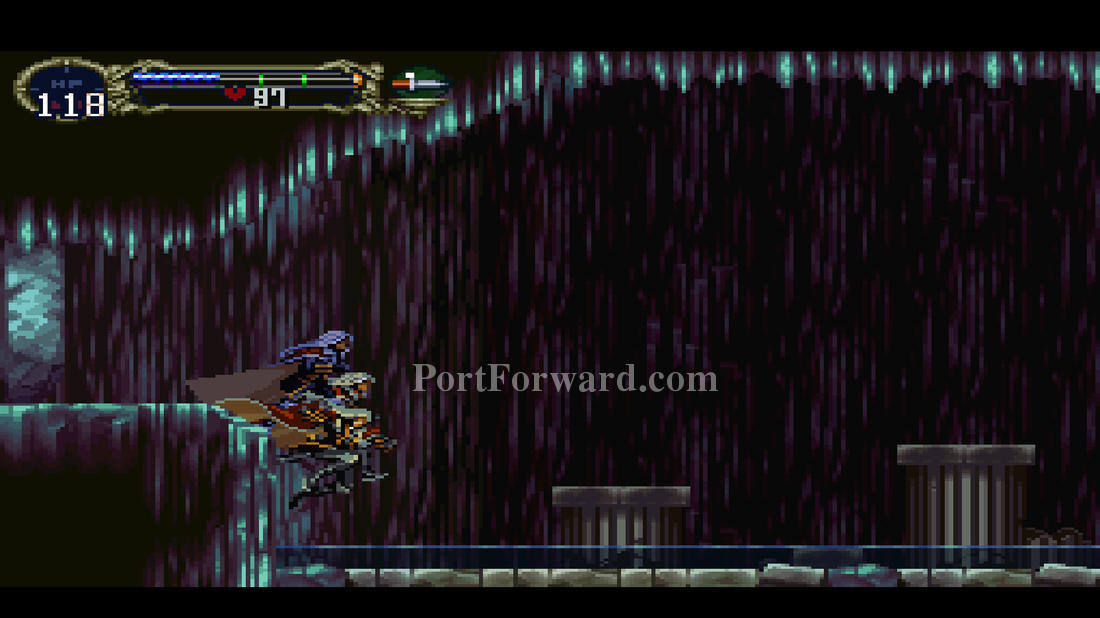
Rising water around the Underground Caverns pillars - PortForward

A long wound opened, spilling slime and black blood.

The creature reared back. The entire room trembled. Water droplets fell from the ceiling all at once. The water leaking under the stone door suddenly began to rise faster. It climbed above his ankles. Pain ran up his legs. If he stood in it too long, his movement would slow.

He had to finish it.

The creature lifted its head for the last time. It did not open its mouth. It raised its entire neck. A downward smash. The jaw was not the danger now. The weight was. Alucard did not raise the sword above his shoulder. He held the point low and turned his body sideways. He waited for the creature to fall. The air compressed first. Water was pushed outward. A shadow covered his face.

He stepped forward.

The serpent’s head shattered the floor behind him. At the same instant, Alucard’s sword surged upward from beneath the neck. Soft flesh, the edge of scales, then something hard as bone. The resistance was great enough to bend his wrist. He did not push with his arms alone. He drove his entire body forward. His cloak dragged in the water, and one knee scraped the floor. The blade passed through the neck and emerged behind the head.

The creature stopped for a moment.

Its mouth opened, but no sound came. Only water poured out. The massive body slowly collapsed to the side. Water rushed one way, then returned. Alucard pulled the sword free and stepped back. The fallen body still twitched, but the motion had no direction. Little by little, it became no more than the motion of the water.

The stone door opened.

No — it did not open. It crumbled downward. A passage hidden behind the chamber wall was revealed. At the same time, a greater sound came from far off. At first he thought it was another waterfall. But the sound came not from above, but from the side. Water was rushing in.

He did not hesitate.

He ran into the passage. Behind him, the water inside the chamber rose. The dead beast’s body lifted on the surface and struck the wall. Ahead was a narrow vertical space. Pillars and platforms jutted out here and there, but most were wet. Water was rising from below. Fast. Too fast.

Alucard jumped onto the first pillar. The moment his foot touched, he looked for the next. The body had to move before the mind finished counting. Water boiled upward beneath his ankles. If it touched him, pain would follow; if it deepened, strength would drain away. He saved his second jump. When one leap was enough, he used only one. The force to push from the air again had to be saved to repair failure.

The third platform broke.

The instant his toe touched it, the stone dropped away. As soon as he felt his body fall, he released the second jump. The air split beneath his foot, and he barely caught a narrow outcropping on the right wall. His fingertips slipped. Water climbed to his thighs. His skin burned as if on fire.

He did not grit his teeth. Even that would waste strength.

He bent his wrist, pulled himself up, and jumped toward the upper platform on the left. The water had now swallowed the dead beast’s chamber completely and was filling the vertical passage like a throat. The sound of it rising from below was closer than the footsteps of any pursuer. He stepped onto the final pillar and threw himself into an opening in the ceiling.

When he rolled into the upper chamber, the water stopped just below.

As if an invisible line barred it. The black water did not rise higher. It only trembled beneath that boundary. Alucard remained on one knee and drew breath. The pain in his shoulder returned late. His clothes were soaked, and pale marks remained where the water had touched his legs. He wiped the slime from the blade with the back of his hand. It did not come clean.

Then he heard singing.

Or rather, a breath that sounded like singing. It resembled a woman’s voice, but it was not speech. It stretched long between the falling drops. It rose as if calling to a person, then fell as if calming a beast. Alucard stood. The room was wide. Its center was low, with higher ground on both sides. Puddles lay across the floor, and the rear wall had half collapsed into a water channel. Old columns had broken down into low cover.

She was at the far end of the room.

Her upper body had the shape of a woman. Wet hair covered her shoulders, and pale arms seemed to float in the darkness. But below that, she was not human. Beneath the water, several long necks writhed. Things that could not be called either serpents or fish. Between them, beast heads growled low. Water dripped from their mouths, forming little bubbles where it touched the floor.

Alucard walked on without stopping. Look too long, and the eye becomes bound to the human shape. The enemies of this castle often held out faces as bait.

She lifted an arm.

The first attack was water. Not merely a jet, but a stream that rose into the air and curved down like an arch. Alucard leaped aside. The water struck where he had stood and scattered across the floor. Droplets grazed his cheek. Cold pain. The same as the black water he had just passed through.

He tried to approach at once. But one of the long necks in the water lunged first. A beast head spat a heavy sphere of water. It seemed slow at first, then quickened as it drew near. Alucard raised his shield. The impact drove his arm back. Though it was water, it had weight. Spray from the shield’s edge burned his wrist.

The moment he took one step back, bubbles rose from a puddle.

They did not burst. They rose into the air and hardened into the shapes of small skulls. Four. Five. Empty eye sockets swayed toward him. Alucard cut in short strokes. One split, scattering water before his face. Another circled behind his shoulder. He lowered his body and swung the shield with his left hand. The watery skull struck it and broke, cold fragments spattering across his cloak.
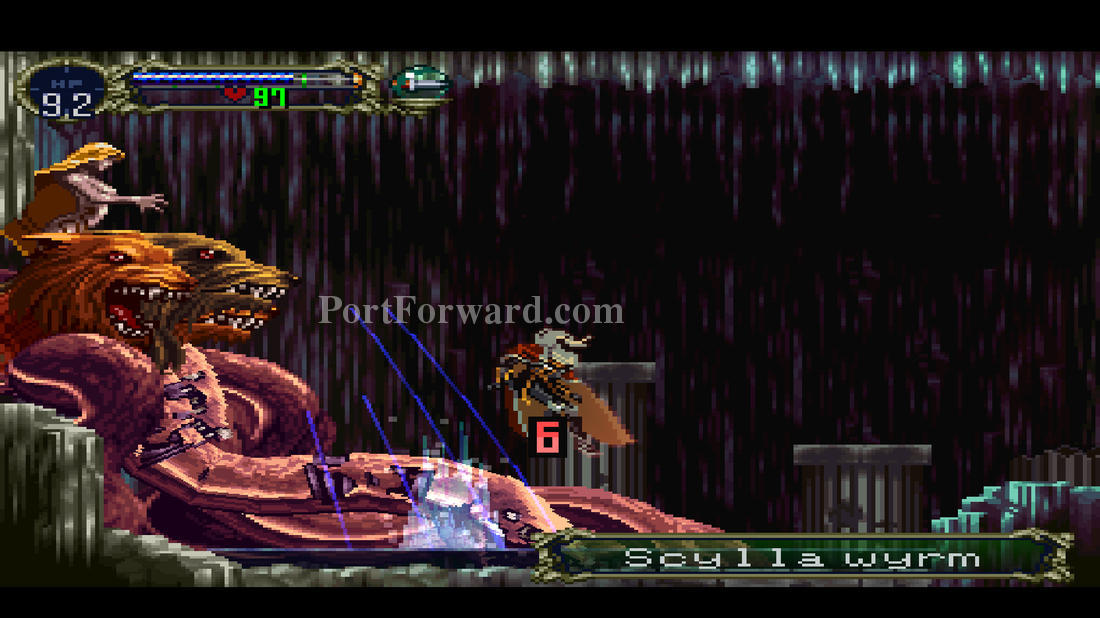
The waterside battle against Scylla - PortForward

She did not move. What moved was what lay below. Her body remained fixed at the center of the battlefield, while water, necks, and beast heads claimed every direction. Try to come close, and the heads blocked the way. Move away, and water streams and skulls followed. The low center of the room was dangerous with water, while the raised floors on both sides were too narrow for safe evasion.

Alucard corrected his first judgment. He could not rush straight to the main body. This was a fight in which the path had to be made first.

The left beast head growled low. Its neck muscles swelled. A water sphere. He did not raise his shield. This time he evaded sideways and cut beneath the head. The blade opened wet flesh deeply. The head twisted, but did not die. Immediately, the neck on the right bent to bite him. Alucard started to step back, then stopped. A puddle lay behind him. He leaned forward. The teeth snapped above his head. The tips of his hair were cut and fell onto the water.

The sword moved upward from below.

The lower jaw of the right neck split open. The beast howled. The entire room answered that howl. Stone fragments fell from the ceiling. Alucard heard it too late. The howl itself was an attack. A falling stone struck his shoulder. One knee bent for an instant. In that gap, the water stream came again.

He rolled. The stream passed, scraping across the floor. He came out of the roll in the low center. Water covered his palm. His skin went numb as if touched by flame. He tried to rise at once, but the floor was slick. His left foot slipped.

Her face seemed to smile for the first time.

The necks beneath the water moved all at once. Three directions. Water sphere, teeth, skull bubbles. Alucard abandoned the attempt to stand. From that low posture, he braced his shield forward and let the water sphere slide off it, then turned his sword backward to strike the skull. He could not avoid the bite. A long neck caught his left arm and passed by. Not deep, but the teeth tore flesh.

He followed the pain.

If he withdrew, the neck would escape. If it escaped, it would attack again. Instead of pulling his arm free, he pushed toward the beast’s jaw. For a moment, the angle of the teeth broke. The sword in his right hand drove in short. It pierced the black flesh inside the throat. The beast opened its jaws. Alucard pulled his arm free, rolled aside, and this time reached the higher floor.

Blood fell from his fingertips. It floated for a moment before touching the water.

He did not catch his breath. Breath belonged after the fight. What he needed now was order. The bubbles rose first from puddles. The water stream was preceded by a tilt of her shoulder before the arm lifted. The water sphere could be read from the swelling of a beast head’s neck. Falling stones came after the howl.

She raised her arm again.

This time, Alucard did not dodge backward. He jumped forward. The water stream descended in an arc. Between its beginning and its end, beneath the highest point, there was a brief opening. He leaped toward that gap twice. The first jump carried him under the stream. The second carried him over a beast head. His blade turned over in midair. As he landed, he cut through the root of the left neck.

One neck fell into the water. The room shook violently.

Her song stopped.

Now the attacks changed. The remaining necks moved lower, faster. The water spheres grew larger, and the skull bubbles rose closer to him. Above all, the howling became frequent. Stones kept falling from the ceiling. Alucard could not stay long on the higher ground. The fragments broke the side platforms apart, and the puddles at the center spread wider. The battlefield was shrinking.

He was forced back. Almost to the entrance.

Then he saw the shadows beneath the water gather in a single direction. For the remaining necks to lunge at him together, the root beneath the main body had to lean to one side. Her upper body lost balance for the briefest instant. The face still looked forward, but one shoulder dipped slightly. There. The seam where the human shape joined the monster below.

Alucard dropped his shield.

The dull sound of it striking the floor cut through the water noise. Both hands closed around the sword hilt. One beast head spat a water sphere. He angled the flat of his sword and split it obliquely. He could not block it completely. Water struck his face and chest. His vision flashed white. But his feet did not stop.

Skull bubbles rose. He did not cut them all. He struck only the front two and took the rest on his cloak. Pain like watery teeth scraped down his back. From the left, a long neck lunged. He lowered his body and passed beneath it. Teeth closed on empty air.

She howled again.

The ceiling answered. Stones fell. Alucard did not avoid them; he used them. One large stone struck the floor in front of the right beast head. The beast turned its head for an instant. Through that gap, he entered. Water reached his knees. His legs grew heavy. But one more step was enough.

Her arm came down. Her nails aimed for his face. The arm looked human, but its force was not. It was sharp and fast, like a branch. Alucard turned his head aside. A red line opened on his cheek. At the same time, the sword rose from below.

The blade cut through the place where the monster’s body and the woman’s form met.

At first, nothing changed. Her eyes stared at Alucard. The sound of water did not stop. But on the next breath, the necks below began to writhe in different directions. A single will had been severed. Alucard did not draw the sword out. He drove the hilt deeper and turned his body into a horizontal cut.

This time, there was a sound.
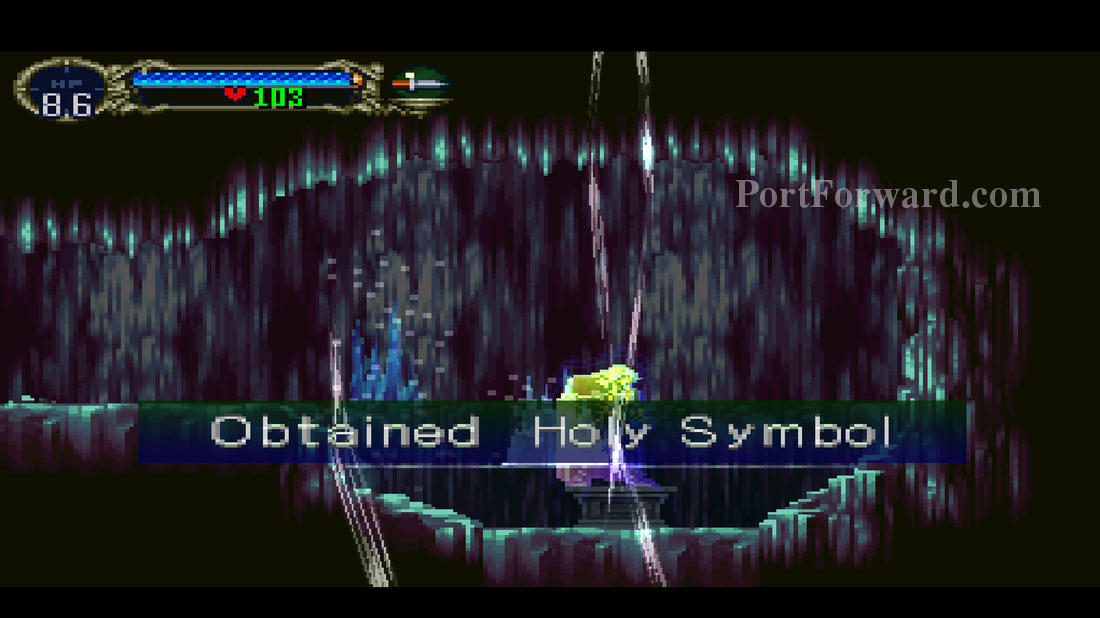
The hidden cavern path where the Holy Symbol is found - PortForward

Not song. Not howl. The sound of many beast throats tearing at once. The water in the room was pushed back. The remaining necks rose toward the ceiling, then fell one by one. The beast heads clattered their teeth and sank into the water. Her upper body tried to remain standing until the end. Pale hands moved as if trying to grasp the air. But there was nothing to grasp.

The body collapsed.

Water burst high. Alucard stepped back. No further attack came. The bubbles in the puddles ceased. The falling stones stopped. When all the movement that had filled the battlefield vanished at once, the underground silence hurt the ears.

He lifted his sword and looked at the blade. Slime, black blood, and water were mixed across it. With a light flick of the wrist, he cast the liquid onto the floor. This time the water did not foam. It merely scattered and settled.

A low grinding came from the rear of the chamber.

The passage the monster had blocked began to open. Water displaced by the battle drained that way, forming a narrow current. The smell of the waterway deepened. Alucard picked up the shield he had dropped and listened for a moment. From far away came a sound like an oar moving through water. A steady friction across the surface. Down here, in this underground place, someone was rowing a boat.

He followed the sound.

The passage was low and long. The walls were marked by many old waterlines. Some were dark and hardened with age; others looked freshly wet. The water here had never remained at one height. Like the castle breathing, it rose and fell. Each time, paths must have opened and closed.

At the end of the narrow way, the floor dropped away suddenly. Below, a wider and darker surface stretched out. An old boat was tied at the edge of the water. Beside it stood a silent ferryman. His face was hidden beneath a hood, and a long oar rested in his hands. Whether he saw Alucard or not was impossible to tell. The boat merely rocked a little with the current.

Alucard stood at the water’s edge. The water was still his enemy. But now he saw a path beyond it. Down here, a road was not only a hole carved through a wall. A silence drifting across water could be a road as well.

The ferryman said nothing.

Alucard asked nothing. Before stepping into the boat, he looked back. From the chamber where Scylla had fallen, there was no sound. Yet that silence did not feel like the silence of a finished battle. It felt closer to the silence of something deeper listening. The castle’s underground had remembered him now. His blood had touched the water, and his sword had severed the necks beneath it.

The boat began to move slowly.

The oar parted the water. The surface folded aside like black cloth. Alucard stood at the center of the boat, keeping his balance. Drops from the edge of his cloak made small dark marks on the boards. As they passed through the darkness, he saw an old statue embedded in the wall. Its face was half-submerged. Whether human or monster, he could not tell. A faint smile remained at the corner of its mouth.

At the end of the waterway, a small light appeared.

It was not candlelight. It was closer to the reflection of sacred metal rising from beneath the water. Without explanation, the ferryman stopped the boat. Alucard stepped off. His toes neared the water, but this time he touched only the stone at the edge. On a narrow altar rested a small relic. It had a strange shape, made less for holiness than for function. Yet around it lingered the unmistakable trace of an old blessing.

When he reached for it, the relic shone coldly.

The power that entered his body was not splendid. It did not sharpen his sword, nor did it lift his legs higher. Instead, it felt like a very thin boundary forming between his skin and the water. A veil that kept the water from recognizing his blood at once. The underground passage changed shape again. The surface that had pushed him away until now, for the first time, looked like a path.

Alucard slowly placed one foot into the water.

No pain came.

The water was cold. Nothing more. He looked down without closing his eyes. Beneath the surface, stone steps continued. A path he had not seen before. Or one he could not have entered even if he had seen it. The stairs descended into the dark, then bent to the left, where a faint current moved.

He climbed out again and looked toward where the boat had been. The ferryman was already receding into the distance. The sound of the oar grew smaller in the dark. What remained was the low breath of water, the cold of the stone walls, and the name that was still not finished in the castle above.

Richter.

The name sank for a moment like a stone dropped into water, then rose again. Maria’s eyes had resembled this cold surface. Anxiety deeper than certainty. Alucard rested his hand on the sword hilt. Monsters could be slain. Read the pattern, find the opening, cut through the heart. But if someone’s will had been clouded like water, when should the blade be raised?

He did not search long for an answer.

This was a castle that showed the next door before it gave answers. Alucard descended again into the underwater stairway. His cloak spread dark across the surface, then followed behind him. The world beneath the water dulled every sound. Even his own footsteps seemed to come from far away. Things with fish-like heads moved in the cracks of the walls, but they did not yet attack. They seemed to sense the boundary newly formed around him.

At the end of the stairs, the current moved to the right. But above and to the left, from a narrow passage leading out of the water, came the faint smell of iron. In an underground world of water and stone, that dry scent arrived suddenly. A distant arena, iron bars, old blood. The road was still far, but its direction was clear.

Alucard lifted his head beneath the water.

Beyond the darkness above, he thought he heard a very low roar of voices. Whether it was real sound or an echo the castle had sent ahead, he could not know. He walked toward it. The water could no longer seize his ankles. It only closed quietly behind him, hiding the battle he had just passed beneath its black surface.
References

[Castlevania: Symphony of the Night Novel Episode 7] Wings Above the High Choir Loft, the Girl Who Denied the Impossible

The blue seal recognized the jewel before it recognized his hand.

When Alucard stopped before the door, the long-closed patterns rose faintly along the grain of the stone. It was less light than a cold breath. Lines felt for one another and locked into place, and the blue knot at the center loosened once, very slowly, in time with the pulse of the Jewel of Open. The door made no sound as it opened. No scrape of metal, no click of a freed lock. Only the sense that the will which had barred the way had withdrawn.

From beyond it drifted the scent of incense.

It was unlike the dry smell of paper in the Long Library. The air here held old candle wax, cold ash, damp stone, and powder left in long-extinguished censers. Before crossing the threshold, Alucard checked the position of his scabbard with his fingertips. The short sword rested quietly at his right hip, and the weight of the hand axe lay near his left hand. Heat from the last battle still lingered beneath his breastplate, but the air flowing from the chapel cooled it layer by layer.

When he took his first step inside, the sound rose higher.

The Royal Chapel was a space that grew upward from below. Its passages were not narrow, but every wall, pillar, and window pointed toward the heights. Stained glass cut the night into wounds of color and cast them on the floor, and Alucard’s shadow passed long across them. Near the ceiling, a broken choir loft hung in darkness. The old wooden railing had half collapsed, and below it stood candlesticks long since extinguished, their hardened wax hanging like frozen tears.

No hymn could be heard. Yet the emptiness left in the place where hymns had vanished was unmistakable. Like stone remaining where knees had once pressed in prayer before the worshippers suddenly disappeared.

Alucard did not stop walking.

The first chamber was a narrow chapel room. The faces of the holy statues along the walls had been scratched away, and one had only its fingers left, pointing into empty air. The hand did not point toward the altar or a cross. It pointed higher, toward a black gap near the ceiling. Something moved faintly inside it.

The sound of wings.

He drew his sword.

But what descended was not a bird. An armored knight fell from the shadow above. The wings on its back were less feathers than an old form of malice. It raised its spear before it even touched the floor, and the instant it landed, it drove a long thrust forward. Alucard did not dodge aside. The passage was narrow. If he moved sideways, his shoulder would strike a pillar. He watched the line of the spearhead, then deflected it with the back of his blade half a beat late.

The metallic note tore upward through the chapel.

At that sound, the darkness above stirred again. Not one knight, but two, then three. Winged suits of armor were waking among the choir lofts. Alucard stepped inside the reach of the first enemy’s spear. The Gladius flashed briefly. An enemy that uses a spear leaves its torso open the moment it extends its arm. He put his blade into that vacancy. From within the armor, dried smoke burst out.

A second spear came from behind.

The end of his cloak reacted first. When he felt the air split behind his shoulder, he lowered his body. The spearpoint passed over his head and shattered the face of a stone statue. Broken fragments fell over his hair. Before the shards touched the floor, Alucard threw with his left hand. The hand axe spun through the air and struck the joint of the knight’s wing. The wing buckled, and the enemy lost its balance and sank downward. At that instant, the third foe drove its spear straight down from above.

He did not retreat. He stepped forward instead.

The spear struck the floor behind his back. Alucard moved in so close that his shoulder almost touched the landing knight, then cut horizontally. The armor opened below the neck, and the darkness within scattered into the scent of incense.

The chapel room fell silent again.

Alucard recovered the hand axe and looked upward. The movements of the winged armor had not been an encounter. They had been a warning. The enemies here did not wait below. They fell from above. Stairs, railings, and broken choir lofts would all become parts of the battlefield. In this place, he had to read the space over his head before the ground beneath his feet.

He climbed the stairs.

The stairs of the Royal Chapel did not simply lead upward. They turned once, narrowed again, emerged before a window, then returned into the dark interior. The face of a saint in the stained glass caught a red glow from somewhere and seemed to bleed. Alucard did not leave his gaze there for long. In this castle, things stared at too long usually opened their eyes.

Halfway up, a small room opened to the side.

Inside was a confessional. The wood had grown black with age, and the lattice window was clogged with dust. One door stood slightly open. There was no sound from within. Alucard stopped. The silence in the room was too perfect. He was about to pass without opening the door.

Then a chair creaked inside.

Alucard lowered the tip of his sword. The door opened a little farther by itself. Inside the confessional stood an empty chair, and on the floor before it remained a mark like the trace of someone kneeling. The old dust there was thin. Someone had recently sat, or knelt, or imitated kneeling.

“Even prayer does not survive long inside this castle.”

His voice was low. No answer came. Instead, from the darkness behind the confessional, a small laugh sounded. It was like a child’s voice, and also like an old woman’s. Alucard did not go in any farther. This castle had doors to open and doors to pass by. Answering every sound deepens not the road, but the trap.

The stairs continued upward.

The higher he climbed, the stronger the wind became. The windows were shut, but night entered through some broken seam. The candles set in small shrines along the wall leaned with blue flames. Among those flames, skeletons rose. Some still in kneeling posture. Some with their hands clasped. Some carried weapons, while others approached with nothing but their bodies.

Alucard did not cut them down in haste. On narrow stairs, the dead become obstacles when they fall. He stabbed first at those descending from above, and kicked those crawling up from below back down the steps. The sound of bones rolling down the stairs vanished into the depths of the chapel. Somewhere, a bell rang very softly. Not a bell struck by anyone, but a sound awakened from within the stone itself.

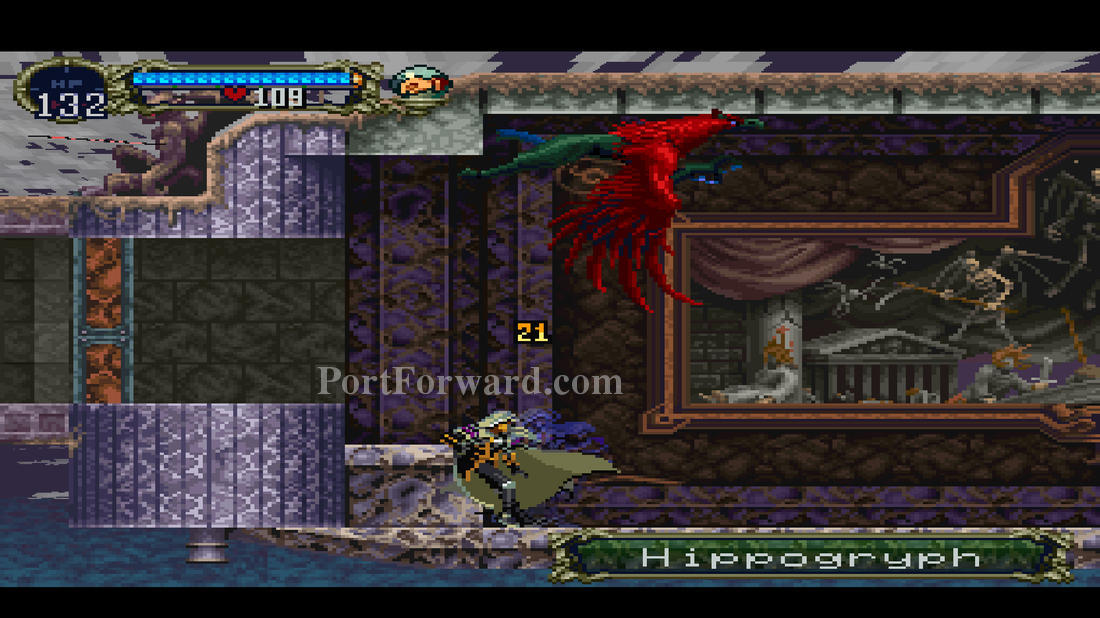
The Royal Chapel tower leading to the Hippogryph battle - PortForward

As though answering that bell, a great wingbeat sounded from higher above.

This was not the wing of armor.

Alucard stopped. The weight of the air had changed. Until a moment ago, the wind had been a cold current entering from broken windows; now it felt as if living lungs were drawing the air in. Dust fell from the high ceiling. Once. Then again. As he looked upward, a tiny feather drifted down through the dust.

It was not white. It held an old shimmer mixed with gray and gold. The moment it touched the floor, it crumbled like ash.

The door ahead stood open.

Alucard crossed the threshold.

The battle chamber lay like the highest breath of the Royal Chapel. It was wide, and the ceiling was wider still in height. Tall windows lined both walls, and their stained glass, half broken, revealed the night sky directly. Between the windows stood statues of saints, but most had lost their heads or broken their wings. In the center of the floor, the faded pattern of some old rite remained. Feathers and fragments of bone lay scattered over it.

Too wide.

Alucard did not go straight to the center. A spacious room looks safe, but for an airborne enemy it merely grants room to strike from above. He walked near the left wall, measuring the distance between a broken statue and the center of the floor. A line of escape. A pillar from which he could spring. A heap of feathers on which he might slip. His eyes drew the path before his feet did.

Then the darkness of the ceiling split open.

The Hippogryph descended.

The wings appeared first. Enormous eagle wings spread as though pushing back the darkness of the room, and then the body of a horse and the forelegs of a lion entered the light. Its beak was hooked, and its eyes were deep as blood-stained amber. It was neither wholly beast nor wholly phantasm. A creature stitched from several bodies by a single desire. An old human imagination, bitten by the malice of the castle and made real.

The Hippogryph did not land. It beat its wings once, hard, changed direction in midair, and immediately dived.

The first attack was clear. Not beak. Not claws. Its entire body became a weapon and came down diagonally. Alucard rolled aside. A heap of feathers slipped beneath his feet, and he slid farther than expected. The Hippogryph’s claws grazed his side and scraped across his breastplate. The old metal screamed.

His first judgment had been shallow. The floor of this room was not clean. Feathers, shards of glass, and the grooves of the ritual pattern deceived his footing.

Still in the posture from that slide, he planted one hand and raised himself. The Hippogryph had already climbed near the opposite wall. When its wings covered the windows, moonlight disappeared for an instant. The next moment, it descended again. This time not in a straight dive, but in a low sweep. Its lion forelegs passed close to the floor, scraping stone.

Alucard started to leap, then stopped. If he jumped too high, the wings would strike him. He lowered his body and slid almost flat against the floor. The claws passed above his head. The movement of the tail came late behind them. He raised his arm to block, but the impact struck his shoulder. His body was shoved sideways, and his fingertips scratched the stone floor.

The Hippogryph soared back into the air.

The pattern revealed itself quickly. It rose high. Folded its wings. Came down. If it did not land, it immediately climbed again. If it landed, the next attack changed. Alucard read this while avoiding the third dive. There was a very brief gap between the moment the enemy’s wings folded completely and the moment its claws extended. But that gap existed in the air. With his short sword as it was, he could not reach it.

He gripped the hand axe.

The Hippogryph came down for the fourth time. Alucard waited until the very end. When the beak drew close to the height of his face, and his own white face reflected small in the creature’s eye, he raised his left hand and threw. The hand axe spun toward the inner joint of the wing. It did not strike cleanly. But it tore out a bundle of feathers.

For the first time, the Hippogryph lost balance.

Its body tilted and landed crookedly. The lion’s forelegs struck the floor, and the horse’s hind legs tore through the ritual pattern. Alucard moved in at once. The Gladius flashed briefly. He pressed in beside the foreleg, outside the line of the beak, and cut beneath the chest. The first slash passed through fur and feathers. The second went deeper.

The Hippogryph lowered its head.

The beak came from the side. Alucard tried to withdraw, but he was late. The tip of the beak caught the red cloth and tore it. He gave the cloth to it and turned his body. As the cloak pulled free from the beak, his blade grazed the side of the enemy’s neck. Not blood, but dark heat scattered.

Then the Hippogryph curled its body.

Its wings wrapped around it, and red light gathered deep inside its chest. Alucard recognized it too late. The motion of drawing breath. Fire forming inside the beak.

Flame burst forth.

He did not jump aside. The fire spread wide. A leap would not clear its edge. Instead, Alucard dropped low and rolled behind the base of a statue. The flames licked the corner of the pedestal. Stone glowed red, and glass shards popped. Hot air lifted his hair.

It did not end with one breath.

The Hippogryph spat fire in short bursts, twice, then three times. The second flame overlapped the place where the first had passed, and the third swept the direction in which Alucard tried to move. He pushed against the floor with his knees and palms, moving low. The flames devoured the air above, but very close to the ground there was room to breathe. The moment he understood that, fear became calculation.

Alucard faces the Hippogryph in the Royal Chapel - PortForward

The fire ceased.

The enemy could not draw another breath at once. In that brief gap, Alucard sprang out. Heat rose through the soles of his feet as he stepped on the heated stone. He ignored it. His sword cut along the inside of the Hippogryph’s foreleg. The great body staggered.

But wounds summoned rage.

The Hippogryph lowered itself without taking flight. Alucard expected another burst of fire and lowered his stance. But the enemy did not breathe flame. It half spread its wings, retreated, and dropped eggs onto the floor.

Not one.

White-shelled eggs rolled across the ritual pattern. Their surfaces were wet, and small shadows writhed within. Alucard moved immediately. If he left them alone, the battlefield would shrink. He stabbed the nearest egg with the tip of his sword. The shell burst, and immature wings and claws twitched once before stopping. He split the second egg with the hand axe.

The third hatched first.

A small Hippogryph burst out with a shriek. Its body was still small, but its beak was sharp. It could barely stand, yet it lunged toward Alucard’s ankle. He pulled his foot back and cut downward. The small body tumbled. But in that moment, the fourth egg split.

The mother descended from above.

Alucard abandoned the thought of destroying every egg. If he clung to that, the main body would tear him apart with a dive. He changed position so the remaining eggs and hatchlings were not between him and the Hippogryph. The small enemies disturbed the footing. The large one fed on that disturbance. The battlefield narrowed again.

The Hippogryph dived. This time two hatchlings leapt from both sides. Alucard kicked the one on the left away with the tip of his foot and pushed the one on the right aside with the point of his sword. In that instant, the mother’s shadow covered him. There was not enough room to evade. He pulled his body upward with his second jump. Not too high, but above the line of the claws. His cloak spread half a beat late in the air, and the Hippogryph’s back passed directly beneath him.

He fell and drove in his sword.

The Gladius was not long, but the weight of the fall carried it deep beneath the feathers and into the flesh. The Hippogryph lurched. Alucard could not leap off immediately. His body caught for an instant on the enemy’s back. A vast wing swung and shook him loose. He fell to the floor, rolled once, and struck his shoulder against the stone.

His breath broke short.

In that time, the Hippogryph gathered fire again. The red light inside the beak. As Alucard rose, he felt his left knee tremble. This time, he had no time to reach the pedestal. He stepped on the body of the nearest hatchling and lowered himself. Flame passed over his head. Hot wind stung his skin. The second breath came lower. He dropped almost flat. Before the third came, he threw the hand axe upward.

The axe could not pierce the flame. But it struck the side of the Hippogryph’s beak. The direction of the fire shifted by the smallest amount. That was enough. Flame grazed his shoulder and swallowed the statue behind him. The saint’s body split black within the fire.

Alucard stood.

Now the openings were clear. Before gathering flame, the Hippogryph always swelled its chest. Before laying eggs, it lowered its body and retreated. Before diving, its eyes moved first. Small signs came before the great body.

He moved to the center.

It was a dangerous choice. But if he remained near the wall, flame and hatchlings would corner him. The center exposed him to the dive, yet left one step in every direction. Alucard held his sword low and waited. One remaining hatchling rushed him from behind. He did not turn. He drove it back with his heel. Its small cry ended against the floor.

The Hippogryph climbed high.

This dive was the fastest. It folded its wings completely, its body descending straight as a spear. Alucard did not flee. He watched the moment its eyes moved. Right. Then the body would correct left. At the instant that correction began, he ran forward. Not away from the line of the dive, but inside it.

The claws tore the floor behind his back.

He was beneath the enemy’s chest. The most dangerous distance, and the shortest. Before the Hippogryph could absorb the shock of landing, Alucard thrust his blade upward. Once. Twice. The third thrust he drove not with the wrist, but with the shoulder. The shorter the sword, the closer his body had to be. A vibration like the enemy’s heartbeat traveled up the hilt.

The Hippogryph spread its wings. It was trying to escape.

Alucard did not let it. Instead of drawing out the blade, he twisted it deeper. The massive body contorted and shoved him away with its foreleg. A claw struck his breastplate, denting the metal. Alucard was pushed back but did not fall. His heel caught in a groove of the ritual pattern. That, instead, held him upright.

The final flame came.

The Hippogryph swelled its wounded chest and drew in a blood-mixed breath. Fire boiled inside its throat. Alucard did not wait for it to emerge. It was too late to throw the hand axe. Too late to leap. He went straight in.

The inside of the beak opened red.

With his left hand, Alucard seized the torn red cloth and wrapped it against the side of the beak. The first tongue of flame burned the cloth. Behind that brief screen, he twisted his body and drove the Gladius in his right hand into the center of the wounded chest.

The flame never fully burst.

It shook backward inside the Hippogryph’s throat, and that light burned its eyes from within. The huge body staggered back. Its wings struck the air once, then again. Windows trembled in that wind, and broken glass fell like rain across the floor.

The Hippogryph breathes fire across the chapel - PortForward

The Hippogryph tried to fly one last time.

But one wing would not follow. The torn joint turned uselessly out of place. Its body rose halfway, then fell. The lion forelegs scraped the floor, the horse’s body collapsed sideways, and the eagle’s head struck the ritual pattern. Its beak opened and closed several times, but no more sound came out.

The feathers in the room drifted slowly down.

Alucard withdrew his sword. The heat on his wrist had not cooled. As he stepped back, light rose from the Hippogryph’s body. It was a vessel-like glow of life. It lingered for a moment over the blood and shards of glass in the battle chamber, then seeped into Alucard’s body. The shock left inside his ribs loosened a little, and the pain in his shoulder dulled belatedly.

Silence came.

Within that silence, footsteps sounded.

Alucard turned his head without sheathing his sword. Maria was walking out from the passage on the right side of the chamber. Her face made it impossible to tell whether she had seen the whole battle or only its final moment. Her breathing was slightly uneven, but her eyes did not waver. Yet beneath those eyes, the fatigue of someone who had forgotten sleep had grown deeper.

“It was you.”

Maria spoke first. Her voice was low. She, too, seemed to understand that loud sounds did not survive long in this chapel.

Alucard lowered the point of his sword. “This is not a place one should come alone.”

“I had to.” Maria looked once at the fallen Hippogryph, then back at him. “I thought you might have sensed something. Some trace of Richter.”

At that name, the air in the room grew a little colder. One feather was still falling. Alucard watched it touch the floor before he spoke.

“I have not seen him yet.”

The light in Maria’s eyes went out for a moment. Too quickly. It was not quite despair, but the shape of a breath long held being forced back down the throat.

“Then you know nothing yet.”

“Do not speak that name lightly.”

Maria’s words stopped.

Alucard looked at her. The words had to be brief. If made long, a warning would become an excuse. What had not yet been confirmed could not be spoken as fact.

“The Belmont name does not remain silent for long inside this castle. If you have followed that name here, then be careful.”

Maria took one step back. Her heel stepped on a shard of broken glass. It cracked softly. She seemed not to hear it.

“Richter is not dangerous.”

Alucard did not answer.

“If he has become dangerous, then this castle must be the reason.” Maria’s voice trembled a little. But even inside that tremor, stubbornness remained. “If it is Richter… he would not vanish without cause.”

She glared at Alucard. It was less anger than a face barely held together by anger. A person who believes in someone grows more violent not when that belief breaks, but when told it might break. Alucard knew that. It had been so long ago too, when love by another name and hatred by another name collided within the same castle.

“I do not pass judgment on what I have not yet seen.”

“Then I have to find him.” Maria murmured the words almost to herself. “There must be a trace somewhere. If it is Richter… if it is him.”

She asked no more. As though afraid that asking would make the answer clearer, she turned her head. But her steps were not those of someone fleeing. They were the steps of someone preparing to go deeper.

“I have to go.”

“It is dangerous alone.”

Maria stopped for a moment. With only her back visible, she said, “Searching for him was dangerous from the beginning.”

After those words, she vanished into the passage almost at a run. Her footsteps faded quickly, and the chapel’s long structure bent and returned the sound several times. The last footstep mixed with the bell’s echo and disappeared.

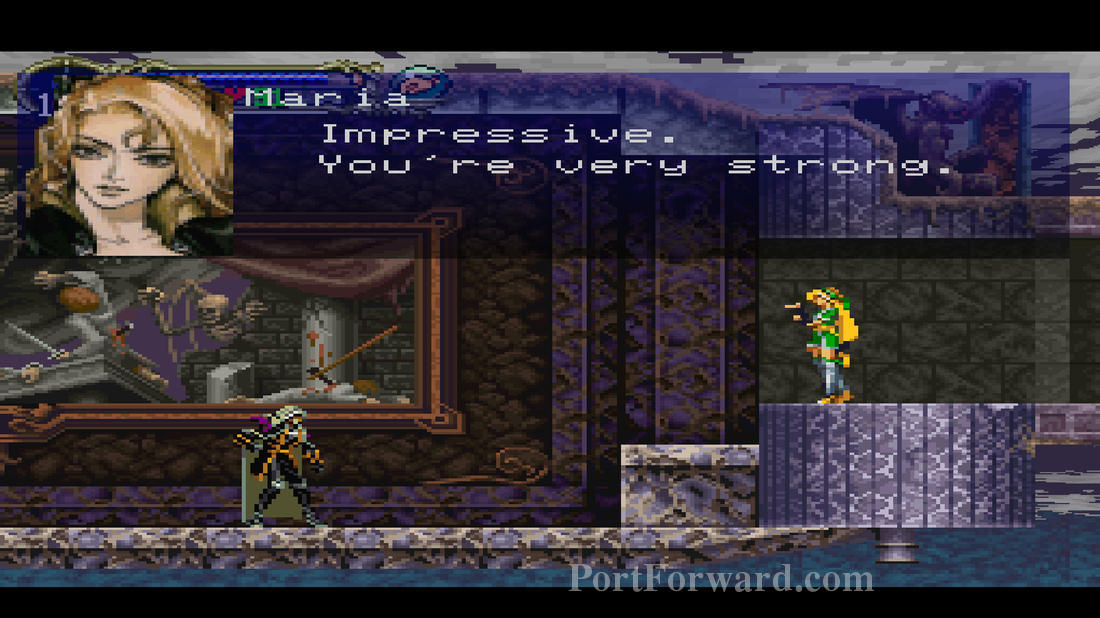
Maria acknowledges Alucard after the Hippogryph battle - PortForward

Alucard did not move for a while.

The fallen Hippogryph’s eyes had already lost their light. But the gaze Maria had left behind remained longer in the room. Eyes that denied the impossible. Eyes that could not yet accept the name of someone dear as the name of danger. Cutting through such eyes was harder than cutting down any monster.

He slowly sheathed his sword.

The passage on the right led toward the Castle Keep. As the incense scent of the Royal Chapel receded behind him, the cold night air grew stronger again. The corridor was broad and long, and crimson carpets hung along the walls like old blood. Suits of armor stood here and there, but not all of them moved. The fact that moving things were mixed among unmoving ones made it worse.

The first Axe Knight raised its axe without a word.

Alucard stopped and measured the distance. The axe was heavy and large. Before it came down, the shoulder would move first. But it could also be thrown. He did not move too close. The moment the knight hurled the axe, Alucard ducked low beneath it and passed forward, cutting into the side before the recovery motion began. Black air leaked from within the armor.

At the end of the corridor were moving platforms. Stone plates slowly rose and fell. Between them, small riders descended on insectlike mounts. The wingbeat of the Flea Riders was neither hymn nor bird flight. It resembled the rapid shaking of a wet leather pouch. They did not come from the front. They dropped from above, rose again, and tried to force Alucard into the gaps between platforms.

He saved the hand axe.

Here, a thrown axe might not return. The darkness below was deep, and the platforms were not constant. He cut only with the Gladius. He lowered his body while a platform rose and leapt when it descended. The second jump had already become familiar to his body, but these distances demanded a higher rhythm. When a platform reached its highest point, and he pushed himself once more in the air, his fingers reached the next ledge.

Once, he was late.

A Flea Rider dropped from the upper left and struck his shoulder. Its small spearpoint dug into the gap of his breastplate. Alucard drew in a short breath and tore the enemy away. The small body thrashed. He threw it against the wall. With a wet sound, its wings split.

He climbed onto the ledge.

The high chamber of the Castle Keep opened upward in a way unlike the Royal Chapel. If the chapel’s height belonged to prayer and fear, this height belonged to power. Pillars made for looking down, stairs that made distant figures seem small, a crimson carpet drawing the eye upward. Yet what Alucard sought now was not a throne.

At the far left, on a high pedestal, a small light rested.

At first it looked like a jewel. When he came closer, he saw it was a stone. But not dead stone. A stone with a very slow pulse inside it. The Leap Stone hovered quietly above the pedestal. It was small enough to hold in one hand, and its color lay somewhere between night sky and tarnished silver. No feather or wing was carved into its surface. Instead, fine lines of unknowable depth folded once more inside the stone.

Alucard reached out.

The moment the stone touched his palm, the world beneath his feet vanished for the briefest instant.

It was not the feeling of falling, but the feeling that falling could not fully claim him. His body had already learned how to push itself upward once more in the air, yet now that force gained a clearer name and form. Until then, it had felt like stepping on an interval the castle permitted. Now it felt as if the air itself formed a foothold for an instant. Not bone and muscle, but will descended to the toes and surged upward again.

Alucard opened his eyes.

Below was unchanged. The platforms moved, and the wingbeats of Flea Riders sounded again in the distance. But the height of the room had changed. The ceiling had not lowered. His body had gained one more answer to the upward path.

He stepped down from the pedestal and went to the nearest ledge.

A height he could not have reached before. He jumped. At the peak, he pushed himself again. This time there was no wavering. Beneath his feet, an invisible stone appeared for an instant and vanished, and his body rose half a beat higher. His fingertips passed over the ledge. Alucard climbed up without sound.

Beyond the crimson carpet, the air of the higher castle waited for him.

But beneath that air, another smell was mixed in. It was not the incense of the chapel, nor the wind of the outer wall. Damp stone, deep water, the fishlike breath of a long-sealed underground place. Somewhere below, water seemed to strike stone in falling drops. It was so distant he could not tell whether it was real or memory.

Alucard turned back toward the Royal Chapel.

The path where Maria had disappeared could not be seen. Only the darkness in that direction seemed a little deeper. She would search for Richter. Carrying belief with her, not yet accepting that belief might become a wound.

Alucard looked down once at the scorched red cloth at the end of his cloak. The place burned by the Hippogryph’s fire had dried black. He did not tear it away. Inside the castle, remaining traces sometimes become the weight of the next judgment.

He stood at the edge of the high ledge.

Below, the descending path and the ascending path could both be seen. The newly acquired stone lay quiet within his garment, and his body still remembered its pulse. Heights that had been closed would now become roads one by one. But to gain the high places also meant seeing the entrances to deeper ones.

Far away, water struck stone once.

A very low, cold sound.

References

[Castlevania: Symphony of the Night Novel Episode 6] The Door Opened by Price, the Demon Beneath the Shelves

The sound of paper scraping came first.

It reached him before he even pushed the door open. The wind of the Outer Wall tugged once more at the end of Alucard’s cloak, then withdrew, and from beyond it seeped the breath of a long library. Damp stone and night air were pierced by the thin, dry smells of leather, ink, and ancient paste. Dust settled across the back of the hand that held the handle. He did not push the door all the way open. He made only enough of a gap for one shoulder to pass through.

A book fell by itself inside.

Just before it struck the floor, the book spread its cover like wings. Its pages caught the air and fluttered upward to the height of Alucard’s face. He slipped his body aside and drew the Gladius in a short arc. The blade split the spine. Torn paper did not scream; it made the sound of crushed dry leaves, and black dust scattered from between the pages like blood.

Alucard stepped through that dust.

The Long Library was less a room than an abyss set upright. The shelves were not attached to the walls; they seemed to replace them. Ladders rose like pillars, and the tops of the high bookcases vanished into darkness beyond the candles’ reach. Near the ceiling, metal ornaments of uncertain purpose swayed with terrible slowness. The wind outside the castle walls could not reach this place, yet the books trembled faintly as though there were wind all the same.

When he set his foot down, dust on the floor drifted low. Alucard shortened his stride. Sound did not travel far here. Unlike the stone corridors, books, cloth, and leather swallowed noise. Silence itself came closer instead. Each breath seemed to lay a thin film of paper dust inside his lungs.

The first stairway was broad. Broad, but not safe. Piles of collapsed books cut off his sight on both sides, and below the rail-less edges, dark chambers opened their mouths. Somewhere on the lower floor, something scratched against the ground. It was not bone. It sounded like wet soil being dragged.

Alucard stopped halfway up the stairs.

Beneath the bookcase to his left, in the shadow, a low flower stalk swayed. Its color was too dark to be called a flower, and its movement too deliberate to be called a stem. Something like a tendril of flesh rose from between the stones and twitched toward Alucard’s ankle. Green saliva gathered in the mouthlike bloom.

When he stepped back, the saliva dropped onto the stair. The stone whitened and blistered where it landed. Poison. Alucard drew his left hand back with the hand axe and threw it low the instant the stalk lifted itself again. The axe flew close to the stair’s edge and struck beneath the bloom. The body lurched.

In that opening, he moved in. The Gladius was not a long sword. To cut deep, he had to enter. Before the poison could gather again, he lowered himself and severed the root. The tendril struck the floor several times before going slack. Paper dust fell over it and grew damp.

He picked up the axe and ran his fingers over the handle once. No poison clung to it.

The deeper he went, the narrower the paths between shelves became. Armless armor sprang from gaps in the bookcases, and squat little creatures leapt across heaps of books. They knew the rules of the Long Library. They did not charge from the front. First they dropped books, and while his eyes were drawn to the noise, they slipped in at his feet. Alucard did not raise his feet high. If he gave one of the small ones his ankle, the poison plants and flying books would come next.

He did not swing the sword in wide arcs. In a tight aisle, a broad cut would catch on the shelves. He cut with short turns of the wrist, stepped half a pace back, threw the hand axe, and entered again. He pressed his cloak beneath his elbow so it would not catch on the corners of the books. Alucard’s movement was less like battle than a careful dance performed by someone trying not to break the belongings of an old room.

But this room did not become gentle just because he was careful.

After the long stairs, the passage suddenly widened. A low desk stood in the center, and beyond it, a chair. The chair was far too large. The old man seated on it looked small by comparison, yet the air in the room seemed to hang from the tip of his finger.

The old man was reading.

Alucard stopped at the threshold. Candlelight flashed white along the edge of the old man’s spectacles. He did not immediately raise his head. Instead, he pressed one finger to the corner of the page so that the paper would not fold, with the practiced gesture of a man who had repeated it since long before memory.

“It has been a long time, old one.”

Only then did the old man’s eyes rise slowly. At first they were the eyes of someone looking at an intruder. Then, for an instant, they wavered.

“Ah. Lord Alucard.” The old man bowed slightly while remaining seated. His voice was courteous, but the calculation beneath that courtesy did not hide itself. “What brings you to this old man?”

Alucard walked to the front of the desk. One footfall sank into the carpet.

“I need your help.”

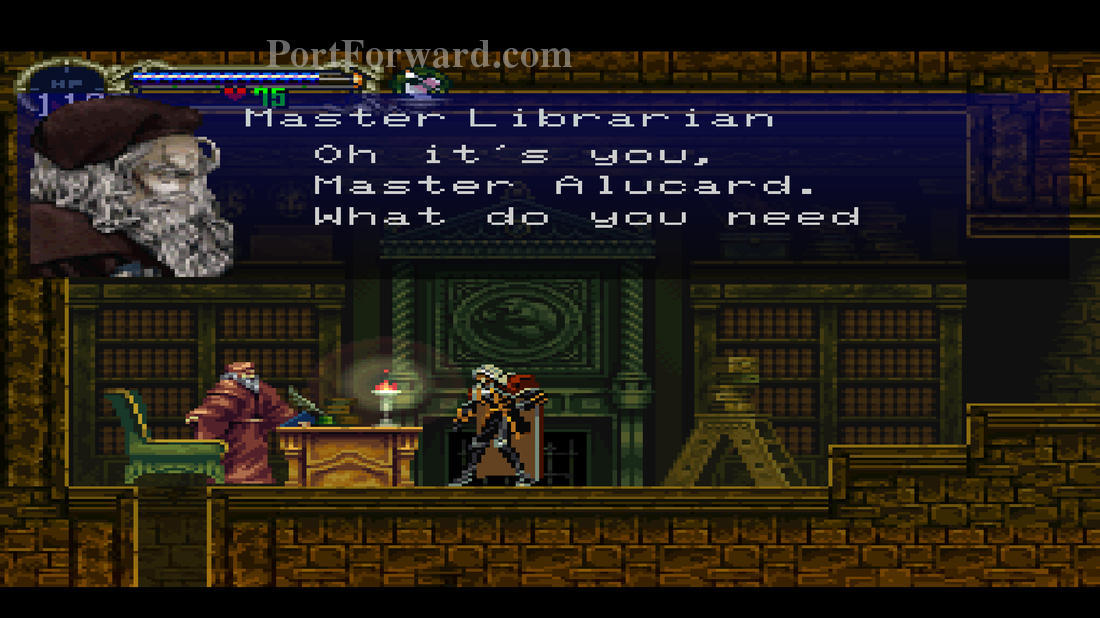
Alucard speaks with the Master Librarian in the Long Library - PortForward

The old man’s finger stopped on the book. A candle trembled slightly. Somewhere in the room, a sleeping book changed its breath.

“Young master,” the old man said quietly, “I cannot aid one who has turned against the lord of this castle.”

Alucard looked at him. Not even an eyelid moved. But the hand that held the sword loosened a little. Silence was needed to distinguish an enemy to be cut down from a door that had to be passed.

“I will pay.”

The old man’s mouth rose very slowly. It was less a smile than the sound of an old lock meeting oil.

“In that case, the matter changes. Say what you require.”

The old man drew a small box from beneath the desk. Inside it, objects had been arranged with exact order: vials, an old map, scrolls marked with strange spells, weapons whose handles alone had been polished by use. But Alucard’s gaze stopped on a small jewel set apart from the others.

It did not shine brightly. Rather, it seemed to swallow light into itself. Within its transparent surface, a blue pattern lay submerged, and when he brought his hand close, that pattern turned with terrible slowness. The moment he saw it, Alucard remembered the blue-sealed doors that had blocked paths throughout the castle. Doors with no keyholes, doors that could not be broken by force. Doors that allowed the existence of a path, but not yet permission.

“That jewel.”

The old man reached for it as if he had been waiting. “It is an object that knows roads. Or, more precisely, the seals that bar those roads recognize this object.”

“The price?”

The old man named it. Briefly. Too easily.

Alucard untied the pouch at his waist. The coins he had gathered in the castle were cold and mismatched. Some belonged to old human kingdoms, and some had been carried like ornaments by the castle’s servants. He set them on the desk without counting. The old man counted them. His counting had not aged.

Each small meeting of metal split the library’s silence.

After confirming the last coin with his thumb, the old man handed him the jewel. When Alucard took it, the blue pattern gave a brief pulse beneath his palm. It did not pierce the skin. Yet somewhere inside his body, he felt a closed door turn to look at him.

“This castle is not kind,” the old man said. “But to one who knows the price, it will sometimes lend a road.”

Alucard placed the jewel inside his garment.

“Which side are you on?”

The old man’s smile stopped. Only for a moment. In that narrow interval, the order this castle had possessed long ago showed its face and vanished.

“I am the keeper of books.” The old man folded his fingers again. “Books record the names of the victorious and the fallen alike.”

“Then record this well.”

Alucard turned. The old man asked no more. Instead, just before Alucard stepped out through the door, a very low voice came from behind him.

“Take care in the lower shelves. They have not been quiet of late.”

Alucard did not stop.

The hidden room behind a rotating bookcase in the Long Library - PortForward

Once he left the old man’s room, the smell of the library thickened again. For a brief while, the order at the old man’s fingertips had seemed to govern the place, but a few steps down were enough for the Long Library to reveal its own laws. Books have no master. Between the shelves live things that have starved as long as knowledge has been stored.

The path to the lower floor was darker than before. The shelves dropped lower and the ceiling pressed down, forcing Alucard to watch above his head more than once as he walked. Blue fire flickered between the pages. Spellbooks opened themselves and rose into the air. One of them did not fly straight at him, but circled from afar. A lure.

Alucard did not follow.

At that moment, the floor shook.

The sound had not come from the shelves, but from beneath the stone. Something heavy seemed to be pushing through the ground below. Then, in the distance, books fell all at once. Not dozens. Hundreds. The entire Long Library seemed to shudder once.

Alucard raised his sword. The short blade of the Gladius caught the candlelight and became a white line.

At the end of the passage there was a door. It was not closed. The darkness inside was simply so dense that he recognized it as an open doorway only after a moment. Above the frame, an angel had been carved, but its face had been scraped away. With only its wings remaining, it could not look down.

The smell changed as soon as he entered.

The scent of books withdrew, and wet soil and cold ash rose in its place. The battle chamber was a long rectangle. Bookcases ran along both walls, but the center had been left empty. No, not left empty. It felt as if something had moved there for a very long time, pushing the shelves back to make space for itself. Books, bones, and clods of soil lay mixed across the floor. The ceiling was high. Too high. A room favorable to an enemy that used the air.

Alucard did not go all the way to the center. He moved only three steps from the door, far enough from the left wall not to place his back against it. He left himself a path of retreat while avoiding a corner that might trap him.

Then, between the shelves near the ceiling, two red eyes lit.

The shadow descended first. When its wings opened, several candles went out at once. A short, twisted body. Long protruding arms. Dark heat moving beneath the skin. The Lesser Demon had been hanging upside down from the top of the shelves; now it bent its head and looked at Alucard. Its mouth opened, and within it boiled a sound that had failed to become human speech.

The first attack came from above.

It folded its wings and dropped. Not with the sound of falling stone, but with the sound of wet cloth tearing. Alucard started to roll left, then stopped. There was a clod of soil on the floor. He might slip. Instead, he stepped half a pace forward and lowered his body. The Lesser Demon’s claws passed over the back of his head and scraped the wall. A whole row of book spines burst open.

Alucard turned and cut at once. The edge of the blade touched the demon’s side. Shallow. The enemy did not retreat from the wound, but spread its wings and sprang upward. The sword had crossed flesh, but there had been no feeling of striking bone. It had twisted away in midair.

His first judgment had been late. This enemy was lighter than its size suggested, and it changed height faster than it changed distance.

The Lesser Demon opened both arms near the ceiling. Black sparks gathered between its fingers. Alucard, expecting poison breath or flame, began to move sideways. But the sparks did not fly at him. They fell to the floor.

The fallen sparks became bones.

First, a skeleton soldier rose onto one knee. Then a hazy shape drifted from between the shelves. It had neither flesh nor bones; it was a curse before it was a body. At the center of the floor, a mound of earth swelled and a mud creature lifted itself upright. What had been part of the ground only moments before had become an enemy.

Alucard did not grit his teeth. He merely adjusted his grip on the sword.

While it summoned, the Lesser Demon’s body stiffened briefly. But a thin membrane of darkness formed around it. Even if he cut now, the blow would not reach. The opening was not during the summoning, but in the first breath after the summoning ended.

The problem was surviving until that breath.

The skeleton came from the front. The mud creature was slow, but it blocked the path. The mist shape did not touch the floor, sliding toward Alucard at shoulder height. He did not meet the skeleton’s first slash with the Gladius. If he blocked it, the mist behind would reach him. Instead, he angled the blade and diverted the skeleton’s wrist, then kicked its ribs with his left foot. The bones collapsed, and a path opened.

Alucard battles the Lesser Demon in the Long Library - PortForward

The mist came close. If it touched him, it would become a curse. Alucard threw the hand axe. It did not completely cut the mist, but it tore the flow apart. In that single beat, he ducked beneath the mud creature’s slow arm and slipped past. The mud arm struck the bookcase and stuck there with a wet heaviness. Books made a soaked sound.

Poison poured from above.

The Lesser Demon was descending diagonally with its mouth open. Green breath swept the floor in a long line. Alucard tried to leap over the breath with his second jump. Yet though the ceiling was high, an iron ornament jutting from the end of a shelf blocked his path. His shoulder grazed the ornament, and his body fell sooner than he had expected. The edge of the poison burned the hem of the red cloth. An acrid smell rose.

A mistake. In this room, the upper space was not free. It was the demon’s road, and the trap of old ornaments.

As soon as he landed, he bent his knees and let the impact pass through him. The Lesser Demon seemed to have been waiting for that. It came down again with its claws spread. This time not from the front, but from behind. Alucard did not look back. He felt the movement of his cloak. The wind pressed at his back. He twisted right and thrust the sword behind him.

Blade met claw. A short metallic note. The demon’s claws were as hard as swords. He could not contest them with force. Alucard loosened his wrist and let the shock pass aside, then lowered himself further and slipped under the enemy’s arm. This time it was deep. The Gladius crossed the Lesser Demon’s belly.

The demon screamed for the first time.

The sound began as a high note no human throat could make, then sank at the end into a low roar like collapsing shelves. Its wings thrashed violently. Alucard stepped back and shielded his face with one arm. A storm of pages rose around him. His vision went white.

Within that whiteness, the second pattern began.

The Lesser Demon no longer summoned only from afar. After being wounded, it scattered sparks as it rose, and swung its claws as it descended. The gap between summoning and attack shortened. Before one skeleton had fully risen, a mud hand was already clutching the floor, and mist shapes seeped from behind the shelves to cut off Alucard’s retreat. The battle chamber was wide, but each enemy that came into being made it a little smaller.

Alucard abandoned the center. If he stayed there, they would come from every direction. He moved close to the right-side shelves. Not too close. If the shelves were at his back, he would have no space to evade the Lesser Demon’s dive. One step of space. Maintaining that gap, he gathered the enemies toward one direction.

The skeleton came first. He cut it down. The mist overlapped behind it. He did not retreat, but recovered the hand axe and threw it immediately. While the axe tore through the mist, the mud creature stretched out an arm. Alucard stepped on that arm. The mud tried to seize his ankle, but he escaped with the second jump. This time he did not rise high. Only the height of a man. Low enough to avoid the iron ornaments. Folding his body in the air, he fell and drove his sword into the mud creature’s head.

The floor splashed.

And above.

The Lesser Demon always aimed for the moment after Alucard landed. It was repetition. At first, it had been a threat. By the third time, it had become a promise. The enemy waited for the instant when Alucard’s feet touched the ground and his knees bent. That was when it tried to tear his back or shoulder with its claws.

Then the opening would appear there as well.

Alucard deliberately delayed his evasion of the next mud creature’s arm. His toes touched the mud. A heavy sensation caught his ankle. The Lesser Demon responded at once. The sound of wings folding at the ceiling. The air being pulled into a single point. Alucard lowered his weight, pretending to be trapped. The enemy descended faster.

Just before the claws reached him, he threw the hand axe upward with his left hand.

The axe had not been meant to strike the demon. Its blade hit an ornament in the ceiling and ricocheted. The metallic note tore through the room. The Lesser Demon’s gaze wavered for an instant. In that tiny moment, Alucard cut the mud holding his ankle with the tip of his sword and slipped aside. The demon’s claws gouged the place where he had been standing.

Landing.

An opening.

The Lesser Demon’s wings had not yet fully spread. Alucard entered. His cloak followed half a beat late. The Gladius was short, and therefore quick. He slipped inside the demon’s arms, opened its chest with the first cut, and split the base of its throat with the second. When the demon tried to fly upward, he reached out and seized its coarse fur.

Its skin was hot. His palm felt as though it were burning.

Alucard did not let go.

The mist gate beyond the Lesser Demon battle - PortForward

He dragged the demon to the floor and pinned it with his knee. Poisonous breath boiled again in the Lesser Demon’s mouth. Too close. There was no distance in which to dodge. Alucard turned his head aside and drove the sword upward from below.

The poison never came.

Black blood overflowed from inside the demon’s throat first. Its wings thrashed once, violently. The surrounding books opened and closed all at once, as though the room itself had blinked.

The Lesser Demon scraped at the floor. Its claws carved into the stone and raised white powder. The summoned skeleton collapsed like a puppet with severed strings, and the mist shape vanished like smoke touched by flame. The mud creature forgot the form of its own body and sank back into a mound of soil.

The last thing remaining was the wings. The demon’s wings trembled a few times, then slowly folded. Only the sound of falling paper remained in the room.

Alucard drew out the sword. Blood did not cling long to the blade. It slid down like darkness and fell to the floor. He looked at his palm. The place where he had gripped the demon’s fur had reddened. When he clenched and opened his hand once, the pain rose late.

A low sound came from the left wall of the battle chamber.

The sound of a hidden mechanism releasing. One bookcase moved very slowly aside, revealing a passage behind it. At the same time, from the center of the floor near where the demon had fallen, a small light rose. It was neither blood nor flame. It was a vessel-like glow of life. Alucard stood before it. The light seeped into his body and cooled the edges of his wounds. His breath deepened slightly. Yet the fatigue did not vanish. His surviving body had merely grown a little broader for a moment.

He followed the passage.

Beyond the battle chamber, it was unexpectedly quiet. The shelves were orderly again, and the floor was almost clean. But that peace did not last. Soon the path ended before a narrow set of bars. Beyond them, another room clearly existed. A faint blue energy moved inside. A shadow like a bat’s wing flickered briefly across the ceiling and vanished.

Alucard approached the bars and reached out. Cold air flowed between his fingers. The iron bars were too close together. A human body could not pass through, and even a sword could not properly enter. They were too old and too strong to be broken by force.

It was not a door, but a gap.

He did not need to recall the low opening he had passed earlier. The castle had already been repeating the same statement in several forms. Some paths demanded a higher body. Some demanded a lighter one. Some opened for a price, and others waited for a transformation whose name he did not yet know.

Alucard withdrew his hand.

The Jewel of Open lay faintly cold within his garment. This jewel was not the answer to these bars. But other doors would now recognize him. Doors sealed in blue. Closed entrances he had remembered in passing. The cold light of the Marble Gallery, the blocked passage leading deeper into the castle, the air that climbed upward.

Behind him, the Long Library turned another page.

Whether it came from the old man’s room, from the books that still lived, or from the last tremor left behind by the dead demon, he could not tell. Alucard sheathed his sword and turned back. A scorched mark from the poison remained at the end of his cloak. He did not brush it away.

The way back was quieter than the way in. The books still watched him, but they did not rush him as before. Or perhaps they were only choosing the moment to do so. The servants of this castle do not vanish unless their master changes. Defeating the demon of one room does not make a library safe.

When he passed the old man’s room, the faint sound of coins touching came from within. Alucard did not open the door. The old man did not call to him. The transaction between them was done. But the end of a transaction does not mean the debt disappears. In this castle, what is bought for a price will one day return with another price attached.

As he descended the stairs, he felt again the trace of the night air that entered from the Outer Wall. Another scent mingled with that cold current. Incense. Extinguished candles, damp stone, and the lingering echo of a cold hymn caught beneath a high ceiling.

Alucard stopped.

Behind the smell of the Long Library’s paper, from somewhere far away, came the sound of wings folding and spreading. It was not the sound of a bookcase shifting. It was larger, and it belonged to a higher place. The wind descending from the castle’s upper reaches made the gap in the door sing faintly.

He pressed one hand to the blue jewel within his garment.

Somewhere, a closed door was quietly waiting for him.

References