[Castlevania: Symphony of the Night Novel Episode 7] Wings Above the High Choir Loft, the Girl Who Denied the Impossible
The blue seal recognized the jewel before it recognized his hand.
When Alucard stopped before the door, the long-closed patterns rose faintly along the grain of the stone. It was less light than a cold breath. Lines felt for one another and locked into place, and the blue knot at the center loosened once, very slowly, in time with the pulse of the Jewel of Open. The door made no sound as it opened. No scrape of metal, no click of a freed lock. Only the sense that the will which had barred the way had withdrawn.
From beyond it drifted the scent of incense.
It was unlike the dry smell of paper in the Long Library. The air here held old candle wax, cold ash, damp stone, and powder left in long-extinguished censers. Before crossing the threshold, Alucard checked the position of his scabbard with his fingertips. The short sword rested quietly at his right hip, and the weight of the hand axe lay near his left hand. Heat from the last battle still lingered beneath his breastplate, but the air flowing from the chapel cooled it layer by layer.
When he took his first step inside, the sound rose higher.
The Royal Chapel was a space that grew upward from below. Its passages were not narrow, but every wall, pillar, and window pointed toward the heights. Stained glass cut the night into wounds of color and cast them on the floor, and Alucard’s shadow passed long across them. Near the ceiling, a broken choir loft hung in darkness. The old wooden railing had half collapsed, and below it stood candlesticks long since extinguished, their hardened wax hanging like frozen tears.
No hymn could be heard. Yet the emptiness left in the place where hymns had vanished was unmistakable. Like stone remaining where knees had once pressed in prayer before the worshippers suddenly disappeared.
Alucard did not stop walking.
The first chamber was a narrow chapel room. The faces of the holy statues along the walls had been scratched away, and one had only its fingers left, pointing into empty air. The hand did not point toward the altar or a cross. It pointed higher, toward a black gap near the ceiling. Something moved faintly inside it.
The sound of wings.
He drew his sword.
But what descended was not a bird. An armored knight fell from the shadow above. The wings on its back were less feathers than an old form of malice. It raised its spear before it even touched the floor, and the instant it landed, it drove a long thrust forward. Alucard did not dodge aside. The passage was narrow. If he moved sideways, his shoulder would strike a pillar. He watched the line of the spearhead, then deflected it with the back of his blade half a beat late.
The metallic note tore upward through the chapel.
At that sound, the darkness above stirred again. Not one knight, but two, then three. Winged suits of armor were waking among the choir lofts. Alucard stepped inside the reach of the first enemy’s spear. The Gladius flashed briefly. An enemy that uses a spear leaves its torso open the moment it extends its arm. He put his blade into that vacancy. From within the armor, dried smoke burst out.
A second spear came from behind.
The end of his cloak reacted first. When he felt the air split behind his shoulder, he lowered his body. The spearpoint passed over his head and shattered the face of a stone statue. Broken fragments fell over his hair. Before the shards touched the floor, Alucard threw with his left hand. The hand axe spun through the air and struck the joint of the knight’s wing. The wing buckled, and the enemy lost its balance and sank downward. At that instant, the third foe drove its spear straight down from above.
He did not retreat. He stepped forward instead.
The spear struck the floor behind his back. Alucard moved in so close that his shoulder almost touched the landing knight, then cut horizontally. The armor opened below the neck, and the darkness within scattered into the scent of incense.
The chapel room fell silent again.
Alucard recovered the hand axe and looked upward. The movements of the winged armor had not been an encounter. They had been a warning. The enemies here did not wait below. They fell from above. Stairs, railings, and broken choir lofts would all become parts of the battlefield. In this place, he had to read the space over his head before the ground beneath his feet.
He climbed the stairs.
The stairs of the Royal Chapel did not simply lead upward. They turned once, narrowed again, emerged before a window, then returned into the dark interior. The face of a saint in the stained glass caught a red glow from somewhere and seemed to bleed. Alucard did not leave his gaze there for long. In this castle, things stared at too long usually opened their eyes.
Halfway up, a small room opened to the side.
Inside was a confessional. The wood had grown black with age, and the lattice window was clogged with dust. One door stood slightly open. There was no sound from within. Alucard stopped. The silence in the room was too perfect. He was about to pass without opening the door.
Then a chair creaked inside.
Alucard lowered the tip of his sword. The door opened a little farther by itself. Inside the confessional stood an empty chair, and on the floor before it remained a mark like the trace of someone kneeling. The old dust there was thin. Someone had recently sat, or knelt, or imitated kneeling.
“Even prayer does not survive long inside this castle.”
His voice was low. No answer came. Instead, from the darkness behind the confessional, a small laugh sounded. It was like a child’s voice, and also like an old woman’s. Alucard did not go in any farther. This castle had doors to open and doors to pass by. Answering every sound deepens not the road, but the trap.
The stairs continued upward.
The higher he climbed, the stronger the wind became. The windows were shut, but night entered through some broken seam. The candles set in small shrines along the wall leaned with blue flames. Among those flames, skeletons rose. Some still in kneeling posture. Some with their hands clasped. Some carried weapons, while others approached with nothing but their bodies.
Alucard did not cut them down in haste. On narrow stairs, the dead become obstacles when they fall. He stabbed first at those descending from above, and kicked those crawling up from below back down the steps. The sound of bones rolling down the stairs vanished into the depths of the chapel. Somewhere, a bell rang very softly. Not a bell struck by anyone, but a sound awakened from within the stone itself.
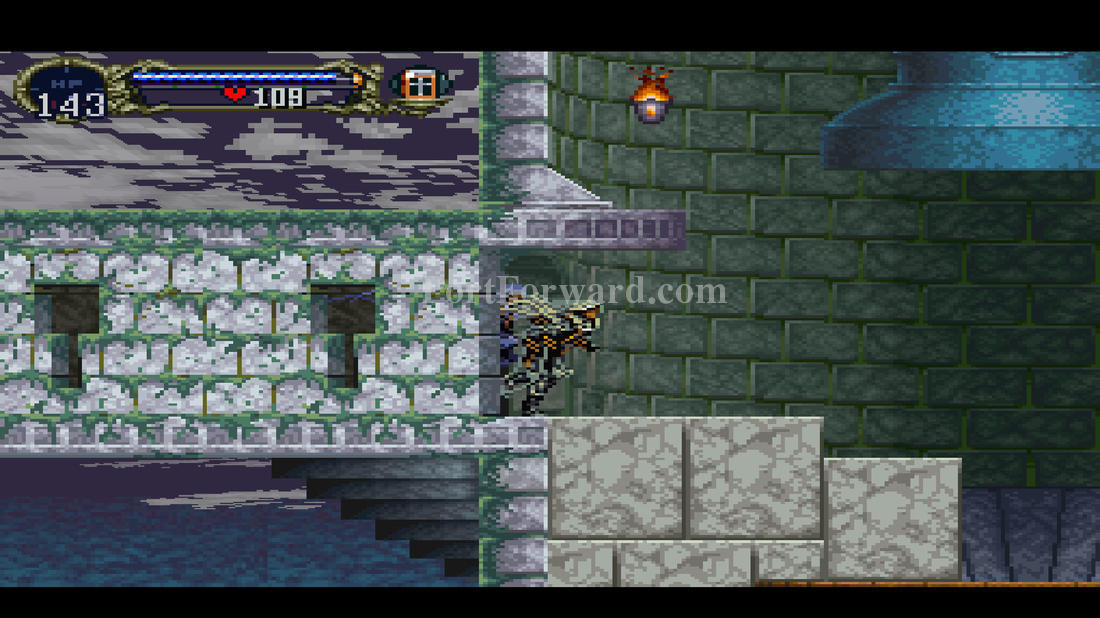
As though answering that bell, a great wingbeat sounded from higher above.
This was not the wing of armor.
Alucard stopped. The weight of the air had changed. Until a moment ago, the wind had been a cold current entering from broken windows; now it felt as if living lungs were drawing the air in. Dust fell from the high ceiling. Once. Then again. As he looked upward, a tiny feather drifted down through the dust.
It was not white. It held an old shimmer mixed with gray and gold. The moment it touched the floor, it crumbled like ash.
The door ahead stood open.
Alucard crossed the threshold.
The battle chamber lay like the highest breath of the Royal Chapel. It was wide, and the ceiling was wider still in height. Tall windows lined both walls, and their stained glass, half broken, revealed the night sky directly. Between the windows stood statues of saints, but most had lost their heads or broken their wings. In the center of the floor, the faded pattern of some old rite remained. Feathers and fragments of bone lay scattered over it.
Too wide.
Alucard did not go straight to the center. A spacious room looks safe, but for an airborne enemy it merely grants room to strike from above. He walked near the left wall, measuring the distance between a broken statue and the center of the floor. A line of escape. A pillar from which he could spring. A heap of feathers on which he might slip. His eyes drew the path before his feet did.
Then the darkness of the ceiling split open.
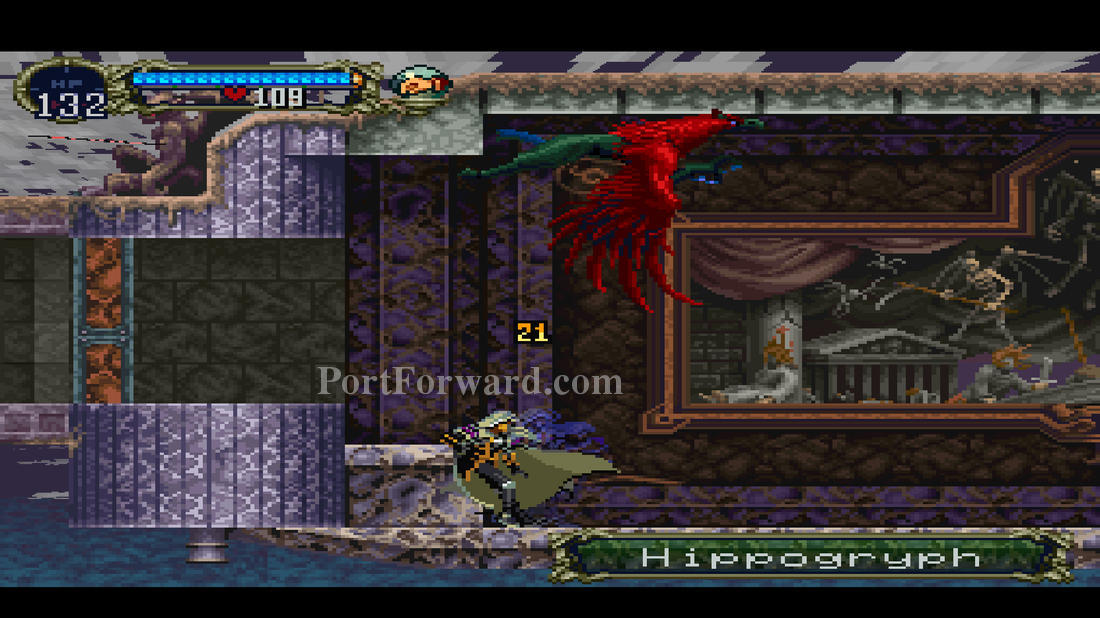
The Hippogryph descended.
The wings appeared first. Enormous eagle wings spread as though pushing back the darkness of the room, and then the body of a horse and the forelegs of a lion entered the light. Its beak was hooked, and its eyes were deep as blood-stained amber. It was neither wholly beast nor wholly phantasm. A creature stitched from several bodies by a single desire. An old human imagination, bitten by the malice of the castle and made real.
The Hippogryph did not land. It beat its wings once, hard, changed direction in midair, and immediately dived.
The first attack was clear. Not beak. Not claws. Its entire body became a weapon and came down diagonally. Alucard rolled aside. A heap of feathers slipped beneath his feet, and he slid farther than expected. The Hippogryph’s claws grazed his side and scraped across his breastplate. The old metal screamed.
His first judgment had been shallow. The floor of this room was not clean. Feathers, shards of glass, and the grooves of the ritual pattern deceived his footing.
Still in the posture from that slide, he planted one hand and raised himself. The Hippogryph had already climbed near the opposite wall. When its wings covered the windows, moonlight disappeared for an instant. The next moment, it descended again. This time not in a straight dive, but in a low sweep. Its lion forelegs passed close to the floor, scraping stone.
Alucard started to leap, then stopped. If he jumped too high, the wings would strike him. He lowered his body and slid almost flat against the floor. The claws passed above his head. The movement of the tail came late behind them. He raised his arm to block, but the impact struck his shoulder. His body was shoved sideways, and his fingertips scratched the stone floor.
The Hippogryph soared back into the air.
The pattern revealed itself quickly. It rose high. Folded its wings. Came down. If it did not land, it immediately climbed again. If it landed, the next attack changed. Alucard read this while avoiding the third dive. There was a very brief gap between the moment the enemy’s wings folded completely and the moment its claws extended. But that gap existed in the air. With his short sword as it was, he could not reach it.
He gripped the hand axe.
The Hippogryph came down for the fourth time. Alucard waited until the very end. When the beak drew close to the height of his face, and his own white face reflected small in the creature’s eye, he raised his left hand and threw. The hand axe spun toward the inner joint of the wing. It did not strike cleanly. But it tore out a bundle of feathers.
For the first time, the Hippogryph lost balance.
Its body tilted and landed crookedly. The lion’s forelegs struck the floor, and the horse’s hind legs tore through the ritual pattern. Alucard moved in at once. The Gladius flashed briefly. He pressed in beside the foreleg, outside the line of the beak, and cut beneath the chest. The first slash passed through fur and feathers. The second went deeper.
The Hippogryph lowered its head.
The beak came from the side. Alucard tried to withdraw, but he was late. The tip of the beak caught the red cloth and tore it. He gave the cloth to it and turned his body. As the cloak pulled free from the beak, his blade grazed the side of the enemy’s neck. Not blood, but dark heat scattered.
Then the Hippogryph curled its body.
Its wings wrapped around it, and red light gathered deep inside its chest. Alucard recognized it too late. The motion of drawing breath. Fire forming inside the beak.
Flame burst forth.
He did not jump aside. The fire spread wide. A leap would not clear its edge. Instead, Alucard dropped low and rolled behind the base of a statue. The flames licked the corner of the pedestal. Stone glowed red, and glass shards popped. Hot air lifted his hair.
It did not end with one breath.
The Hippogryph spat fire in short bursts, twice, then three times. The second flame overlapped the place where the first had passed, and the third swept the direction in which Alucard tried to move. He pushed against the floor with his knees and palms, moving low. The flames devoured the air above, but very close to the ground there was room to breathe. The moment he understood that, fear became calculation.
The fire ceased.
The enemy could not draw another breath at once. In that brief gap, Alucard sprang out. Heat rose through the soles of his feet as he stepped on the heated stone. He ignored it. His sword cut along the inside of the Hippogryph’s foreleg. The great body staggered.
But wounds summoned rage.
The Hippogryph lowered itself without taking flight. Alucard expected another burst of fire and lowered his stance. But the enemy did not breathe flame. It half spread its wings, retreated, and dropped eggs onto the floor.
Not one.
White-shelled eggs rolled across the ritual pattern. Their surfaces were wet, and small shadows writhed within. Alucard moved immediately. If he left them alone, the battlefield would shrink. He stabbed the nearest egg with the tip of his sword. The shell burst, and immature wings and claws twitched once before stopping. He split the second egg with the hand axe.
The third hatched first.
A small Hippogryph burst out with a shriek. Its body was still small, but its beak was sharp. It could barely stand, yet it lunged toward Alucard’s ankle. He pulled his foot back and cut downward. The small body tumbled. But in that moment, the fourth egg split.
The mother descended from above.
Alucard abandoned the thought of destroying every egg. If he clung to that, the main body would tear him apart with a dive. He changed position so the remaining eggs and hatchlings were not between him and the Hippogryph. The small enemies disturbed the footing. The large one fed on that disturbance. The battlefield narrowed again.
The Hippogryph dived. This time two hatchlings leapt from both sides. Alucard kicked the one on the left away with the tip of his foot and pushed the one on the right aside with the point of his sword. In that instant, the mother’s shadow covered him. There was not enough room to evade. He pulled his body upward with his second jump. Not too high, but above the line of the claws. His cloak spread half a beat late in the air, and the Hippogryph’s back passed directly beneath him.
He fell and drove in his sword.
The Gladius was not long, but the weight of the fall carried it deep beneath the feathers and into the flesh. The Hippogryph lurched. Alucard could not leap off immediately. His body caught for an instant on the enemy’s back. A vast wing swung and shook him loose. He fell to the floor, rolled once, and struck his shoulder against the stone.
His breath broke short.
In that time, the Hippogryph gathered fire again. The red light inside the beak. As Alucard rose, he felt his left knee tremble. This time, he had no time to reach the pedestal. He stepped on the body of the nearest hatchling and lowered himself. Flame passed over his head. Hot wind stung his skin. The second breath came lower. He dropped almost flat. Before the third came, he threw the hand axe upward.
The axe could not pierce the flame. But it struck the side of the Hippogryph’s beak. The direction of the fire shifted by the smallest amount. That was enough. Flame grazed his shoulder and swallowed the statue behind him. The saint’s body split black within the fire.
Alucard stood.
Now the openings were clear. Before gathering flame, the Hippogryph always swelled its chest. Before laying eggs, it lowered its body and retreated. Before diving, its eyes moved first. Small signs came before the great body.
He moved to the center.
It was a dangerous choice. But if he remained near the wall, flame and hatchlings would corner him. The center exposed him to the dive, yet left one step in every direction. Alucard held his sword low and waited. One remaining hatchling rushed him from behind. He did not turn. He drove it back with his heel. Its small cry ended against the floor.
The Hippogryph climbed high.
This dive was the fastest. It folded its wings completely, its body descending straight as a spear. Alucard did not flee. He watched the moment its eyes moved. Right. Then the body would correct left. At the instant that correction began, he ran forward. Not away from the line of the dive, but inside it.
The claws tore the floor behind his back.
He was beneath the enemy’s chest. The most dangerous distance, and the shortest. Before the Hippogryph could absorb the shock of landing, Alucard thrust his blade upward. Once. Twice. The third thrust he drove not with the wrist, but with the shoulder. The shorter the sword, the closer his body had to be. A vibration like the enemy’s heartbeat traveled up the hilt.
The Hippogryph spread its wings. It was trying to escape.
Alucard did not let it. Instead of drawing out the blade, he twisted it deeper. The massive body contorted and shoved him away with its foreleg. A claw struck his breastplate, denting the metal. Alucard was pushed back but did not fall. His heel caught in a groove of the ritual pattern. That, instead, held him upright.
The final flame came.
The Hippogryph swelled its wounded chest and drew in a blood-mixed breath. Fire boiled inside its throat. Alucard did not wait for it to emerge. It was too late to throw the hand axe. Too late to leap. He went straight in.
The inside of the beak opened red.
With his left hand, Alucard seized the torn red cloth and wrapped it against the side of the beak. The first tongue of flame burned the cloth. Behind that brief screen, he twisted his body and drove the Gladius in his right hand into the center of the wounded chest.
The flame never fully burst.
It shook backward inside the Hippogryph’s throat, and that light burned its eyes from within. The huge body staggered back. Its wings struck the air once, then again. Windows trembled in that wind, and broken glass fell like rain across the floor.
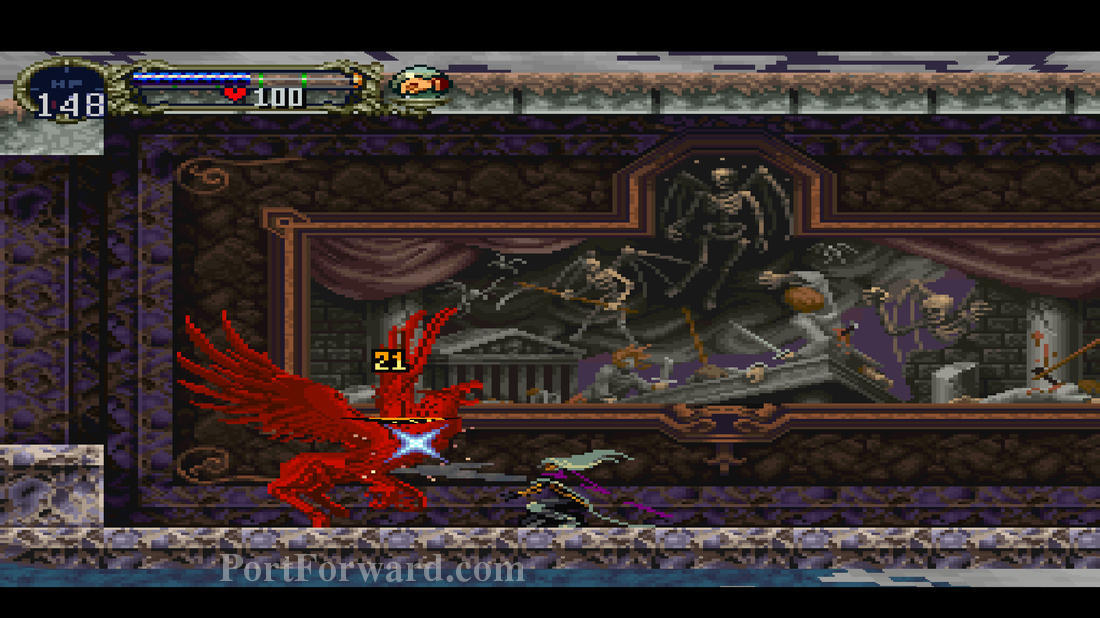
The Hippogryph tried to fly one last time.
But one wing would not follow. The torn joint turned uselessly out of place. Its body rose halfway, then fell. The lion forelegs scraped the floor, the horse’s body collapsed sideways, and the eagle’s head struck the ritual pattern. Its beak opened and closed several times, but no more sound came out.
The feathers in the room drifted slowly down.
Alucard withdrew his sword. The heat on his wrist had not cooled. As he stepped back, light rose from the Hippogryph’s body. It was a vessel-like glow of life. It lingered for a moment over the blood and shards of glass in the battle chamber, then seeped into Alucard’s body. The shock left inside his ribs loosened a little, and the pain in his shoulder dulled belatedly.
Silence came.
Within that silence, footsteps sounded.
Alucard turned his head without sheathing his sword. Maria was walking out from the passage on the right side of the chamber. Her face made it impossible to tell whether she had seen the whole battle or only its final moment. Her breathing was slightly uneven, but her eyes did not waver. Yet beneath those eyes, the fatigue of someone who had forgotten sleep had grown deeper.
“It was you.”
Maria spoke first. Her voice was low. She, too, seemed to understand that loud sounds did not survive long in this chapel.
Alucard lowered the point of his sword. “This is not a place one should come alone.”
“I had to.” Maria looked once at the fallen Hippogryph, then back at him. “I thought you might have sensed something. Some trace of Richter.”
At that name, the air in the room grew a little colder. One feather was still falling. Alucard watched it touch the floor before he spoke.
“I have not seen him yet.”
The light in Maria’s eyes went out for a moment. Too quickly. It was not quite despair, but the shape of a breath long held being forced back down the throat.
“Then you know nothing yet.”
“Do not speak that name lightly.”
Maria’s words stopped.
Alucard looked at her. The words had to be brief. If made long, a warning would become an excuse. What had not yet been confirmed could not be spoken as fact.
“The Belmont name does not remain silent for long inside this castle. If you have followed that name here, then be careful.”
Maria took one step back. Her heel stepped on a shard of broken glass. It cracked softly. She seemed not to hear it.
“Richter is not dangerous.”
Alucard did not answer.
“If he has become dangerous, then this castle must be the reason.” Maria’s voice trembled a little. But even inside that tremor, stubbornness remained. “If it is Richter… he would not vanish without cause.”
She glared at Alucard. It was less anger than a face barely held together by anger. A person who believes in someone grows more violent not when that belief breaks, but when told it might break. Alucard knew that. It had been so long ago too, when love by another name and hatred by another name collided within the same castle.
“I do not pass judgment on what I have not yet seen.”
“Then I have to find him.” Maria murmured the words almost to herself. “There must be a trace somewhere. If it is Richter… if it is him.”
She asked no more. As though afraid that asking would make the answer clearer, she turned her head. But her steps were not those of someone fleeing. They were the steps of someone preparing to go deeper.
“I have to go.”
“It is dangerous alone.”
Maria stopped for a moment. With only her back visible, she said, “Searching for him was dangerous from the beginning.”
After those words, she vanished into the passage almost at a run. Her footsteps faded quickly, and the chapel’s long structure bent and returned the sound several times. The last footstep mixed with the bell’s echo and disappeared.
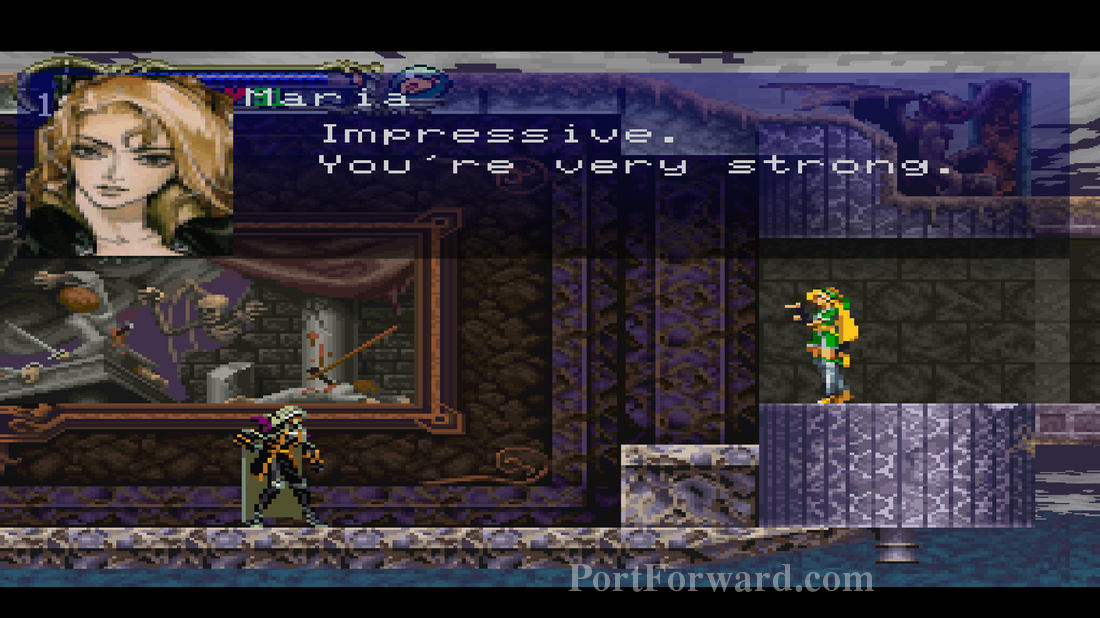
Alucard did not move for a while.
The fallen Hippogryph’s eyes had already lost their light. But the gaze Maria had left behind remained longer in the room. Eyes that denied the impossible. Eyes that could not yet accept the name of someone dear as the name of danger. Cutting through such eyes was harder than cutting down any monster.
He slowly sheathed his sword.
The passage on the right led toward the Castle Keep. As the incense scent of the Royal Chapel receded behind him, the cold night air grew stronger again. The corridor was broad and long, and crimson carpets hung along the walls like old blood. Suits of armor stood here and there, but not all of them moved. The fact that moving things were mixed among unmoving ones made it worse.
The first Axe Knight raised its axe without a word.
Alucard stopped and measured the distance. The axe was heavy and large. Before it came down, the shoulder would move first. But it could also be thrown. He did not move too close. The moment the knight hurled the axe, Alucard ducked low beneath it and passed forward, cutting into the side before the recovery motion began. Black air leaked from within the armor.
At the end of the corridor were moving platforms. Stone plates slowly rose and fell. Between them, small riders descended on insectlike mounts. The wingbeat of the Flea Riders was neither hymn nor bird flight. It resembled the rapid shaking of a wet leather pouch. They did not come from the front. They dropped from above, rose again, and tried to force Alucard into the gaps between platforms.
He saved the hand axe.
Here, a thrown axe might not return. The darkness below was deep, and the platforms were not constant. He cut only with the Gladius. He lowered his body while a platform rose and leapt when it descended. The second jump had already become familiar to his body, but these distances demanded a higher rhythm. When a platform reached its highest point, and he pushed himself once more in the air, his fingers reached the next ledge.
Once, he was late.
A Flea Rider dropped from the upper left and struck his shoulder. Its small spearpoint dug into the gap of his breastplate. Alucard drew in a short breath and tore the enemy away. The small body thrashed. He threw it against the wall. With a wet sound, its wings split.
He climbed onto the ledge.
The high chamber of the Castle Keep opened upward in a way unlike the Royal Chapel. If the chapel’s height belonged to prayer and fear, this height belonged to power. Pillars made for looking down, stairs that made distant figures seem small, a crimson carpet drawing the eye upward. Yet what Alucard sought now was not a throne.
At the far left, on a high pedestal, a small light rested.
At first it looked like a jewel. When he came closer, he saw it was a stone. But not dead stone. A stone with a very slow pulse inside it. The Leap Stone hovered quietly above the pedestal. It was small enough to hold in one hand, and its color lay somewhere between night sky and tarnished silver. No feather or wing was carved into its surface. Instead, fine lines of unknowable depth folded once more inside the stone.
Alucard reached out.
The moment the stone touched his palm, the world beneath his feet vanished for the briefest instant.
It was not the feeling of falling, but the feeling that falling could not fully claim him. His body had already learned how to push itself upward once more in the air, yet now that force gained a clearer name and form. Until then, it had felt like stepping on an interval the castle permitted. Now it felt as if the air itself formed a foothold for an instant. Not bone and muscle, but will descended to the toes and surged upward again.
Alucard opened his eyes.
Below was unchanged. The platforms moved, and the wingbeats of Flea Riders sounded again in the distance. But the height of the room had changed. The ceiling had not lowered. His body had gained one more answer to the upward path.
He stepped down from the pedestal and went to the nearest ledge.
A height he could not have reached before. He jumped. At the peak, he pushed himself again. This time there was no wavering. Beneath his feet, an invisible stone appeared for an instant and vanished, and his body rose half a beat higher. His fingertips passed over the ledge. Alucard climbed up without sound.
Beyond the crimson carpet, the air of the higher castle waited for him.
But beneath that air, another smell was mixed in. It was not the incense of the chapel, nor the wind of the outer wall. Damp stone, deep water, the fishlike breath of a long-sealed underground place. Somewhere below, water seemed to strike stone in falling drops. It was so distant he could not tell whether it was real or memory.
Alucard turned back toward the Royal Chapel.
The path where Maria had disappeared could not be seen. Only the darkness in that direction seemed a little deeper. She would search for Richter. Carrying belief with her, not yet accepting that belief might become a wound.
Alucard looked down once at the scorched red cloth at the end of his cloak. The place burned by the Hippogryph’s fire had dried black. He did not tear it away. Inside the castle, remaining traces sometimes become the weight of the next judgment.
He stood at the edge of the high ledge.
Below, the descending path and the ascending path could both be seen. The newly acquired stone lay quiet within his garment, and his body still remembered its pulse. Heights that had been closed would now become roads one by one. But to gain the high places also meant seeing the entrances to deeper ones.
Far away, water struck stone once.
A very low, cold sound.
댓글
댓글 쓰기