[OutRun Novel Episode 7] Where Only the Music Remains
Where Only the Music Remains
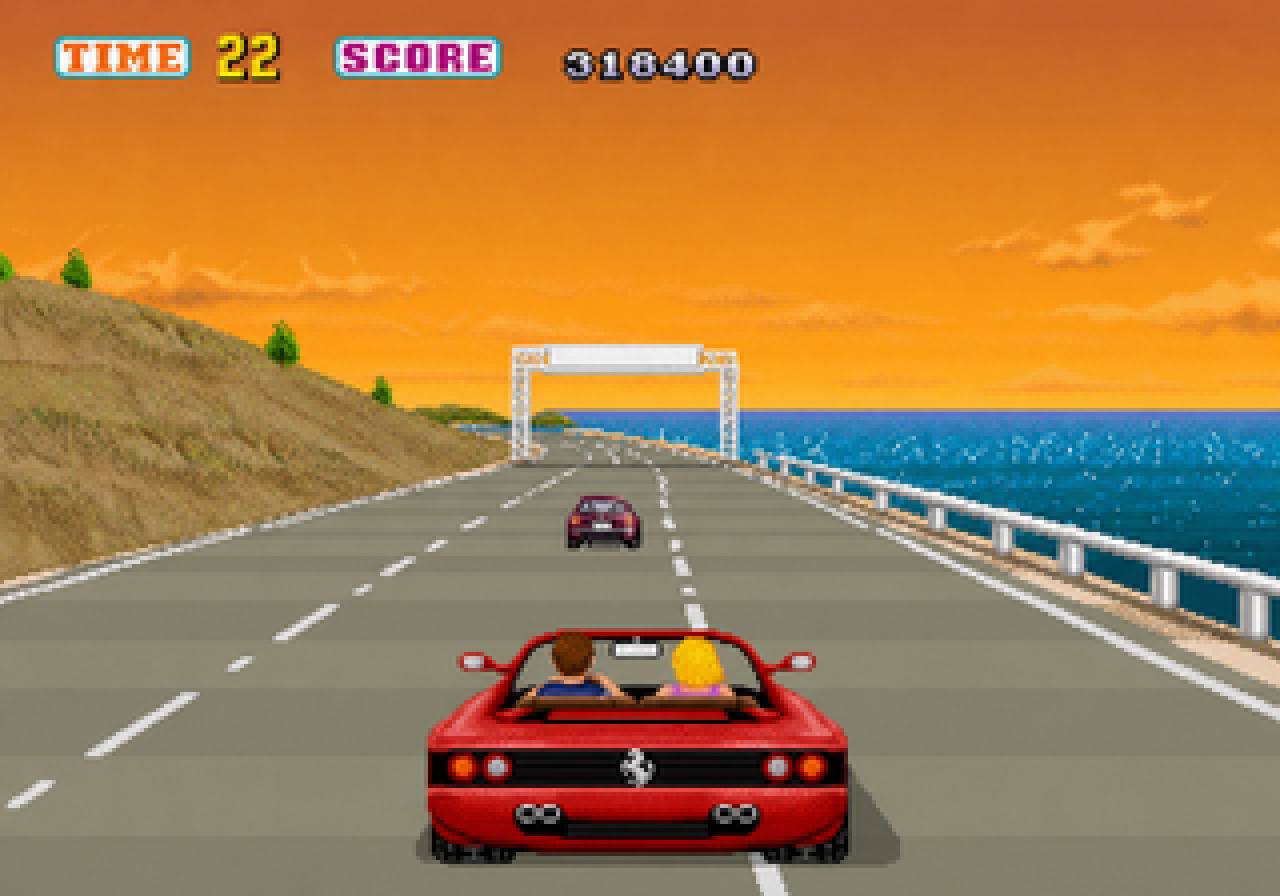
From a distance, the checkpoint gate always seems late. You feel as if you're almost there, yet those two pillars refuse to grow any larger. Other things arrive first: the long shadow laid across the road, the face of a sign flashing once at the bottom of the downhill and disappearing, the thin metallic ring of the melody filling the car. The wind was already carrying the smell of the destination, but at his fingertips there was still only the faint tremor in the steering wheel.
The numbers on the dashboard were ticking down. It was enough. Not barely enough, either - by now it was nearly certain. And somehow that certainty did nothing to lighten his foot. He kept the accelerator in that in-between place, neither pressing harder nor letting up, holding it there for a long time. The red car gave a low murmur, like an animal catching its breath.
The woman in the passenger seat was looking straight ahead. The sea had dropped below the level of the road now, showing itself only in thin slivers between the trees and the guardrail. Until a moment ago, time had been the problem. Now the strange fact that they had some to spare made the space between them go quiet.
"Looks like we'll make it now."
She said it first.
It could have been relief. It could have been a check for confirmation.
He didn't answer right away. The grain of light across the windshield shifted once. The road bent just slightly, and at last the checkpoint gate took on a clear shape: white pillars, a sign connecting them above, and beneath it the invisible layers of wind left behind by all the cars that had passed through before. Once they crossed under it, the numbers would come back to life. The road would continue without breaking. That was how the rules always worked.
She glanced over at him.
"What's wrong?"
"Nothing."
"That face doesn't look like nothing."
He didn't smile. He only rubbed the leather of the steering wheel once with his right thumb, over the smooth patch worn down by long use. The music was moving into the chorus. To someone hearing it for the first time, it might have sounded light, even cheerful, but if you listened to it for long enough on the same stretch of road, there was something in it that tugged backward. At the end of each phrase came the briefest hesitation before the next one arrived. The car kept going forward, but the music seemed to glance behind itself.
There was a small car in the lane ahead. It wasn't slow, exactly, but it was definitely slower than they were. The opposite lane was clear. He could pass. Under ordinary circumstances, he wouldn't even have needed to think about it. He eased a little toward the center line - then brought the car back.
The woman must have felt the movement, because she said,
"You can go by."
"Yeah."
"But you're not."
"Don't need to."
This time she didn't reply. Instead she slowly curled and uncurled the fingers resting on the window frame. Sunlight brushed across the back of her hand. The closer they got to arrival, the more her attention drifted away from the scenery outside and toward the things inside the car: the way his wrist bent when he shifted gears, the line of his jaw tightening for a moment in a curve, the tiny pocket of silence before the music changed tracks. Those things didn't rush past the way the road did.
Tucking in behind the small car lowered their pace by a shade. The sound of the wind changed. So did the engine note, the motion of her hair, everything. As one layer of strain peeled away - the strain that had been pushing them downhill without pause - the world around them somehow came into sharper focus. Off to the right, below the road, water opened wide under the late sun. On the slope to the left, dry grasses bent and shivered. Far ahead, beyond the checkpoint, the marker for the next section floated faintly in view. There was still road left to take.
She parted her lips, then closed them again. Knowing how hard it was to bring back a sentence once it had passed, she said it anyway.
"When I asked you to slow down a little..."
"Yeah."
"It wasn't just because I was scared."
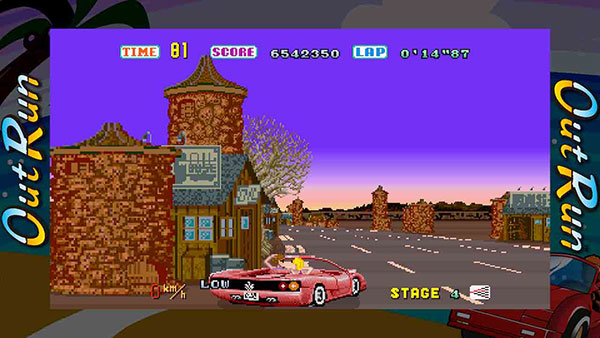
This time he didn't look at her immediately. Instead he watched the car ahead drift very slightly left and opened the distance a little more.
"I know."
"You do?"
"You didn't have the face of someone who was only scared."
She let out a small breath.
It was hard to tell whether it was a laugh or a sigh.
"Then why did you keep driving like that?"
The question was gentle, but everything that had been held back until now was inside it. To avoid being late. To avoid missing something. Or maybe just because he couldn't stand hearing the word late. Instead of searching for an answer, he dropped down a gear. The engine rose for a moment, then settled again.
"I thought if I stopped, it would be over."
"Who said that?"
"I don't even know."
After that, she went quiet for a while. The wind lifted the ends of her hair and let them fall. The checkpoint gate was close now, close enough that one more push would get them there in no time. Even so, he stayed behind the smaller car. Not the slowness of someone gritting his teeth and resisting impatience, but the slowness of someone choosing his speed for the first time.
Then the car ahead peeled off to the right, and the road opened.
No one was blocking them now. The opposite lane was empty. A short, straight stretch remained between them and the gate. It was exactly the kind of finish the red car did best. The music was entering the last part of the chorus. One more repetition, and they'd probably already be through.
She said,
"Your call."
It didn't sound like permission. It didn't sound like a test, either. It was simply the choice, returned to him. On this road, right now, what came first for him: the numbers, the passing time, or something else entirely.
He stepped on the accelerator.
The car leapt forward. The engine shed its low voice and climbed into something bright and sharp. The wind rushed deeper into the cabin in an instant. Her shoulders tipped back. The checkpoint gate swelled fast in the windshield. The hesitation of a moment ago suddenly seemed absurdly brief.
And then, right in front of the gate, he stopped accelerating.
He didn't slam the brakes. He just didn't ask for any more. The car was still fast, but he refused that final scrap of excess. Not the fastest possible crossing - almost as if he were choosing the longest possible last moment. The gate filled the windshield, then in an instant passed overhead.
The shadows of the pillars swept once across the body of the car.
The numbers came alive again. Time stretched back out. A tiny electronic chime skimmed through the cabin like an old promise.
She laughed before she knew she was doing it. Whether from relief, disbelief, or both, she couldn't have said.
"So we made it after all."
He nodded.
"Yeah."
"But why'd you do that at the end?"
This time he thought for a moment before answering.
"If you finish too perfectly, it feels like it's really over."
She didn't repeat it back to him. She just looked ahead again. The road beyond the checkpoint resembled the last section and yet had already put on a different face. It was preparing to split again. Even from a distance, the signs hinted at two different directions. One side looked brighter, wider. The other entered shadow first. They weren't close enough to choose yet, but the air of the two roads was already different.
He let the speed rise a little, then leveled it off again. There was plenty of time now. Really plenty. And somehow that made the choice harder, not easier, because now the numbers weren't forcing it.
The music was heading toward its end. When a familiar melody enters its final repetition, you hear it differently - more sharply than you did at the beginning. Even if you know the song by heart, there's always something you only catch at the end: a thin keyboard line tucked behind everything else, a drum coming in a beat late, a connecting tone so brief you missed it the first time. For a while they said nothing, just listened to that ending.
She placed a hand on the dashboard. Her fingertips moved with the rhythm for a second, then stopped.
"You said it at the start," she said.
"Said what?"
"That the road doesn't really begin until after you've chosen the music."
He moved one shoulder slightly.
It could have been agreement. It could have been embarrassment.
"I did."
"I think I get it now. A little."
He didn't smile, but the corner of his mouth loosened a fraction.
"Only a little?"
"A little more than a little."
"And how much is that?"
"Enough that I'll still be hearing it for a while after I get out."
A brief silence followed, and he couldn't brush it away lightly. After I get out. The words summoned the time after arrival before they had even arrived. They were still driving together, and yet she was already speaking about the air after she was no longer in the car. A destination never ends with arrival alone. You pass the gate, slow down, come to a stop, take your hands off the wheel, turn the music off - or turn it way down - and then something remains. He had never been in the habit of thinking about that part. It was always the next gate, the next branch, the next section first.
"Once you get out," he said, "you won't hear the music anymore."
"Something stays anyway."
He didn't answer.
The road was gradually leaning toward the next fork. The colors of the signs sharpened. Direction arrows cast long shadows over the pavement. Either way, the road would continue. Only the scenery would change. That difference was almost the whole trip.
She asked,
"This time, do you want to choose first, or should I?"
"You."
"Why?"
"Because before, you told me to decide."
She laughed softly. The sound blurred into the wind almost at once.
"Then the one where we get the sea a little longer."
He looked back at the sign. There wasn't much distance left to make the call. The right side opened into more light. The left dipped under the trees. Which road would keep the sea beside them longer - he knew almost by instinct. All those accumulated landscapes had taught his sense of direction before his hands ever had.
The car changed lanes smoothly.
The dividing line of the fork vanished beneath the tires.
She said nothing, just looked out the window. Sometimes a choice is more precise than words. He had chosen her road, and she didn't need him to confirm it. Instead she turned her face slightly toward the wind. Her hair swept back, exposing one ear. That small movement spoke of a crossing more clearly than the gate they had just passed.
The music ended.
A short silence settled inside the car. Only the engine, the wind, and the fine vibration of the road coming up through the tires remained. He could have reached out and skipped to the next track. Just like at the beginning, he could have chosen another one and kept the road going that way.
But he didn't touch it.
The silence lasted longer than expected. It wasn't empty silence. It was the kind that leaves what was just there suspended in sharp outline. She didn't say anything either, as if both of them felt it would be a waste to break it.
The road opened back out toward the sea. Far off, the late light on the water shone like a sheet of thin metal. Guardrails passed in steady intervals. Palm shadows crossed the asphalt. The red car no longer looked like something being chased. But it wasn't stopped, either. It was simply moving at its own speed.
On impulse, he looked not at the gauges but at the reflection of her hand below the windshield. Her fingers, resting on the dashboard, were no longer keeping time. Even so, he could still see the beat of the song that had just ended in the tips of them. Sometimes what is gone remains more vividly in front of your eyes.
A little later, she said very softly,
"The next song..."
Without looking at her, he asked,
"Yeah?"
"Let's wait a bit."
Instead of answering, he nodded.
The car kept going along the road they had chosen. Behind them, the gate they had just passed was already gone from sight. Ahead, there was still a light that had no name yet. For a while the sea ran beside the road, and the wind moved in and out of the car without rest. In the place where the music had stopped, strangely, nothing felt lacking.
The red car carried that silence with it and kept driving, unchanged, until the next sign came close enough to read.
댓글
댓글 쓰기