OutRun at 40: Sega’s blue-sky arcade hit sold the drive, not the race
It’s a car game that asks you to pick the music before you even leave the line.
That can sound unremarkable now. But in a 1986 arcade, for a sit-down driving machine to greet players not with “How fast can you finish?” but with “What do you want to listen to on the road?” was a strange little signal. OutRun was already steering away from the usual racing-game lane.
It is fast, of course. The time limit is strict, traffic pops up more often than you remember, and one bad angle into a corner can shove you straight onto the shoulder. Yet the game never feels harsh in the way arcade racers often do. The sky opens wide in a wash of blue. The road keeps splitting between sea, palms, and rolling hills. More than the thrill of beating somebody, OutRun gives you the feeling of going somewhere on a perfect day. Calling it just “an old racing game” undersells what it was doing.
2026 marks 40 years since OutRun first appeared. The exact start of its arcade run varies a bit depending on the source, but the broad outline—Sega arcade release, September 1986—shows up in Sega’s own materials and in period flyers. Sega developed and published it, with Yu Suzuki as the central figure. That’s the kind of information that fits neatly on a timeline. But the reason the game lasted has more to do with its first impression than its chronology.
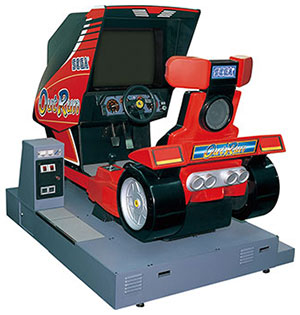
This car isn’t looking that hard at the finish line
OutRun has checkpoints, time-over screens, and crashes. If you can’t hold the road, you won’t make it to the end. It is as unsentimental as any arcade game in that sense. But what the player feels as the goal is subtly different. It’s less “I need to take first” than “I want this drive to keep going a little longer.”
Sega’s official page describes OutRun as the original “driving game.” It sounds like a bit of branding, but the distinction matters. In a racing game, the center of gravity is competition: position, overtaking, winning, losing. In OutRun, the center is the scenery. The road forks. Music plays. A red open-top sports car is pulled deeper and deeper into the screen.
That difference changes the whole mood. The cars ahead are less rivals than moving obstacles that break your rhythm. The route splits feel less like strategy than the tactile pleasure of choosing a destination. You still have to take corners well to survive, but every bend is really about the next view, not the leaderboard. That’s OutRun’s peculiar kind of ease. You are hurrying, but it feels leisurely.
The hand that picks the music
You can’t really talk about OutRun without talking about its music. The three BGM tracks you choose from at the start are not just menu options. They are the moment where you decide what kind of drive this will be.
It looks like a small flourish, but within the grammar of 1980s arcade design it was remarkably elegant. A lot of games shoved the player forward the instant the coin dropped: enemies, bullets, countdowns. OutRun pauses for a breath. It lets you pretend you’re choosing a radio station, and in doing so gives you the pleasant illusion that this road belongs to you.
That is part of why Hiroshi Kawaguchi—Hiro—has remained so closely associated with the game. A track like Magical Sound Shower is not just decoration laid over the action. It pushes the sensation of speed by other means. The buoyant holiday air that engine noise alone can’t create, the music opens that up first. It’s no accident Sega later treated the soundtrack as its own subject with SEGA AGES OutRun -Music Collection-. In OutRun, the music was never an extra. It was part of how the game lodged itself in memory.
The arithmetic behind the motion cabinet
For all its romantic glow, OutRun was not made naively. If anything, it feels like a game built by people who understood the arcade as a business with unusual clarity.
That becomes clearer if you look at Sega’s line of motion and “taikan” games around Yu Suzuki: Hang-On, Space Harrier, then OutRun. This was a period when Sega was pushing games that hit the body before the brain had time to catch up. The cabinet moved, the screen rushed toward you, and the player felt not just in control of a machine but physically aboard it. OutRun’s large cabinet made that sensation legible even from the arcade entrance.
What’s interesting is the calculation inside that fantasy. In a 4Gamer interview, Suzuki speaks quite specifically about arcade operating targets of the time: goals like 200 plays a day, average play length, turnover. Even while selling a dreamy coastal drive, the game still had to be engineered around the cold realities of coins in and coins out.
That is why OutRun does not try to hold you forever. A single run is short, failure comes quickly, and the game leaves behind just enough regret to make another credit feel reasonable. It’s a fine balance. You feel as if one slightly better run might reveal the next stretch of scenery, and the song you picked is still hanging in your ears. As an arcade design, it is extremely smart.
Fifteen courses, and the feeling of a trip
According to Sega’s official materials, OutRun is built from 15 courses and 16 possible routes. On paper that sounds like strategy-guide trivia, but its real meaning is a little different. The branching structure is not there simply to make you hunt for the optimal path. It’s there to leave you with a lighter, more tempting thought: maybe next time I’ll take the other road.
In arcade games of the period, repeat play was nearly a condition of survival. A game people sampled once and abandoned could not keep a cabinet busy for long. OutRun did not rely on making players memorize the same road forever. Instead, it left them with the sense that there were still landscapes they hadn’t seen. The multiple final destinations fit that idea perfectly. You are not so much conquering an ending as changing your route and going again.
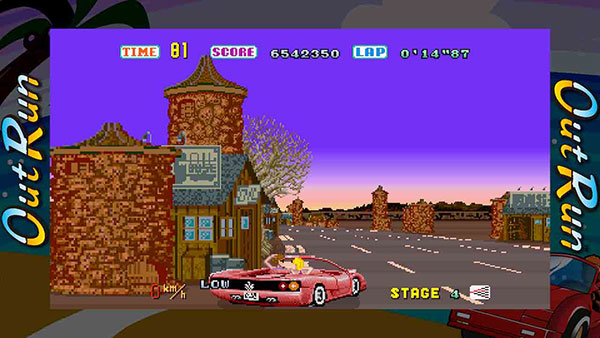
At that point, OutRun starts to connect quietly to later driving games. The idea that a car game can work without centering rank and rivalry. The idea that roads, music, weather, and scenery can be enough to keep a player moving. Today that sensibility is familiar in open-world racers and more scenic driving games, but in a 1986 arcade it must have felt much sharper. The screen was simple; the game’s ambitions were already headed somewhere larger.
Super Scaler and the speed of blue
The technical side deserves at least a little space too. OutRun is often cited as one of Sega’s signature Super Scaler games. Before the true 3D polygon era, it created the illusion of motion by rapidly enlarging and shrinking sprites, making the road and scenery seem to pour toward the player.
Seen now, some of it is plainly rough. The road bends with a kind of honest simplicity. The scenery arrives in layers. The handling is nowhere near the precision of a modern driving sim. But that roughness doesn’t read only as a limitation. OutRun’s speed is convincing not because it resembles reality, but because the arcade screen exaggerates with total confidence. The sky becomes bluer, the sea feels closer, and the road opens up with more drama than real life could sustain.
It feels less like an actual drive than like stepping into a poster of one. OutRun never hides that exaggeration. In fact, exaggeration is the game’s native language.
What still remains after 40 years
Seen today, OutRun also carries obvious traces of its era. The red convertible sports car and blonde passenger are pure 1980s iconography, and so is the Japanese arcade imagination of a Western resort landscape. Not every part of it has aged gracefully.
But the core is still alive. OutRun puts the desire to drive ahead of the desire to place. It behaves as if the play has already begun the moment you choose the music, and when a short run ends, what lingers is not only failure but the small ache of a road you didn’t get to see.
That’s why OutRun feels a little too vital to leave behind museum glass. There is pleasure in revisiting the old technology, certainly, but the bigger thing it leaves you with is the sense that a car game does not have to act like a fight. Put on a good song, head under a blue sky, choose one fork in the road. OutRun turned that simple scene into something people have remembered for 40 years.
References
- SEGA AGES OutRun official page: https://archives.sega.jp/segaages/outrun/
- SEGA AGES OutRun official image: https://archives.sega.jp/segaages/outrun/img/original.jpg
- SEGA AGES OutRun official screenshot: https://archives.sega.jp/segaages/outrun/img/ss_06.jpg
- The Arcade Flyer Archive, Out Run Sega Japan 1986: https://flyers.arcade-museum.com/videogames/show/4680
- 4Gamer Yu Suzuki interview: https://www.4gamer.net/games/999/G999905/20220308098/
- Wired, How Out Run changed video games forever: https://www.wired.com/story/out-run-video-game-design
- SEGA AGES OutRun Music Collection announcement: https://archives.sega.jp/segaages/news/190207.shtml
- Out Run upright owner's manual: https://www.arcade-museum.com/manuals-videogames/O/outrun_manual.pdf
댓글
댓글 쓰기