[OutRun Novel, Episode 2] Under the Blue Sign
The blue sign looked like a piece of sky that had fallen to earth.
At first it really was hard to tell where one ended and the other began. A blue rectangle hung over the far end of the road, wavering in the sunlight, the white letters beneath it still too distant to read. He didn’t force his eyes to make them out. Try to read what’s far away, and you lose the road right in front of you. For now, the curve leading to the sign mattered more than the sign itself.
Off to the right, the sea flashed.
The road bent low between the cliff and a white guardrail. From a distance the rail looked like a soft line; up close, it became a hard boundary. Beyond it, blue light came rolling in—beautiful, and dangerous because it was beautiful. Let it steal your eyes for even a second and the car begins to drift outward. A little is enough.
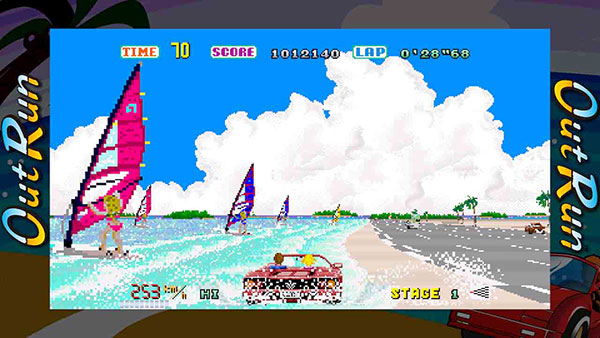
The woman in the passenger seat rested a hand on the top of the door. The bracelet on her wrist chimed once in the wind.
"You going to slow down?"
"Not yet."
"You always say that right up until it’s too late."
Instead of answering, he drew the wheel a little tighter inward. The car tucked itself closer to the inside of the curve. The tires shivered softly over the small ripples in the pavement. The music kept playing. The track he’d picked at the starting line was no longer just something filling the cabin. Every time a phrase ended, the road seemed to change with it. He couldn’t tell whether the melody was following the road, or the road was pushing the melody along.
Two cars appeared up ahead.
One sat in the left lane, the other in the right. From far off there seemed to be plenty of room between them. The closer he got, the smaller that gap became. Wind slapped at his face, and the numbers on the dash kept shrinking. They fell without emotion. The sea, the music, the silence beside him—none of it could persuade the numbers.
He didn’t look at them for long.
Watch the time and the road goes blurry. Watch the road and time drains away more coldly than before. He couldn’t hold both in view at once. He chose the road. The sign was still ahead, and the gap between those two cars existed only now.
"Now?" the woman asked.
"A little closer."
"There is no ‘a little’ out here. Either it’s there or it isn’t."
Before she finished, the car on the left gave the slightest twitch. A sliver opened between it and the car on the right—barely the width of a hand. He slipped into it. As the red body shot between them, the sky flashed past one window and the sea the other, each a different color. White light came in from the left, blue from the right, and both were gone at once.
Her hand tightened on the door.
But she didn’t scream. Strangely, he was grateful for that. On the road, some silences are sturdier than words. He carried that silence beside him as he cleared the two cars. Even then he didn’t let his breath go right away. Only after the car was fully ahead of them, only after their shadow shrank in the rearview mirror, did he ease the tension from his fingers.
"Nice," she said.
"Close."
"That’s what I mean."
"You mean you liked it."
This time she smiled a little. The wind tore the smile apart almost immediately, but he caught the pieces. When you’ve been on the road together long enough, you learn to read breathing before expressions. Even without words, he knew: she hadn’t hated the danger entirely—but that didn’t mean he had permission to do it again.
The blue sign was close enough now to give up its letters.
Checkpoint.
A simple word. Not a grand promise, not arrival. Just a place you had to pass through. And yet the nearer it came, the narrower his chest felt. Sometimes a smaller word lands heavier than the destination itself. That was how it felt now. Pass beneath it and time would stretch a little. The road wouldn’t end. Whether that was comfort or just another demand, he couldn’t tell.
The road bent hard right again.
He lifted his foot just a touch. The nose of the car dipped, then settled. The woman’s hair blew across her cheek. She caught it with one hand; the other stayed on the door. Sunlight and shadow crossed the back of that hand in turns, as if the road were sketching quick little lines over her skin.
"What comes after the sign?"
"Road."
"That’s not an answer."
"On this road, it’s the most accurate one I’ve got."
She sighed, but didn’t press.
He didn’t know for sure either. This road never told you everything in advance. From far away it looked like one clean line; up close it split in two. A lane that seemed wide enough suddenly narrowed the instant another car entered it. Signs were the same. While you were waiting for them, they looked as big as the whole sky. Once you’d passed them, they became a tiny patch of color behind you.
That thought stayed with him.
He tried not to think about the destination. He didn’t want that word inside the car yet. Arrival always brings the end of the music with it. He wasn’t ready to hear this song finish. Not before the first sign, at least.
A low yellow wall flicked by at the roadside.
A small shadow clung to it. There might have been a window, but he couldn’t see inside. A strip of cloth hanging in front fluttered in the wind. The whole scene passed too quickly to feel properly seen. And yet it sharpened after it was gone. At speed, scenery reaches the heart later than it reaches the eye.
"Did you see that?" the woman asked.
"The yellow wall?"
"So you did."
"A little."
"Does ‘a little’ count as seeing?"
He didn’t answer. Another car had appeared ahead, moving slowly—and of course it was right before the sign. It rolled heavily along the right lane. There wasn’t much road left before the checkpoint. Stay behind it on the right and he’d lose time. Move left and the end of the curve vanished from sight. The road didn’t tell him which choice to make. It only made one thing clear: do nothing, and he’d be late.
The woman spoke first.
"Left."
He was already turning the wheel.
The car moved outward. The guardrail came closer. Up close, that white line looked colder than he expected. Beyond it, the sea shone with almost unbearable beauty. He tried not to look at the light. The harder he tried, the larger it became. For a moment the music seemed to fall away, and the sound of the tires came forward.
The car shook.
Her bracelet struck the door with a quick metallic click. He pushed the wheel back inward. The red car swept past the slower one and slid under the sign. A wash of blue shadow crossed through the cabin overhead.
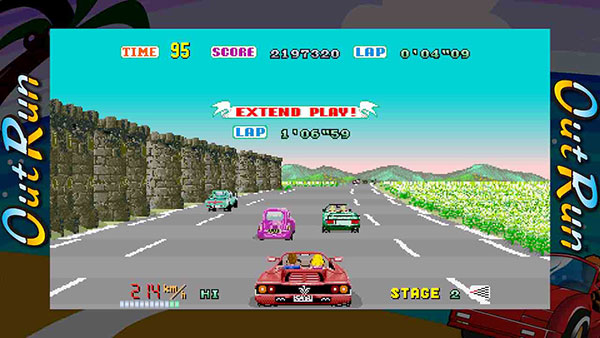
A sound rang out.
Short and bright. It sounded like a door unlocking somewhere, though there was no door in sight. The numbers on the dash seemed to catch their breath. Time, which had been draining away, ticked upward again. Oddly, the sight of it didn’t relax him. More time didn’t mean he could stop. It meant he had farther to go.
Beyond the sign, the road opened up for a moment.
It felt like a gift. The curve, the traffic, the guardrail, the numbers—everything that had been tightening around him took one step back. In that brief pocket of space, he opened his fingers, then wrapped them around the wheel again. His palms were damp. The music moved into its next phrase without a care in the world, as if it remembered none of the danger that had just passed.
The wider road didn’t last.
At first it felt like the car itself was taking a breath. The wind softened for a moment, and the sea no longer pressed close on the right but spread wider instead. The white railing along the coast dropped lower, and beyond it the blue plane of the water ran long and open. He wanted to look at it for more than a second. But on this road, looking for more than a second was almost impossible. The instant your eyes linger, the next curve arrives first.
Short black marks streaked the pavement ahead.
They looked like traces left by someone who had come through before him. He tried not to place the car over them, but he couldn’t avoid them all. When the tires crossed one of the dark lines, the body gave a tiny shake. The woman felt it and set her hand on the door again.
"The road’s rougher here than before."
"A wider road isn’t always an easier one."
"You don’t like easy roads?"
He smiled for a second.
"It’s not that I dislike them. It’s more that easy roads don’t seem to like me."
"That the road’s fault?"
"Sometimes."
"You’ve been saying ‘sometimes’ a lot."
He said nothing. Some things couldn’t really be answered: why a broader road still didn’t put him at ease, why passing the sign left him feeling as if he’d missed something, why more time made his body feel even more hurried. The moment you try to explain those things, they go flat. So he simply kept his eyes ahead.
Far off, a white ornament shaped like a bird flashed briefly above the guardrail.
Whether it was really a bird, a marker, or some roadside sculpture, he couldn’t tell. The instant it entered his vision, it was already gone behind them. The woman turned her head slightly, but by then there was nothing there.
"What was that just now?"
"Didn’t catch it."
"Guess this time I did."
"A little counts as seeing, right?"
She threw his own line back at him. He didn’t laugh, but something loosened inside his mouth. Until then the road had seemed to move only forward; with that one sentence, the scene they’d already passed slipped back into the car. Even missed scenery arrives late sometimes.
"So we passed it," she said.
"Yeah."
"You happy?"
He couldn’t answer right away.
They had crossed the checkpoint, but his mind didn’t stay there. It was already fixed farther ahead. At the end of the road, something seemed to be splitting. Not clearly yet. Sunlight and shadow overlapped in a way that made one road look like two, and he couldn’t tell if it was a trick of the light or a real fork. The right-hand road seemed to climb toward the hills. The left looked as if it would pull closer to the sea.
"Not yet," he said.
"Not yet?"
"I think I need to see the next road first."
She looked ahead when he said it. He couldn’t see her eyes behind the sunglasses, but her jaw moved just slightly. Maybe a smile, maybe tension. He didn’t try to check. If he looked over now, the fork would reach him first.
In the rearview mirror, the blue checkpoint sign was already shrinking.
A moment ago it had been everything. Now it was being pushed backward. For some reason that stung. Promises on the road always vanish like that. Before you reach them, they feel urgent. The instant you touch them, they flare bright. Then they give way to the next promise waiting ahead. That’s why people keep driving. What hasn’t arrived yet always looks larger than what already has.
The woman turned her bracelet around her wrist.
"That sign just now," she said.
"Yeah?"
"It looked bigger before we passed it than while we were passing it."
"That’s true of most things."
"The destination too?"
He let the answer wait. The moment the word destination entered the car, the music seemed to thin out. There would be one, eventually. At some point the road would end, the car would stop, the music would disappear. But that was still too far away. Or rather, it needed to be.
"For now, let’s just watch the next road."
She nodded. Whether the answer pleased her or not, he couldn’t tell. But she didn’t ask again.
He was grateful for that. On the road, some questions grow old while they’re still waiting for an answer. The moment they started talking about the destination, the guardrail, the wind, the music—all of this—might be pushed into the background. He wasn’t ready for that yet. On this road, the things that vanish are the things at the center.
The fork rushed toward them.
To the left, the sea opened wide beyond the outer edge. To the right, the road slipped between hills and gathered shadow. Both roads looked right. Both roads looked as if they would cost him something. He still hadn’t chosen. His hands were on the wheel, his foot on the accelerator. The decision was very close now, but it still remained in his hands.
The music didn’t stop.
He waited a little longer.
Strangely, the brief stretch of time just before the road split in two felt longer than the moment he had passed beneath the sign.
댓글
댓글 쓰기