Castlevania: Symphony of the Night, First Run: The Beginning
Game Story - How CD-ROM Gave the Castle Its Air
When people think of this game, they usually start with the action, the exploration, and the sheer tactile pleasure of controlling Alucard. But from a slightly different angle, the real marvel of the game is something else: the way it makes you want to stay inside the castle. Not simply because the map is large. The PlayStation CD-ROM gave the game room for voice, music, and richly textured backgrounds, and together those elements make the castle feel less like a stack of stages and more like a place you actually inhabit. Alucard is still moving through an action game, of course, but at a certain point the player’s sensation shifts from passing through to living there.
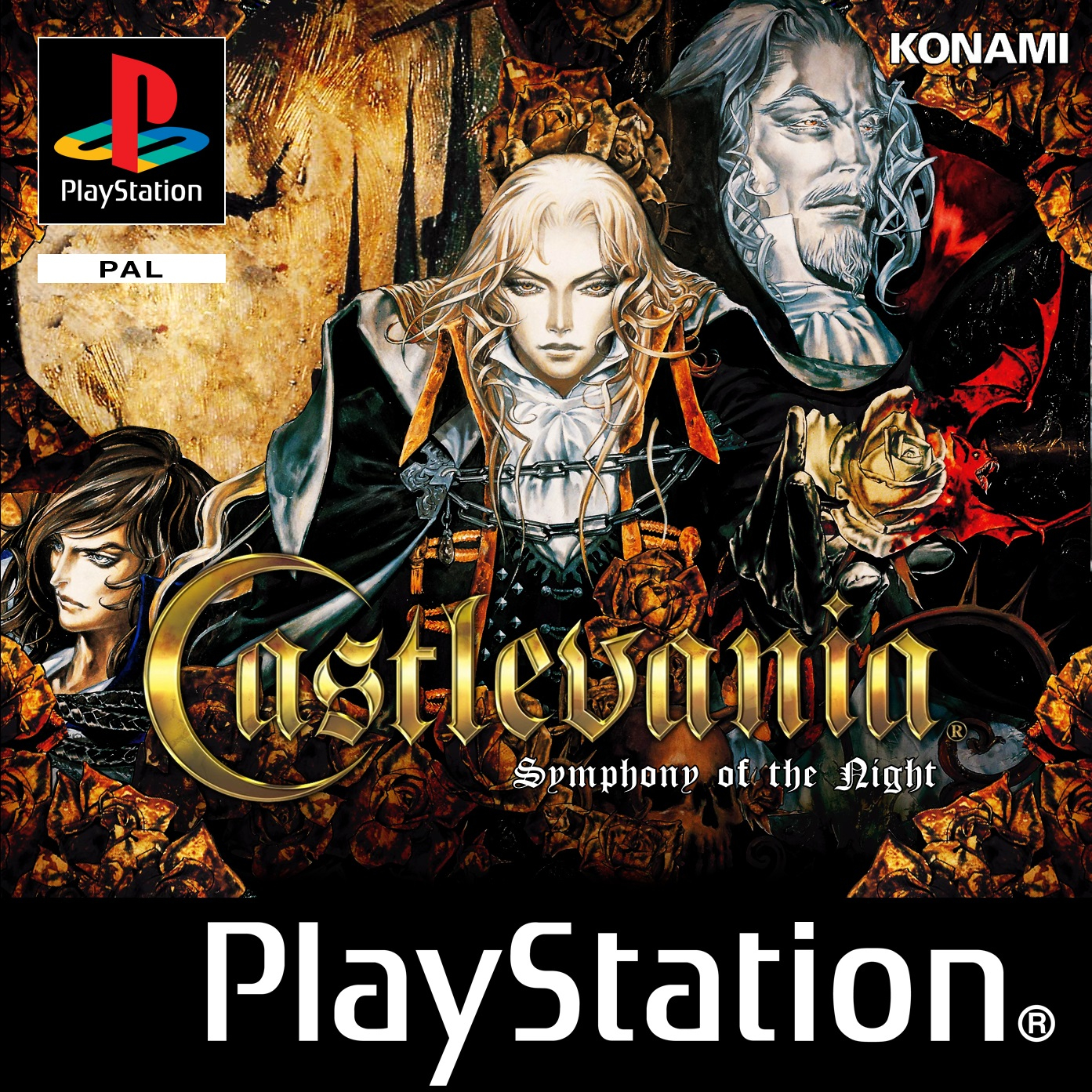
That difference starts accumulating the moment you set foot inside. In older action games, a castle was usually a backdrop for killing enemies and moving on to the next zone. Functionally, that was enough, but the way those spaces held the player was relatively simple. Here, by contrast, the rooms, corridors, and chapels all seem to carry distinct temperatures and echoes. Some spaces feel cold, some ornate, some strangely hollow. That impression does not come from map layout alone. It comes from the depth of the background layers, the way the music settles over each area, and the occasional but forceful use of voice. Together they create the illusion that the place has air in it.
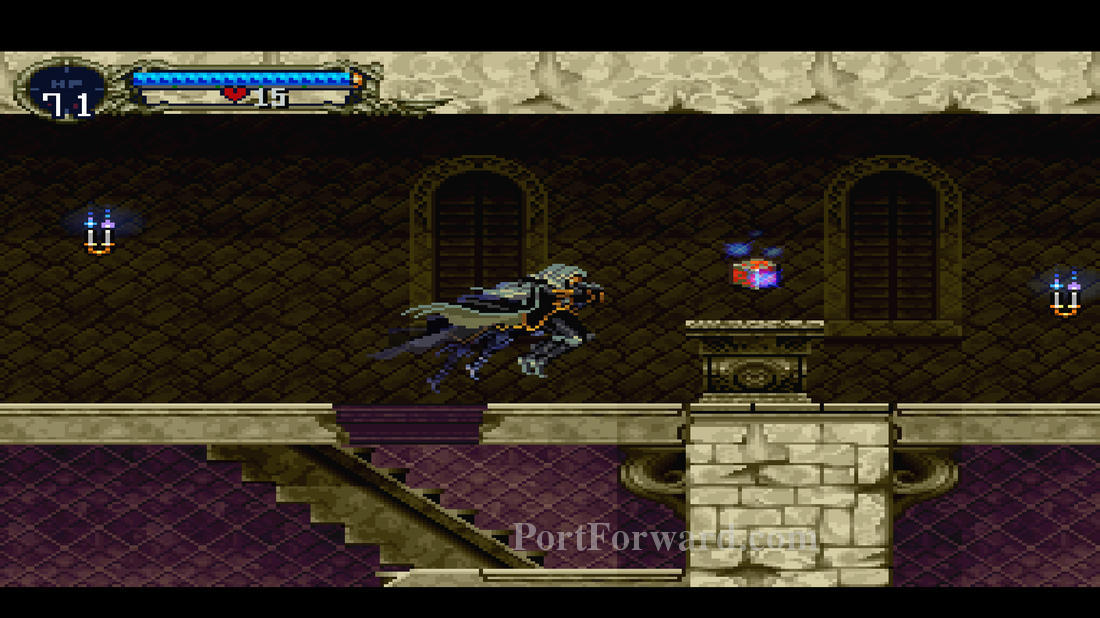
The music does especially heavy lifting. It is not just good background music; it defines the character of each space. Even while the player is busy fighting enemies and looking for the way forward, the mood of a new area arrives in the body first. The score does not leap out and demand admiration so much as it changes the material of the room itself. So even though you are wandering one castle, each region invites a different kind of stay. In some places you move with tension; in others you instinctively slow down. It is rare for an action game to use music not to drive the tempo forward, but to shape the texture of time spent lingering.
The voice work is even more interesting. There is not enough of it to explain the world in exhaustive detail. In fact, because it appears only at limited moments, it makes the castle’s overall silence feel more pronounced. The fewer words there are, the larger the stillness becomes, and when a single line drops into that stillness it lands with real weight. That is a very different sensation from the text-heavy presentation of the cartridge era. The important thing is not merely that the game has voices, but that those sparse voices widen the castle’s empty spaces. The game does not constantly explain itself. Instead, the occasional spoken line leaves behind the feeling that this is a place where someone’s history still lingers.
The background layers also deserve more than the usual praise for being pretty. In this game, the scenery gives the sense that the space continues one layer, then another, behind the platforms where the player stands. That depth does not actually expand where you can go, but it does lengthen your psychological stay. Your eyes keep finding places to rest. Distant structures, darkness beyond windows, decorative columns and walls—all of it weakens the feeling that this is merely a route to be crossed. Action games often simplify backgrounds for readability. Here, the background does the opposite: it holds the player in place. Even while searching for the path forward, your gaze keeps drifting across the surroundings.
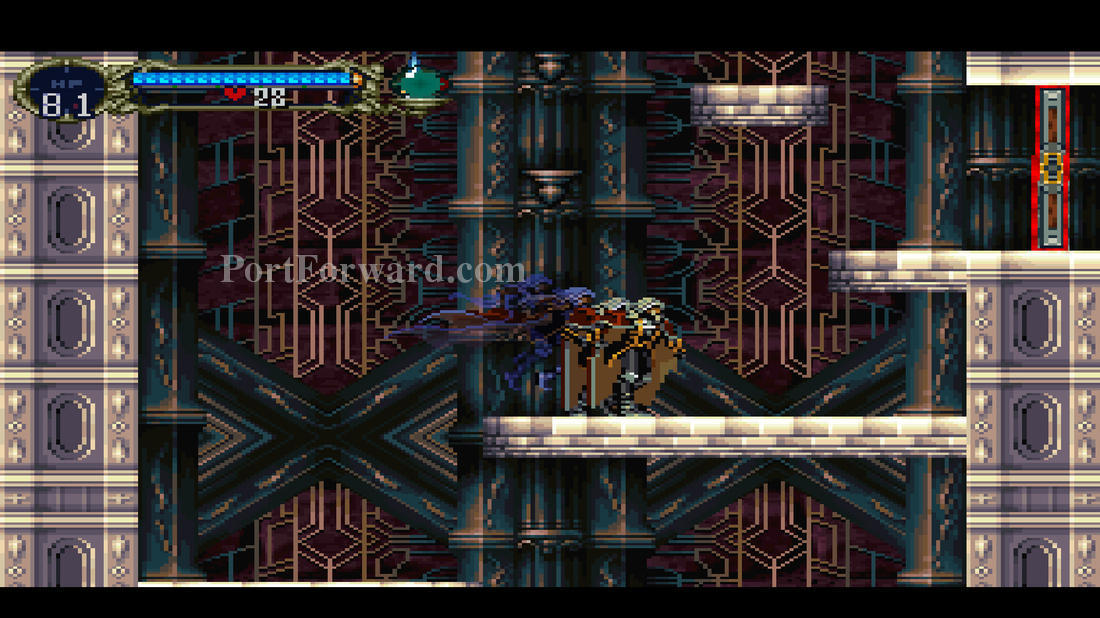
That matters because Alucard’s movement is so smooth to begin with. In most games, great movement creates a strong urge to push ahead—faster, farther, more efficiently. But this game does something strange. Its excellent controls do not accelerate your consumption of space; they help you dwell in it. You can absolutely tear through the castle with jumps, dashes, combat, and fluid traversal, yet the actual feel of play keeps nudging you toward, “Let’s stay here a little longer.” Your hands are playing an action game, but your senses are out for a walk. That mismatch is a big part of the game’s peculiar, lasting pull.
That also changes what exploration means. Usually, exploration is described as the search for hidden routes or stronger gear. Those rewards matter here too, of course. But before the reward, this game creates a simpler desire: to see the next space. And the key is that this desire comes from mood more than numbers or efficiency. The question is less “What will be in the next room?” than “What will the next room feel like?” In that sense, the player is not just conquering the castle; they are collecting its moods.
This sense of dwelling also fits perfectly with the relaxed abundance of the PlayStation CD-ROM era. The shift in storage media meant more than just greater capacity. When sound and background art gain a different grain, the way space itself is designed changes too. This game does not use that extra room simply to add more stuff. It uses it to make you stay longer. Voice is not decoration but a tool for controlling the density of silence. Music determines the mood of a place more than the excitement of battle. Backgrounds do more to justify lingering than to guide you onward. That is why the castle becomes more than a dungeon: it turns into a vast interior you can roam for hours and gradually come to know.
What is interesting is how differently that sensation lands for different kinds of players. Experienced players can immediately read optimal routes, equipment choices, and the depth of the systems. A newcomer, by contrast, may not fully understand the structure at all, yet still remember the castle’s atmosphere first. In other words, the game’s spatial direction works on a layer independent of skill. It is a game that is fun because it plays well, but also memorable simply because of what it feels like to exist inside it. Those two things do not coincide as often as you might think.
In the end, the castle here feels less like a backdrop than a housemate. The player defeats enemies, opens routes, and raises stats, but every part of that process unfolds in constant contact with the castle’s air. That is why the memories that remain after hours of play are not just boss strategies. A corridor’s music, the color of a room, the resonance of a voice heard somewhere in the distance—those details stay strangely vivid. It is a story about Alucard crossing the castle, yes, but at the same time it becomes an experience of the player briefly living inside it.
Play Story - Movement, Return, and What Stays in the Hands
Combat is inseparable from that movement. The player keeps deciding whether to pass an enemy, stop for equipment and experience, or push toward a save room with health running low. The memory of play therefore rests less on how beautiful a room looked than on the speed, risk, and condition in which it was crossed.
A ledge that cannot be crossed and a sealed passage read differently after a new ability is acquired. That is why many players remember revisiting the castle as more than repetition. The hands are faster than before, the inventory holds more choices, and a place that once behaved like a wall can become a shortcut.
The play feel becomes clearest not when Alucard lands a hit, but in the rhythm of moving, stopping, and returning. His jump feels light, while the backdash is far quicker than an ordinary retreat. In a short corridor it avoids an attack; in a long passage it becomes part of the movement cadence itself. The distance between the player’s hand and Alucard on the screen seems to shrink with every room.
Fiction - The Last Stair Remembered by Blood
Glass broke somewhere above the staircase.
Richter Belmont did not look up. A heart dropped from a red candle, struck the stone twice, and dissolved into his gloved hand. The leather made a wet sound when he closed his fingers. He could no longer tell whether it came from rain or from the sweat worked into the handle of his whip. Far above, flames leaned in one direction although there was no wind. Toward the throne room.
He took the remaining stairs three at a time. Each fall of his heel sent a low note through the castle. Beyond the black windows, clouds swallowed the moon and released it again. In those brief exposures, the carved beasts on the pillars appeared one by one. Richter pretended not to look and saw them all. The Belmonts did not trust darkness. They trusted the habits darkness repeated.
The final door was unlocked. When he pushed it open, the cold inside touched the back of his hand first.
Dracula sat on the throne without leaning against it or gripping its arms. His ease made the waiting unmistakable. His face beneath the black hair was corpse-pale. One finger tapped the edge of the throne in a slow measure. Three times. A pause. Three again.
“What have you come this far to save?” His voice did not echo. It arrived from every wall at once, as though the room had known it before he spoke.
Richter threw his wet cloak behind one shoulder. “I did not come to save anything.” The chain of the whip scraped the floor as he freed it. “I came to finish this.”
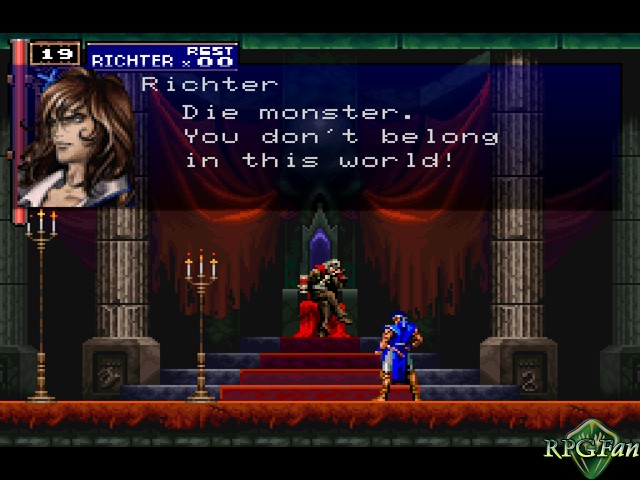
Dracula's mouth moved by the smallest degree. He spoke of humans as prisoners of appetite, creatures who injured one another and eventually called him back. Richter knew the elegance of that excuse. Monsters described human ugliness with perfect accuracy so their own ugliness could masquerade as fate.
“People choose,” Richter said. “If men called you back, men can put you down again.”
The throne was empty.
Richter turned before thought could catch him. Air folded behind his back. Three blue flames opened above Dracula's fingertips. The first split against the whip. The second passed over Richter's lowered head. The third came low. He folded one knee, slid beneath it, and carried the force of rising into his shoulder.
The whip crossed Dracula's chest. No flesh tore. Only the black cloak moved like water, and the Count vanished again.
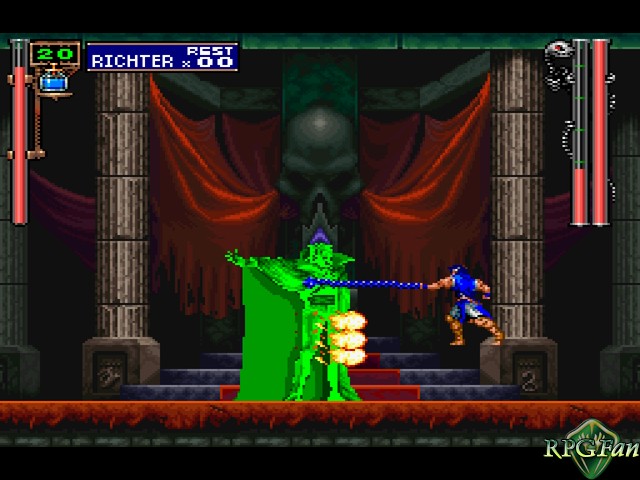
Right pillar. Left of the throne. Right again.
There was a habit in the teleportation. Dracula pretended to choose the point farthest from Richter's gaze, yet always left the same distance: one and a half lengths of the whip. Close enough to mock, close enough to watch the prey's face after it believed the fire had missed. By the third exchange Richter no longer measured. His heel changed direction first. The whip reached the place where Dracula would appear one beat before he did.
The metal tip struck empty air. Then the black body formed around it.
For the first time, the amusement left Dracula's eyes.
The flames returned. Richter did not retreat. A short turn of the wrist broke the first. The returning chain caught the second. Hot fragments crossed his cheek. When the third came for his chest, he threw himself backward. His shoulders never touched the floor. His legs described a circle over his head, and the instant his boots found stone again, the whip rose from below.
The darkness before the throne tore open.
Dracula's human shape fell to one knee, but it was the shape rather than the body that collapsed. Bone grew beneath the cloak. Shoulders widened to the breadth of pillars. Fingers lengthened into claws that scored the floor. The face split upward and became a vast mouth. Every candle beside the throne went out at once.
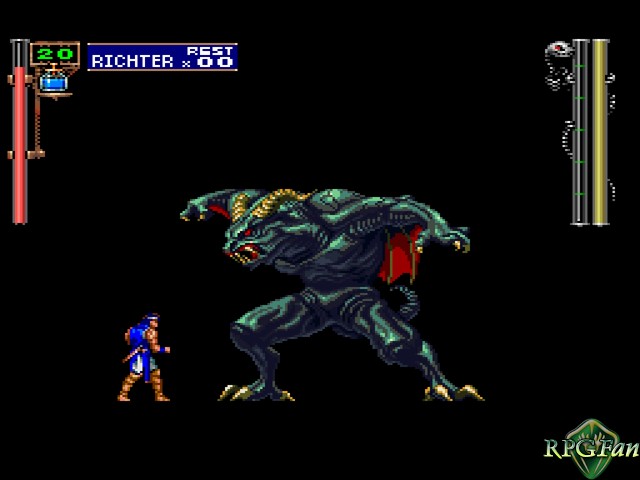
Richter reset his grip. The skin of his palm had already opened. Blood followed the grooves and gathered between the sacred marks. Red light swelled inside the creature's throat.
He did not run. He watched the light climb from throat to mouth. One. Two. Just before release, the enormous head drew back by a fraction. Richter moved then. Fire consumed the place where he had stood and softened the stone beneath it.
The beast raised one forelimb. Each impact tilted the throne room. Richter did not brace against the shaking; he traveled with it. Once he slipped beneath the claws and struck behind the knee. Once he ducked close and looped the whip beneath the jaw. When the monster lifted its head, he released rather than pulled. The chain peeled free across the flesh, and he opened the distance again.
Dracula raged in patterns. The more wounds he took, the larger his attacks became, and the larger they became, the more clearly they announced themselves. Fire required a breath. A leap began with the right claw sliding half an inch backward. Richter watched the half inch, not the strength behind it.
The final fireball filled the room with red. Richter turned the whip in a circle. Light gathered around the chain in overlapping traces of a cross. It burst an instant before the fire arrived.
The center of the beast's chest opened. There was no blood inside, no organ—only a black cavity, like a whole night compressed into one wound. Richter ran toward it. A claw crossed his shoulder and tore the cloak. He did not stop. One step deeper, both hands on the handle, his whole body turning.
The end of the chain entered the heart of the dark.
Dracula's scream began as one voice and ended as hundreds. The carved beasts on the pillars opened their mouths with him. Windows burst outward. As the enormous body collapsed into ash, a human face surfaced inside it for a moment—without anger, without mockery, the expression of someone who had remained awake too long and had finally reached the instant before sleep.
Richter did not lower the whip until the last of the ash touched the floor.
The first stone fell behind the throne.
A crack traveled from ceiling to pillar. The castle did not mourn its master. It shook like an animal whose heart had been removed, uncertain which part should fail first. Richter looked toward the dawn entering through the broken windows. His hand was still bleeding. Beyond the iron smell of the chain came the clean air left after rain.
He turned away. Dust had already begun to cover the descending stairs.
In the ash behind him, one small ember curled red and refused to go out.
댓글
댓글 쓰기