[Chrono Trigger Novel - Episode 9] When Kindness Becomes Evidence
The sounds of the festival followed them far up the road to Guardia Castle.
As the sun sank beyond the forest, the bells and songs from Leene Square broke into scattered fragments among the leaves. Each time the noise reached them, the guards walking on either side of Crono adjusted their grips on their spears. To them, it was still a festival day, and the boy in iron shackles was the criminal who had ruined it.

Marle kept protesting from behind the escort.
“I was the one who asked him to come with me. Crono didn't even know my name, let alone who I was.”
The knight at the head of the column gave no answer. It was the silence of a man who could not be rude to a princess but had no intention of disobeying his orders.
Once they passed through the castle gates, the three companions were separated.
Marle was ushered toward the central staircase with such force that it amounted to being dragged away. Lucca was stopped in the entrance hall because she had no standing at court. Crono walked with his head turned until both of them disappeared from view. The last things he saw were Marle wrenching her arm from a soldier's grasp and Lucca studying the upper walls as if she were counting the castle windows.
“Face forward.”
The guard behind him pulled the chain between his cuffs.
Crono turned. The rough iron chafed against the bandage on his palm, sending a sharp sting through his hand.
The room they put him in had no windows. A long bench stood against one wall, and the iron door opposite it had a small opening at eye level. The guard fastened Crono's cuffs to a ring in the wall and, as he left, told him that his trial would begin the following morning.
“If you've got anything to say, say it then. The Chancellor will hear it all.”
Even after the door closed, the word Chancellor seemed to linger in the room.
Crono remembered the true chancellor they had pulled from the cathedral in the year 600—the man who had lain folded inside a chest, waiting to die. The face was different, but the office bore the same name. Until the morning of the Millennial Fair, a chancellor had meant no more to Crono than a man who stood beside a king. Now the title first called to mind a creature that borrowed a human face and twisted orders and reports to suit its purpose.
He sat with his back against the wall.
Whenever the cuffs tugged at the wound in his side, the place where Yakra's spikes had grazed him began to throb. His cracked sword had been confiscated at the castle gate. The soldier who took it had inspected the blade and asked whether Crono had used such a weapon to threaten the princess. When Crono did not answer, even his silence was recorded like a confession.
Late that night, voices drifted in from the corridor.
“Her Highness insists on giving a statement herself.”
Another man gave a quiet laugh.
“And if we admit that the runaway herself was of sound mind, what becomes of the royal family's dignity?”
“But her testimony that she wasn't abducted—”
“A protected person refusing protection is not testimony. It is a symptom.”
The footsteps receded.
Crono looked down at the iron around his wrists. The moment they entered the castle, Marle's claim that she had chosen to go with him had become proof that she was incapable of choosing for herself.
The next morning, the same chain led him into the courtroom.
Tall windows lined the walls beneath a lofty ceiling, but none of their sunlight reached the defendant's stand. The royal crest was set into a circle at the center of the floor, and nobles and officials occupied the seats on either side. Seven jurors stood in a row at the front, their faces grave.
The King sat above them all.
Crono could not know what had passed between him and Marle the night before. Shadows lay beneath the King's eyes, and the crown hid whatever part of his expression belonged to a father. To his right stood the Chancellor, holding a red folder.
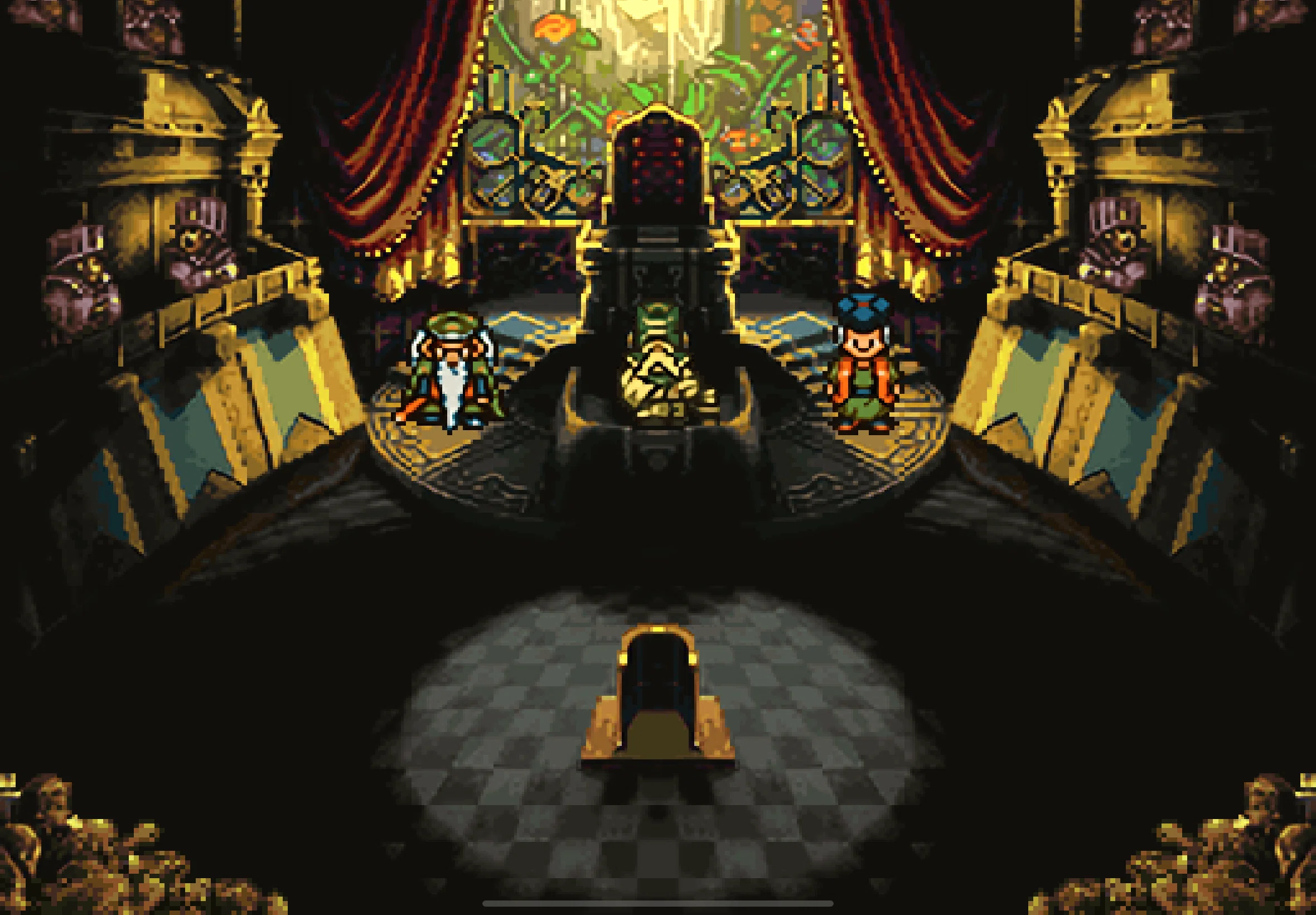
Crono's counsel was a young man named Pierre. He was still turning through his papers moments before the trial began.
“The princess maintains that no abduction took place,” he said. “All you have to do is answer truthfully.”
His voice was calm, but the fingers gripping the pages had gone white.
The Chancellor stepped before the defendant's stand.
Before addressing the charge of abducting the princess, he announced, he would establish what kind of person Crono was. Whether he had intended to lure away a girl he had met by chance, whether he had coveted a royal ornament, and how he had treated the weak during the festival—these things, he argued, would reveal the truth at the heart of the case.
“Which of you approached the other first?” the Chancellor asked.
Crono remembered the sunlight at the entrance to the square: Marle walking backward as she watched the bells, and himself turning to avoid a cat. Neither of them alone had caused the collision.
“It was an accident.”
A murmur passed through the room. Some of those present had apparently not expected Crono to speak even a full sentence.
“An accident,” the Chancellor repeated with a smile. “Then who proposed that you remain together afterward?”
“Marle did.”
“And how long did it take you to grow familiar enough to address Her Highness in that manner?”
Pierre rose at once.
“The defendant did not know her identity at the time.”
“That is precisely what I am establishing.”
The Chancellor turned to the jury. That a strange girl had been the one to suggest they spend the day together should plainly have favored Crono. Once it passed through the Chancellor's mouth, however, it became evidence of improper familiarity with royalty.
The second witness was a child from the Millennial Fair.
Frightened by the vast courtroom, the little girl clung to her mother's skirt. Pierre crouched to ask about her cat, and she told him that Crono had found it after it ran away.
“Did he ask for anything in return?”
The girl shook her head.
“Did you think he was a bad person?”
This time she shook it more emphatically.
The hard line of one juror's mouth softened.
The Chancellor asked the child nothing. Instead, he told her mother that the royal household would grant them a reward and dismissed the witnesses. It was a deft way of making an act of kindness small—absorbing it into the greater generosity of the Crown without ever disputing that it had happened.

The candy merchant was called next.
He testified that Crono had not hurried Marle while she chose what to buy. Other customers had complained behind them, but the boy had waited without protest. He had neither tried to pay for her nor seized her arm to pull her away.
“Then the defendant allowed the girl to act according to her own wishes,” Pierre said.
“He did.”
“Did he appear to you to be an abductor?”
The merchant glanced at the Chancellor before shaking his head.
The Chancellor rose.
“The merchant did not know that the girl was the princess. The defendant claims that he did not know, either. This testimony, therefore, has no bearing on whether an abduction was intended. It establishes only that the defendant did not interfere with a man's business.”
The laughter in the courtroom was quiet, but it was enough to redden the merchant's face.
The final testimony was submitted as a written statement from Taban.
It said that Marle had volunteered for the Telepod demonstration and that, after the accident, Crono had used her pendant to go after her. Lucca's measurements, written out during the night, were attached. They made no mention of a Gate through time, describing the event only as an unexplained spatial phenomenon.
The Chancellor folded the statement slowly.
“The Crown has yet to determine what this machine truly is. One fact, however, is beyond dispute. The defendant vanished with the princess and remained with her for nearly a day in a place no one else could reach.”
“The defendant did not take the princess anywhere. He followed her.”
For the first time, Pierre raised his voice.
“Because he would not leave her alone in danger.”
“Danger created by his own friend?”
Had Lucca been in the courtroom, she would never have let that pass unanswered. Crono looked toward the empty gallery. Marle's place was empty as well. Her voice had remained locked outside the courtroom for the entire trial.
Pierre asked that the wounds on Crono's palm and the bandage around his side be entered as evidence. The princess had returned unharmed, he argued, and the defendant's injuries proved that he had put himself in danger to bring her back.
The Chancellor countered that there was no proof of how the wounds had been sustained.
The same day split into two different stories.
Returning a lost cat became a trivial kindness. Waiting while Marle chose her candy became a meaningless gesture. Her decision became a lapse in judgment, and Crono's pursuit of her became an attempt to flee and conceal his crime. Few outright lies were needed. It was enough to cut the facts loose from what came before and after, then set them down in a different order.
Throughout the trial, the King looked more often at the closed door than at Crono.
Marle had to be on the other side.
When Crono was called upon for a final statement, he was silent for a moment. To explain his innocence, he would have to speak of a castle in the year 600, a missing queen, a cathedral ruled by monsters, and Marle vanishing from the world. He could not make them believe it—and if he did, believing him might place them all in even greater danger.
He looked at the jurors.
“Marle went of her own will.”
That was all.
The jurors filed one by one into a chamber at the rear. As the court waited, clouds passing over the windows moved patches of light across the floor. Pierre rolled his quill between his fingers again and again. The Chancellor tied the cord around his folder like a man who already knew the verdict.
The seven returned.
The judge called the first name.
“Not guilty.”
The second juror said the same, and so did the third.
The child with the cat, the time spent waiting by the candy stall, the instant Crono had looked to the fallen girl before the pendant on the ground—each seemed to take its place beside him, one vote at a time.
When the final juror declared him not guilty, a single, restrained breath escaped the gallery.
The judge raised his gavel.
“On the charge of abducting Her Highness, the court finds the defendant not guilty. However, for placing the princess in danger without royal sanction, he is to be detained for three days and then released.”
Something struck the door outside. Marle's voice came through, faint but unmistakable.
“You heard them! Now open this door!”
The King closed his eyes, then opened them again.
The Chancellor's expression did not change.
As Crono was led from the courtroom, Pierre hurried after him.
“It will be over in three days. The princess will have had time to calm down as well.”
In the passage leading to the prison's north tower, they encountered the prison supervisor. The Chancellor drew a sheet from his red folder and handed it to him.
“The sentence is to be carried out three days from now. Until then, do not take your eyes off him for an instant.”
The supervisor looked down at the page.
“Carried out? I understood the verdict to be three days' detention followed by release.”
For the first time, the Chancellor's smile disappeared.
“Are you the court recorder, or are you the jailer?”
“But this document says execution—”
“Official orders are sometimes delayed. Do you mean to question the will of the Crown?”
The supervisor fell silent.
Crono stopped, and the spear behind him pressed into his clothes. Several paces away, Pierre stared at the paper, his face rigid. Before he could speak, the Chancellor motioned with one hand, and the prison's iron door swung between Crono and the court.
As it closed, the festival bells rang out the hour of noon.
Within the same castle, two promises sounded together: the verdict that Crono would be freed in three days, and the order that he would die.
댓글
댓글 쓰기