[Castlevania: Symphony of the Night Novel Episode 11] The Chamber Where Many Corpses Hung from a Single Heart
Something wet fell from the ceiling and burst in front of Alucard’s boot.
It was not blood. It was too old for that. It was not flesh, either. It was closer to something that had lost its form long ago yet had not finished rotting—grave water and ash clotted together, collapsed, and broken loose again. It trembled once on the stone floor, then spread into a black stain as though nothing had happened.
Alucard stopped.
The heat of the abandoned mine faded with every stair he descended. The stink of singed fur and burning saliva left behind in the chamber where Cerberus had fallen was now faint. From ahead rose a deeper smell. Earth. Rotten cloth. Air from inside coffins long sealed. There was almost no water here, yet the scent seemed to soak the lungs. If the water of the underground caverns possessed the chill of something living, the dampness here was the breath slowly exhaled by the dead.
He pressed the hilt of his sword once with his fingers. Gladius was silent. A hand that had passed through too many chambers now checked the scars on the grip before drawing the blade. The sword was not the only thing that had survived battle. Calluses on the palm, memory in the wrist, burn marks along the cloak’s edge, the dented rim of the shield. All of them had become part of the next judgment.
At the foot of the stairs, the candles had gone out.
Coffins rested in the wall niches. Some were closed; others lay half open. The opened ones were not empty. As if something had tried to push its way out and stopped midway, a dried hand clutched one coffin’s edge. Alucard looked at those fingers, then turned his gaze away. In this castle, few things are completely dead. More precisely, death rarely serves as an ending.
The first coffin shook.
Its lid slid off and struck the floor. The sound was dull. What emerged from within was bone, though not pure white bone. Dark red remnants of sinew clung to its joints, and dried scraps of cloth hung between its ribs. It rose and immediately snapped its neck sideways. A series of ill-fitting cracks followed. Then it stretched out an arm.
Alucard did not advance.
He drew his left foot half a step back and let the bones come to him. A Blood Skeleton does not dodge a sword. A body that has lost the fear it knew in life has lost its sense of distance as well. It dragged its feet forward, its elbow extending in an unnatural line. Just before its nails scraped beneath his cuirass, Gladius came down in a diagonal cut.
The bones collapsed.
But the pieces that hit the floor did not die. Ribs moved on their own. Fingers scratched at the cracks in the stone. Alucard looked down at them and halted his second strike. To erase it completely would require time. But some enemies in this castle are not meant to be destroyed, only passed. He moved on before the scattered bones remembered the shape of a body.
Something caught the edge of his cloak.
Without turning, he reached back and pulled the fabric free. One broken finger, caught in the cloak’s hem, followed for a moment before striking the stone and falling away. It was a small sound. But that small sound woke the entire passage.
The coffins ahead opened one after another.
Alucard did not run. Running meant losing the space, not the enemies. He walked quickly. When bones rose on the left, he twisted half a body to the right; when a hand emerged on the right, he cut the joint with the tip of his blade. The floor was uneven. The stones between the coffins had long since sunk, and some parts dipped slightly when stepped on. He did not set his heels down deeply. He divided his weight through the balls of his feet and moved through the passage.
Two skeletons blocked his path.
They were not separate bodies. Two skeletons below carried a long bone frame like a palanquin, and upon it sat something that had little left but a skull and spine. Bone Ark. Bone bearing bone, the dead carrying what was deader still. It looked almost ridiculous, but Alucard did not smile. The upper skeleton opened its mouth. Its jaw widened far beyond nature, and within it a faint blue point appeared.
He threw himself toward the side wall.
The blue sphere flew past and struck the coffin behind him. The coffin did not break; it burst from within. Shards of wood, bones, and old cloth filled the corridor at once. Alucard passed low through them. He did not raise his shield. The shield had been badly crushed once in Cerberus’s jaws, and it still hung heavily on his arm. Instead of the shield, he used distance. Just after the explosion, before the upper skeleton’s jaw closed again, he slipped in and cut the knee of the left skeleton bearing the frame.
The palanquin tilted.
The upper skeleton tried to open its mouth again, but balance gave way first. Alucard rose in a low arc with the force of the Leap Stone. Not too high. Only high enough not to strike his head against the ceiling. A second step formed beneath him in the air, and he used that rhythm to pass over the skeleton’s head. As he landed, he drew Gladius backward. The upper skeleton’s neck was severed. The blue light vanished from inside its mouth.
For a moment, the collapsing bones sounded like rain.
He did not stop.
The passage gradually widened. The coffins in the wall niches disappeared, and in their place appeared rootlike plants dangling from the ceiling. They had no leaves, too lifeless to be living plants, yet their tips sometimes moved, too restless to be dead vines. Thornweed spread low along the floor. It did not wait for prey to come close. The moment Alucard’s shadow touched it, thin thorned stems snapped outward.
He folded his cloak behind his left arm. If the cloth tore first, the next movement would come late. When he cut a stem with the tip of his sword, black sap sprayed from within instead of green. The sap struck the stone and gave off a faint smoke. Alucard shifted his feet so as not to step on the second stem. The smaller enemies of this castle are not crueler than the greater ones, but they demand more trivial mistakes. A shallow wound can slow a step, and a slowed step can kill in the next room.
When he entered a wider chamber, the light trembled.
Three small demons were leaping in different directions at the center of the room. Gremlins. The moment they saw Alucard, they laughed. Their laughter resembled the thin little sound he had heard when the Demon Card first seeped into his palm. From inside his coat, the card responded faintly. If called, it would appear. The little horned, winged thing might answer that laughter.
He did not call it.
A newly gained hand is not yet one’s own hand. To trust it in the midst of battle, that laughter sounded too much like the castle.
One Gremlin threw an oil-smeared bone shard. Another set it alight. The burning bone hit the floor and burst in a small explosion, spreading black soot low across the ground. Alucard slid aside. The third Gremlin sprang toward the place where he would land. It was not faster than his blade. But it was fast enough to bend expectation.
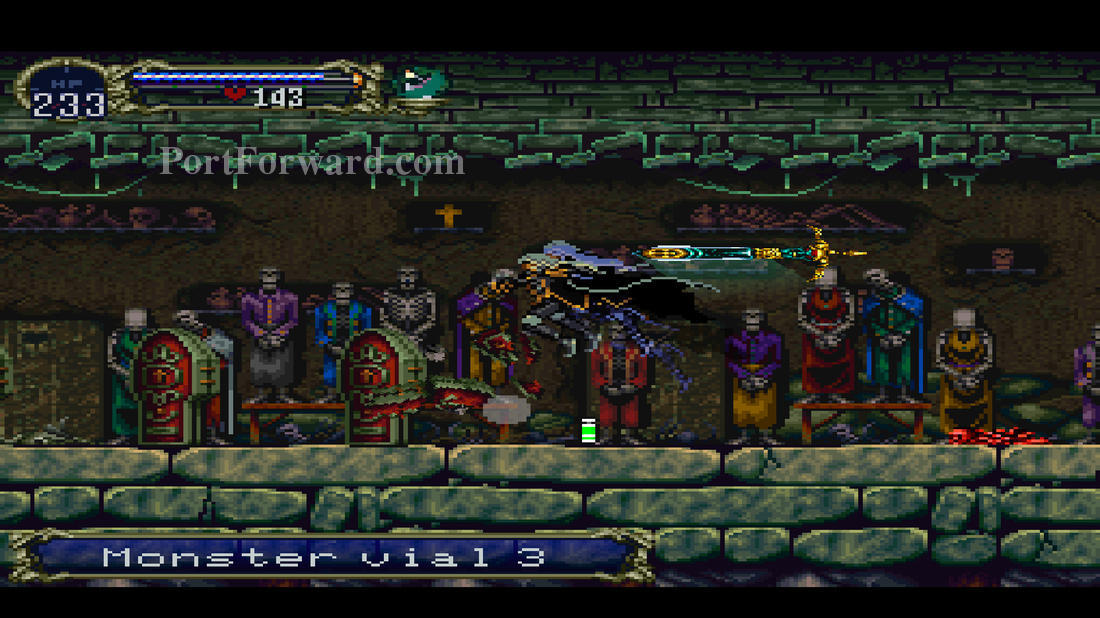
Alucard lowered his wrist. Gladius rose briefly from below. The Gremlin’s laughter was cut off. The other two retreated at once, but it was not flight. One climbed onto a low crevice in the wall, while the other kicked an urn on the floor. The urn shattered, spilling old cloth and bones from within.
He raised the shield on his left arm.
Fire burst. The shield cried out again. The crushed metal folded farther inward, and pain leapt through his wrist. Alucard used that pain to grip harder. The instant the flame vanished, he hurled the shield forward. It did not strike the Gremlin. But it hit the wall with a sharp noise, and the sound drew both of their eyes at once.
That was enough.
The first lost its head. The second tried to flee, but the second leap of the Leap Stone was faster. Alucard twisted in midair and pierced the small shadow clinging near the wall. The Gremlin writhed, pinned there, then disappeared. The light in the room shrank.
Alucard picked up the fallen shield.
The metal was hot. One side of the grip had warped. He looked at it for a moment before fastening it to his arm again. An imperfect tool is still a tool. But one must know when it is time to abandon it. The castle demands such decisions in the middle of battle.
The passage on the right descended. At its end waited a darkness entirely different from the rest. A black space so deep the point of a sword would never seem to reach it. There were spikes inside. He could not see them, but the air told him. A very low metallic scrape, the long moan of wind passing through narrow blades. Alucard stopped at the threshold.
Perhaps Form of Mist could pass through.
The thought vanished as soon as it appeared. The power to become mist did not last long. In a passage where he could not tell where the spikes began or ended, brief mist was not a path but a wager. And if his body returned while standing among those spikes, the mistake would end without time for explanation.
He did not stare into the darkness for long.
Not now.
The words did not leave his mouth. But the castle sometimes remembers unspoken judgments more clearly. Alucard turned his back on the black passage and descended along the path to the left. The groan of the spikes followed him for a while from behind, then broke off at the place where the room changed.
The chamber below was strangely quiet.
At its center lay an old suit of armor. It did not look displayed. It looked as if someone had removed it and set it down. Dust covered it, yet there was no rust. Alucard approached. The armor was not ornate. Instead of decoration, its surface was crossed by very fine lines. They looked at once like a map and like the cracks that form on the soles of feet that have walked a long way.
He touched it.
The armor gave off a very low resonance.
The sound existed only inside the metal. And yet within that resonance, Alucard felt the chambers he had passed through: the long shadow of the Entrance, the chains of the Alchemy Laboratory, the polished floor of the Marble Gallery, the high incense of the Royal Chapel, the water of the Underground Caverns, the blood of the Colosseum, the fire of the Abandoned Mine. The armor seemed to know those paths. Or perhaps it was an object whose weight changed according to the number of paths walked.
Walk Armor.
The name entered his body like the footfall of someone who had traveled far. He hesitated briefly. The cuirass he wore now bore many marks of battle. Cerberus’s flame had scorched its surface, and the hollow left by the Minotaur’s axe still remained. Alucard unfastened the old cuirass. As it came away from his body, cold air brushed across his chest.
Walk Armor was colder than he expected.
But once worn, the metal soon remembered his body heat. Its heaviness was not constant. Standing still, the unfamiliar armor pressed down on his shoulders; but when he took a step, that weight divided through his feet. Armor that made the next step a little more bearable in proportion to the distance already walked. Like any reward the castle gave, it was not kind. It was merely as strong as the distance survived.
He did not discard the old cuirass on the floor. He placed it inside an empty coffin by the wall. He did not close the lid. It was not a burial, only a brief setting aside of the body that had carried him this far.
The room to the left was small.
A red light breathed quietly within it. A chamber of respite. Alucard entered. As the light wrapped around him, the pain in the wrist that had held the shield and the burned skin left by Gremlin fire slowly subsided. But the smell did not vanish. The scent of the catacombs does not remain on the skin; it remains in thought. When he closed his eyes, the coffins seemed ready to open again.
He did not remain long.
When he left the chamber of red light, the passage had grown quieter still. That was strange. In this castle, silence usually has a cause. Either the enemies are gone, or something larger is drawing breath in hiding. Alucard drew his sword. The blade of Gladius floated pale in the darkness. He went left, not upward. After one more room, the candles disappeared.
The next chamber made no sound.
None at all. His footfalls touched stone, yet no echo returned. His cloak moved, yet there was no sound of cloth. Alucard stopped on his second step. The silence was not empty. The whole room was eating sound. Ahead lay a wide space. The ceiling was high, the walls built of massive blocks. The floor was covered with bones and shattered coffin fragments piled in low mounds.
And above them, high in the center of the room, it hung.
At first it looked like a mass of corpses stuck to the ceiling. Soon it was clear that the mass was a single body. Arms, legs, heads, backs, bellies, fingers, hair. None of them were where they should have been. Countless human bodies clutched one another and were clutched in turn, forming a round shell. Faces looked in every direction. Some had closed eyes; some were frozen with mouths agape. Yet at first, none of those mouths made a sound.
Alucard slowly drew in breath.
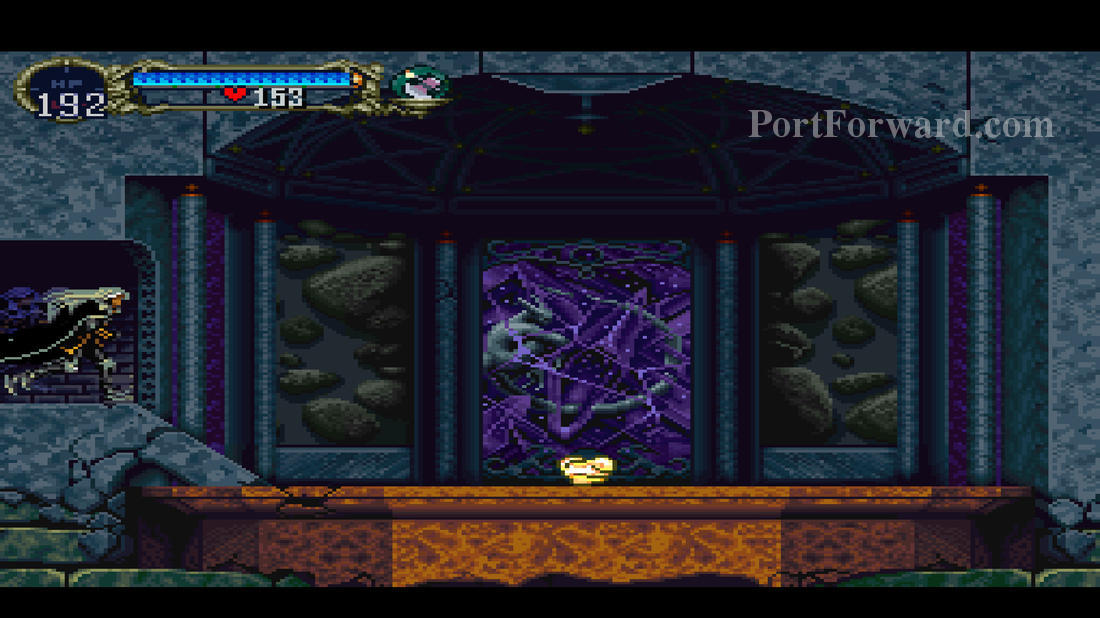
The stench of rot entered his lungs. But before that, something almost like shame touched him. Dead bodies becoming enemies was not rare in this castle. But this was different. It was not a single corpse revived. It was too many deaths bound together beneath one command, with the borders between them erased.
A low vibration came from inside the mass.
At that instant, the heap of bones on the floor moved.
Bones rose first, then bodies with flesh still clinging to them lurched upward. They did not rise one by one. As if each exhalation from the central mass produced human corpses from the floor, several bodies stood at once. Their limbs were incomplete, their necks broken, some without faces at all. Yet they walked toward Alucard.
Granfaloon.
Another name followed belatedly.
Legion.
Many things. Yet one.
The first corpse stretched out a hand. It was slow. Alucard cut it down. The second and third were the same. He advanced toward the mass at the center of the room, cutting through the bodies on the floor. Each time the blade passed through rotting flesh, there was almost no resistance. Too easy. An enemy too easily cut down is seldom the true attack.
He realized that too late.
A shadow fell from above.
One corpse dropped from Granfaloon’s shell and struck his shoulder. Walk Armor rang low under the impact. He staggered and fell to one knee. The fallen corpse tried to seize him. Rotten fingers climbed toward the nape of his neck. Alucard shoved its jaw away with his elbow and reversed his sword in a short thrust. The corpse loosened, but by then others on the floor had approached.
He stepped back.
Too late.
Something caught his ankle. A dead hand gripped his boot. When he tried to pull free, another hand caught the edge of his cloak. The battle suddenly ceased to be about blades and distance. It became a matter of weight and number. Each enemy was weak, but when many deaths clung at once, a single step became a swamp.
Alucard dissolved his body into mist.
Briefly. Very briefly.
The hands clutched empty air. His body blurred through their fingers and escaped. The next moment flesh and bone returned, and his knees nearly gave way. Form of Mist was not the answer to this battle. It could let him evade countless hands once, but it could not erase the numbers that ruled the whole room.
He retreated toward the wall.
Now he saw the structure of the chamber. Granfaloon floated in the center, and the floor beneath was where the corpses gathered. Near both walls were low ledges. Not true platforms, but if he matched his rhythm with the Leap Stone, he could stand on them. Bodies falling from above mostly struck the center below. Near the walls, the space was narrow, but the angle of descent lagged slightly.
He leapt to the left ledge.
With the first jump he stepped on a protruding brick in the wall; with the second, his hand caught a higher edge. Rotten hands scratched the empty air below. Pulling himself up, Alucard looked at Granfaloon. One part of the shell was moving. Countless bodies shifted against one another, then suddenly tumbled downward. In the space left behind, something long and slender was revealed inside.
It was neither flesh nor bone.
A tendril like a black sinew stretched from within. At its tip was an eye. Its closed lid slowly opened. Alucard immediately lowered his body.
Light split the room.
The laser passed before its sound. A white-blue line carved across the brick, and a heartbeat later came the smell of heated stone. Alucard rolled off the ledge. His shoulder struck the floor. Walk Armor took the impact and supported his body, but his breath was cut short. The light licked across the place where he had been a moment before.
The eye closed.
The tendril swayed again. Its movement had limits. It could not turn freely. It could only sweep within the range closest to its own position. Alucard saw this. Granfaloon’s shell was divided into sections, and wherever corpses fell away, the tendrils within were revealed. The exposed tendrils attacked. The remaining shell dropped bodies.
A living shield and dead weapons.
He discarded his first judgment. Advancing by cutting down every corpse on the floor would have no end. Stripping the shell blindly would only make the room more dangerous by exposing more tendrils. What mattered was the center. The single heart binding many deaths together. He had to reach it.
Alucard moved again.
This time, low, but not in a straight line. When the shadow of a falling corpse appeared on the floor, he slipped half a step aside; when a tendril’s eye opened, he avoided its front at once. The laser was fast, but before it opened, the eyelid and the tip of the tendril stiffened first. That short warning had to be read. Once. Twice. The third light grazed his shoulder. A hot line remained on the surface of Walk Armor. The flesh beneath did not burn deeply, but heat entered under the metal.
Alucard did not grit his teeth.
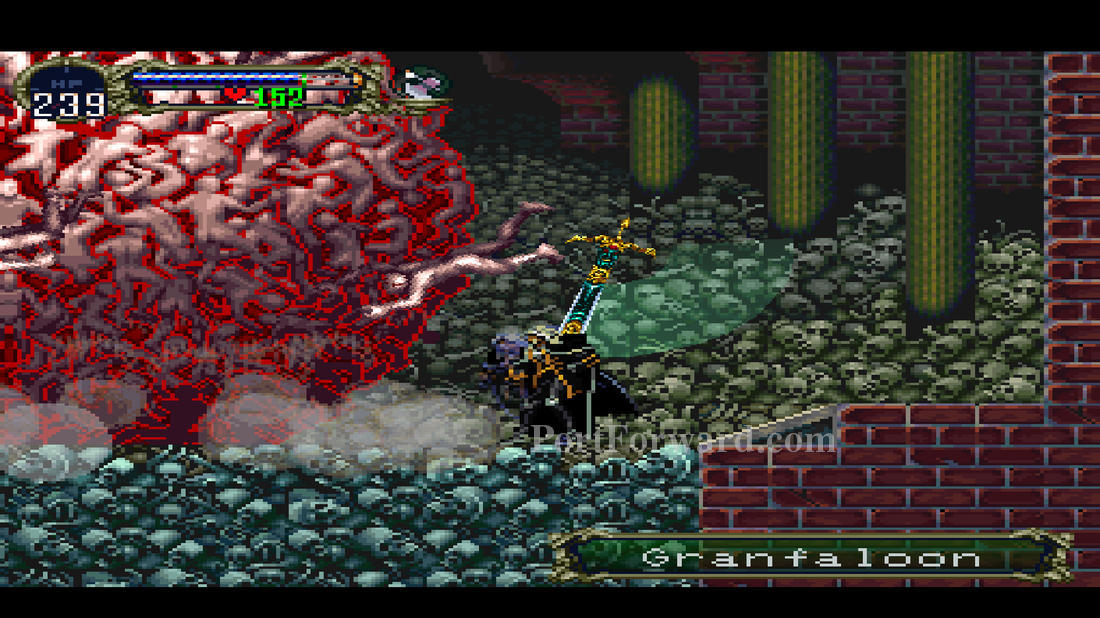
Instead, he cut off his breath. If he followed pain with breath, his movement would slow.
He aimed for the lower right of Granfaloon’s shell. That section had already thinned where many bodies had fallen. The first cut split flesh. The second severed tangled arms and ribs. On the third, part of the shell came away whole. The bodies that fell tried to rise again when they hit the floor, but Alucard was already crossing over them.
A tendril was revealed.
The eye opened.
This time he did not retreat. He moved closer. The time when the eye gathered light. At close range, the laser’s angle narrowed instead. The tendril tried to bend downward, but could not leave its territory. Alucard drove the point of his blade beneath the eye. The tendril convulsed. The light went wide, scraping the ceiling on one side of the room. Chunks of brick fell like rain.
The whole of Granfaloon howled.
Only then did sound return.
Countless mouths screamed at once. High voices and low voices, human things and things that had given up being human, filled the chamber together. For a moment, Alucard heard that sound not with his ears but through his bones. The metal of Walk Armor vibrated. Drawn by the sound, the corpses on the floor began to move faster. They no longer staggered. They charged.
The battle changed.
Several parts of Granfaloon’s shell split open, and the tendrils within opened their eyes. Light that had fired one beam at a time now alternated in succession. From right to left, from below to above, across the center and along the walls. The beams did not follow him perfectly, but they slowly erased the safe places in the room. From the remaining shell, corpses still fell. From above they dropped, from below they crawled, and from the sides light shot toward him.
For the first time, Alucard abandoned his shield.
This time he did not throw it. He unfastened it from his left arm and let it fall to the floor. The shield now harmed his balance more than it protected him. Metal struck stone, and several corpses reacted to the noise, turning their heads. A small opening. He used it.
With two leaps, he reached near the center. He stepped on a falling fragment of stone as though it were a foothold, then drove himself forward again in midair. He stabbed his sword into Granfaloon’s lower shell. It did not go deep. Too many bodies were holding one another together. He gripped the hilt with both hands and put his weight into it. The blade tore downward. One arm, one shoulder, one face fell away. The face opened its eyes as it dropped.
Alucard did not look at it.
He could see the center.
Behind the shell, inside where countless tendrils gathered, there was a round core. It did not beat like a heart. It resembled an eye. A closed eye. Or a mouth not yet born. Around it, the remaining corpses desperately covered the opening. He threw himself toward it.
Light came.
Three beams. One from below, one from the right, one bending in from the front. He could not avoid them all. He loosened his body into mist. The first beam passed through him. He felt magic and heat tear through the border of his body. The second he evaded. The third grazed his left arm just as the mist returned to flesh.
Skin burned.
For a moment his fingers would not obey. Gladius nearly slipped. Alucard seized the hilt more deeply with his right hand. His left hand did not move. He gave up on the left and swung only with the right. It was not a perfect cut. It was short, rough, and his stance had collapsed. But the blade passed between the necks and shoulders of the final corpses covering the center.
The shell opened.
For the first time, Granfaloon’s inner core was completely exposed.
Sound ceased.
For a very brief moment, the whole chamber drew breath.
Alucard did not miss that stillness. He stepped onto the back of a fallen corpse and jumped. The body crushed beneath him. The first leap carried him beneath the core; the second placed him before it. In midair, he drew the sword back. His left arm was still numb. With only his right hand, the depth might be insufficient. So he did not simply thrust the sword.
He drove his whole body in.
Gladius pierced the center of the core. The sensation was unlike stabbing flesh. It was resistance like breaking glass underwater. Countless thin things snapped inside all at once. With the blade still buried, Alucard twisted his body. The sword carved through the core’s interior. A black light flashed once. No—it was not light, but something like the opposite of light.
Granfaloon screamed.
This time it was not the sound of many mouths. It was one deep voice. When that voice emerged, the bodies forming the shell suddenly let go of one another. Arms fell, legs fell, heads poured down. The round shape hanging in the center of the chamber collapsed. Alucard pulled out the sword and dropped. The floor was covered in corpses. Just before landing, he used the strength still left to blur his body slightly, then gathered it again. The impact lessened, though it did not vanish. His knee struck stone.
Rain fell from above.
A rain of corpses.
He bowed his head and drew his cloak in. Arms, bones, and nameless faces landed around him. Some tried to move, but soon lost all strength. Once Granfaloon’s command vanished, they returned to the weight that should have ended long ago. Dead bodies become suddenly quiet. That quiet does not resemble peace. It is closer to a halt that arrived far too late.
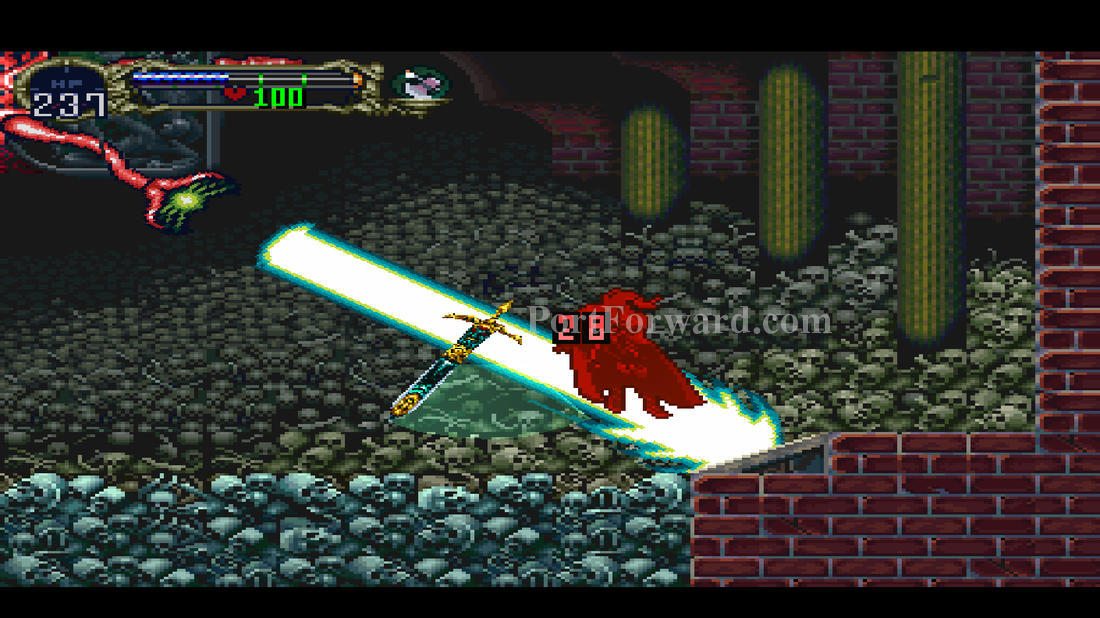
At the center of the chamber, from the place where the core had broken, a small light rose.
Alucard slowly stood. His left arm still tingled, and the smell of burning remained on his shoulder. He walked toward the light. A glow like a vessel of life seeped into his body. His lungs widened slightly, and the rhythm of his blood settled. Yet the smell of the room remained. No matter how much the body recovered, the blood required longer to forget what had just been seen.
A low sound came from the rear wall.
A passage opened. More precisely, the lower-left section of the wall yielded its place. At the same time, stone platforms appeared one by one in the chamber’s central air. As if they had been there from the beginning but unseen, a road revealed itself where the dead bodies had vanished. A path that could be used only after the battle ended. Sometimes the castle gives reward and mockery in the same shape.
Alucard picked up the shield he had dropped.
It could scarcely be used now. Its edge was folded, and the inner grip had been half torn away. He looked at it for a moment, then stood it against one side of the room. It was not discarded but left behind. In a chamber where many deaths had been bound into one body, a small piece of metal that could no longer protect stood alone.
He entered the opened path.
The passage beyond Granfaloon’s chamber was unexpectedly empty. Perhaps too much death had already been spent here, leaving no more enemies behind. The bricks were dark, and the floor was coated in fine dust. Alucard’s footprints remained clear upon it. Walk Armor rang very softly with every step. The armor that remembered the paths walked seemed to engrave the weight of the chamber just passed into its lines.
At the end of the passage, in a small room, there was a sword.
It did not rest on a pedestal. It leaned against the wall. As though someone had used it, set it down for a moment, and never returned. The blade was black. It did not reflect light. Even when candlelight touched it, the surface did not brighten; rather, it seemed to swallow a little of the light around it. The hilt was simple, but it bore lines like the markings of an old funeral rite.
Alucard approached.
Mormegil.
The name resonated low in the back of his throat. A sword bearing the property of darkness. As befitted a blade placed in the castle’s depths beyond a multitude of corpses, it resembled not the light of victory but the shadow of one who had survived. He reached out and took the hilt in his right hand.
It was cold.
Its weight differed from Gladius. This sword did not pull the wrist forward. It drew inward. As if, before being swung, it first asked the silence of its wielder. Alucard lifted the blade slightly. The candle flame in the room quivered faintly. The shadows along the wall lengthened.
He did not fasten it to his waist at once.
Gladius was still familiar in his hand. It was that blade which had just pierced the central core. A new sword was power, but power was also a choice. A sword of darkness would be useful in darkness. Yet there were things in this castle that fed upon darkness. Trust any blade too long, and at some point the blade chooses the path.
Alucard took Mormegil with him. Not because he would use it immediately, but so that he would not miss the moment when he must.
On the return, he had to pass once more through Granfaloon’s chamber.
The room had become like a mountain after collapse. The corpses no longer gathered in one place. Their faces lay turned in different directions. Some mouths still hung open, but there was no sound. Alucard walked carefully among them. Not because they were enemy bodies, but because they had once been bodies. So that he would not forget what this castle used to make its monsters.
The platforms that had appeared in the center of the air now formed the path back. Alucard stepped on them one by one. With the Leap Stone, he could have passed more quickly, but he did not hurry. Each platform carried the room below a little farther away. The moment when many deaths had been one scattered again into many silences.
Just before crossing the threshold, he looked back.
The chamber made no sound again.
This time, it was not a silence that ate sound. It was the silence of something that had no sound left to make.
Alucard emerged into the passage. Far off, from the direction of the spiked darkness he had passed earlier, metal scraped very faintly. A path not yet reached. A path requiring a sense his body did not yet possess. He held that direction in his eyes, then moved on. For now, he had to climb elsewhere. The deeper the castle descends, the older the things it shows; but not every answer lies below.
Inside his coat, the Demon Card trembled faintly once more.
There was no laughter. Perhaps before what it had just seen, even that small demon had briefly closed its mouth. Alucard did not press the card with his fingers. What is quiet is often best left quiet.
He climbed back against the darkness of the Catacombs.
Behind him, the chamber of corpses closed; ahead, the cold stairs of the abandoned mine waited. Yet farther still, from somewhere in the castle’s upper reaches, a wholly different scent drifted down faintly. Not rotting flesh, not burned fur, not wet stone. Old perfume. Wine mingled with blood. A scent that might belong in the chamber of an aristocrat, so courteous it became ominous.
Alucard did not stop.
Gladius rested quietly at his right hip, and Mormegil swallowed light inside his cloak. With every step, Walk Armor gave a low sound. Into that resonance, the weight of the many deaths he had just passed was added.
Beyond the upper darkness, there came the faintest sound of someone setting down a glass.
댓글
댓글 쓰기