[Castlevania: Symphony of the Night Novel Episode 9] The Arena Where Blood Scent Names the Man
A roar sounded beyond the iron bars.
At first, it seemed like the lingering echo of water. Ears that had spent too long in the underground waterways mistook every reverberation for the language of water. But this sound was not wet. It was a low tremor descending along stone walls, as if long-dead throats had risen together and begun beating beneath his feet. Alucard stopped walking and lifted his head. The smell of water had retreated behind him. Ahead came the scent of dry iron and old blood.
He slowly tightened the glove on his left hand. The droplets remaining on its back vanished between the seams of leather. The Holy Symbol held a quiet, cooled light somewhere within his body. Water could no longer burn him. But that did not mean safety. Whenever the castle withdrew one threat, it offered another kind of threshold.
The passage gradually widened. The rounded walls carved by water disappeared, replaced by a corridor of square stones fitted with precision. These stones were not wet. They were dry, their edges worn down by long friction. Countless feet had been dragged in the same direction here. Not the feet of those going to fight, but of those going to watch.
Alucard walked while skimming the wall. The edge of his cloak no longer dragged water, but it was still heavy. Each time the damp fabric touched the back of his calf, it followed a little late. He swept it behind his left arm again and checked the sword hilt with his right hand. The blade rang softly. It was unlike the metallic sounds he had heard in other parts of the castle. Here, even metal seemed to clear its throat before stepping onto a stage.
The first enemy did not come from the front.
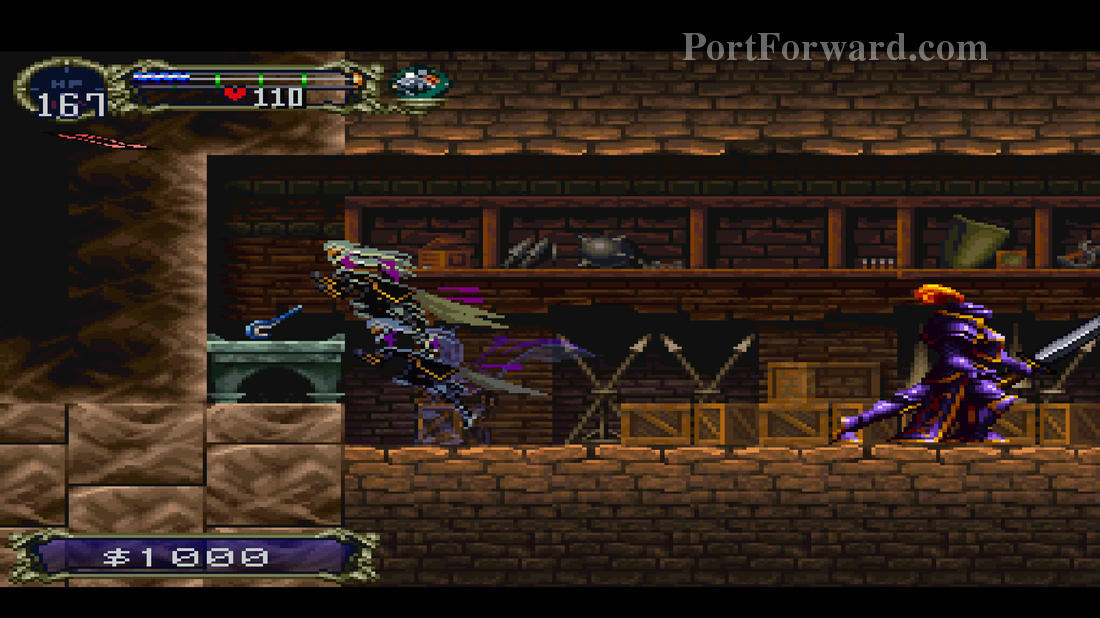
From the upper ledge came the sound of a chain loosening. Alucard read its direction with his ears before his eyes and stepped back. A huge iron ball swept over his head and struck the floor. Stone shattered, and dust rose. At the end of the chain stood a knight in plate armor. No eyes could be seen through the slit of its helm. It pulled the chain with both hands, drawing the iron ball back. The scraping sound across the floor filled the entire corridor leading toward the arena.
Alucard did not rush in. A chained weapon makes distance itself a trap. Even when it seems close, the iron ball can return once more; even when it seems far, the chain is longer than an arm. He watched how quickly the ball was retrieved. Heavy things are strong, but slow. Yet slowness did not always mean weakness. Because it was slow, it claimed space.
The iron ball swung again. This time it came low, sweeping toward his knees. Alucard did not jump over it. The ceiling was low, and the shadow of the ledge hung above. He slid one step forward and pressed the chain down with the back of his sword before the ball could gather full speed. Metal sparked and rang through his wrist. The instant the chain struck the floor, the knight’s body was pulled forward.
That brief bend was the opening.
Alucard’s sword passed beneath the helmet. The armor did not fall at once. It stood for one beat. Then, as if unable to bear the hollow weight within, it slowly pitched forward. The chain did not leave its hand until the end, and the iron ball rolled once across the floor before stopping at Alucard’s feet.
He stepped over it.
The corridor curved along the outer rim of the arena. Every door had bars. In some rooms, weapons hung on the walls. In others, beasts reduced to bone sat motionless. Their skeletons were bound in chains, though they had dried long ago beyond any need for restraint. Even so, each time Alucard passed, their jaws lifted slightly. This was a place where the line between spectator and prisoner had blurred. In this castle, even those who watch eventually enter the cage.
Another roar rose from below.
This time it was clearer. Not the voice of men. Not the voice of the dead. It was the sound of stone, iron, and old blood colliding with one another. The sound of a place that had remembered repeated battles for too long, now making itself echo like applause. Alucard looked down through the gap in the railing.
The arena was not round. Its floor stretched long, with raised sides and a lowered center. The spectators’ seats climbed in tiers, but no one sat there. Instead, every empty place held shadow. The banners were torn, and thick chains hung from iron rings near the ceiling. Across the floor were countless overlapping scars left by old blades. Some lines were straight. Some bent sharply. Some broke along places where blood had dried.
He walked while looking at those lines. A battlefield always leaves the writing of earlier battles behind. Who retreated, who pressed forward, where weight had gathered, where a foot had slipped. The arena floor was more honest than paper. It had not been written by survivors, but carved by the bodies of the fallen.
Near the entrance was a chamber glowing red. Its light breathed quietly within. Alucard paused at the threshold. The castle had not placed such a room beside the arena out of mercy. It was there to make the fighting last longer. Delay death, and more movements are made. More movements become this place’s memory.
He entered and stood before the light. The fatigue in his body settled. The pain in his shoulder, the lingering heat of flesh torn by water, the weight of damp clothing all lowered for an instant. But they did not vanish entirely. Even when the castle erased wounds, it did not erase memory. Alucard passed through the light without closing his eyes.
When he came back through the door, the roar had ceased.
The silence was worse.
At the end of the upper corridor stood a great door. Bands of iron crossed over thick wood, and at the center was carved an emblem of a bull’s head and wolf’s teeth biting into one another. For a carving, the teeth were far too sharp. Sharp enough to draw blood if touched. Alucard did not stare at the emblem for long. In this castle, symbols were often not warnings, but invitations.
When he pushed the door, laughter came from inside.
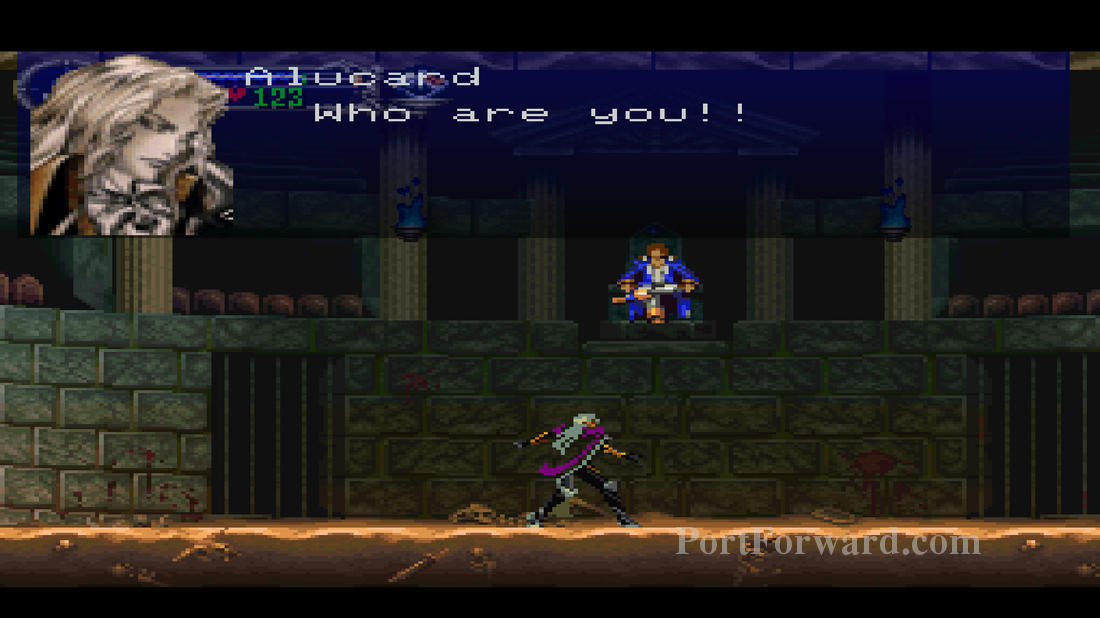
In the highest seats, in the darkest place, someone was sitting. Or rather, the shape of someone was. The line of the shoulders was human, and the posture had the indolence of one seated on a throne. Yet no light reached the face. Alucard drew his sword. The blade caught the light from the doorway and gleamed in a long line.
“Who are you?”
His voice was low. Before the sentence, the sword point asked the question.
The figure in the spectators’ seats raised a hand instead of answering. The gesture was neither a priest’s blessing nor a king’s command. It was the motion of one opening a door behind a stage. On both sides of the arena floor, black gaps opened. Within them was not a chamber, but darkness itself. Hot breath flowed out.
“Come out of the gates of hell, my servants.”
Alucard narrowed his eyes. That voice. He was not hearing it for the first time. But before memory could answer, blood reacted. There were countless scents of blood within the castle. Rotten blood, monster blood, the blood of dead priests, the old blood of royal lines. But the scent descending now from the spectators’ seats was different. A whip, holy water, a human will that cleaved the night. The smell of a bloodline that had opposed Dracula’s name for far too long.
He spoke very slowly.
“That smell of blood… Belmont.”
For a moment, the shadow in the seats seemed to smile. No answer came. Instead, the command fell.
“Attack. Rid my castle of this vermin.”
My castle.
Those words caught Alucard’s feet before the old blood on the floor could. But thought could not continue to its end. From the black door on the left, the wolf emerged first.
It stood too straight to be called a wolf. Human shoulders, a beast’s waist, long arms. Its gray fur was coarse like dust before battle, and each time its claws scraped the floor, thin sparks sprang out. The Werewolf lowered its body. It looked not at Alucard’s eyes, but at his thighs. An enemy that read movement before intent.
From the right came the Minotaur.
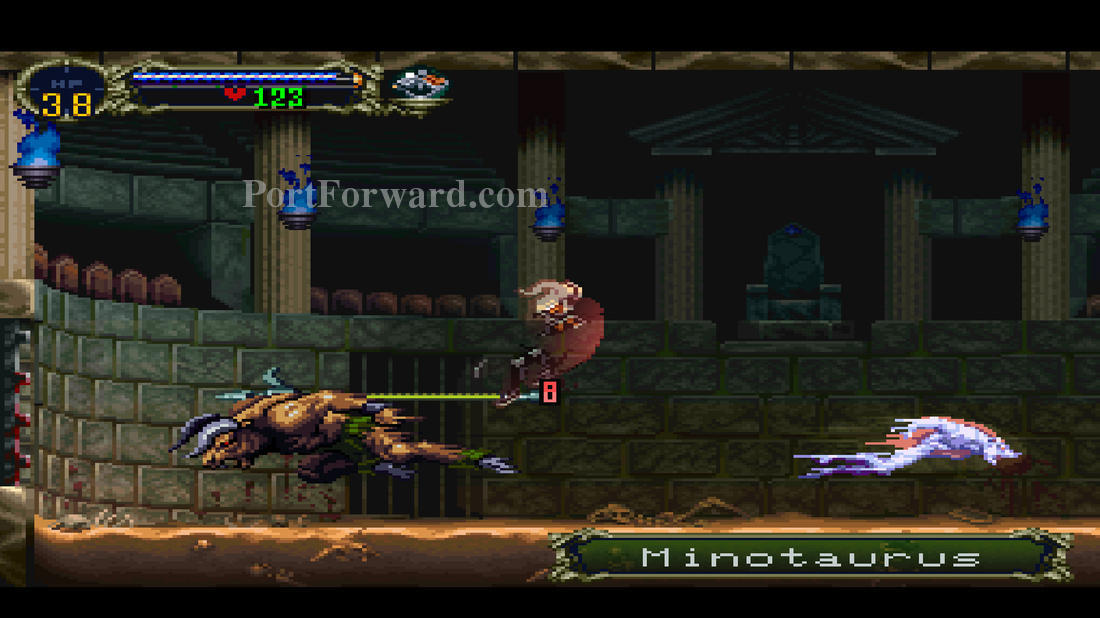
He nearly filled the height of the doorway as he entered. A bull’s head, a broad chest, thick arms. In one hand he held a massive axe. Its blade was duller than moonlight, pressing down light with its weight instead of reflecting it. When the Minotaur breathed out for the first time, white steam spread from his nostrils. A single step made the entire arena floor rumble.
The two enemies did not move at the same time.
That was worse.
The Werewolf came first. Not in a straight line. It seemed to curve right, then appeared from the left the instant its toes struck the floor. Alucard raised his sword, but too late. Claws scraped across the edge of his shield and pushed his arm aside. Reflex made him step back. At that moment, the Minotaur’s shadow covered him from above.
The axe came down.
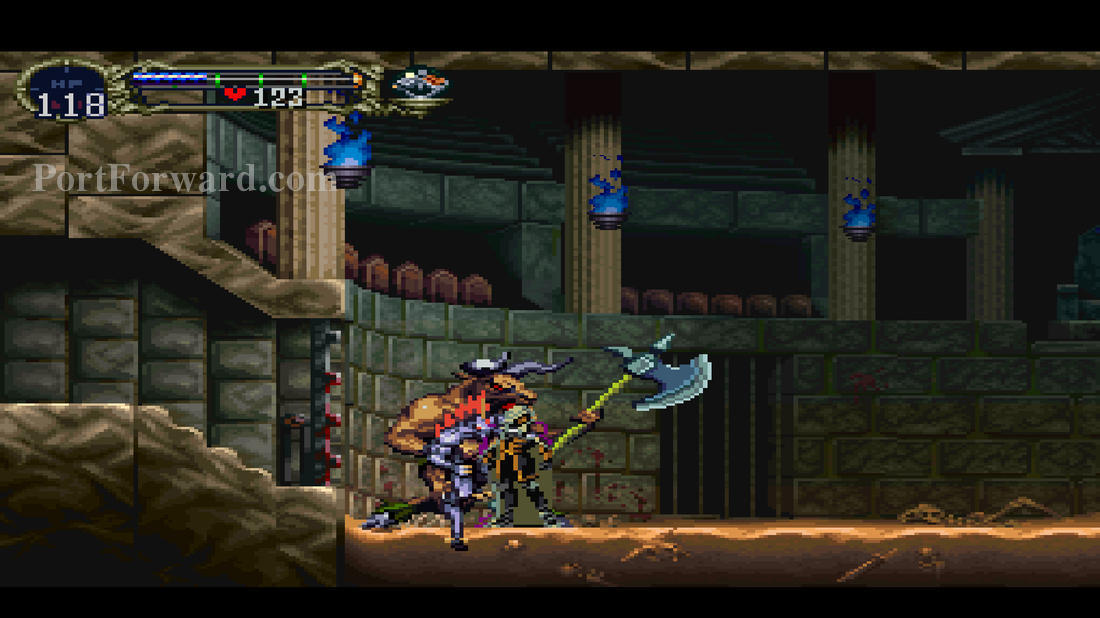
Alucard rolled aside. The blade struck the floor. Stone cracked, and a shard grazed his cheek. He swung his sword as he rose from the roll, but it only touched the Minotaur’s arm shallowly. It did not cut deep. Beneath muscle and hair, the flesh was hard as stone. Worse, the motion of pulling the axe free was already the beginning of the next attack. The Minotaur lifted the axe and turned his body, the rotation sweeping wide close to the floor.
Alucard jumped. The first leap took him over the axe blade, and the second carried him away from the Werewolf’s follow-up kick. But the air was no complete refuge. The Werewolf kicked off the wall and rose near the ceiling, twisting its body. A gray shadow fell in a curve. Alucard turned in midair and brought his sword down, but the wolf’s foot brushed along the flat of the blade as though stepping on it.
The instant he landed, the Minotaur charged.
Alucard did not raise his shield. It was not a weight to block. He tried to evade to the right. But the Werewolf was already there. The beast’s arm swept low, cutting off the escape route. His first judgment had been wrong. He could not see them separately. The fast one closed the path; the heavy one crushed the closed path.
The Minotaur’s shoulder grazed his side. It was not a direct hit, but it was enough to drive the breath from him. Alucard slid backward across the floor. The soles of his boots scraped over lines of dried blood. Only now did those lines reveal their meaning. Many had been forced back this way.
Without stopping, he planted his left hand on the floor. Stone dust bit into his palm. Keeping low, he extended his sword horizontally. The Werewolf followed at once. A fast enemy does not wait for a fallen opponent. It came in with a short jump, claws striking downward. Alucard folded himself even lower. The claws passed above his head. The tip of his sword grazed the wolf’s ankle.
Blood spattered.
For the first time, the Werewolf retreated. It was not a deep wound. But for a fast enemy, a small pain in the ankle changes distance. Alucard confirmed it and tried to rise at once. The Minotaur’s axe returned.
This time not from above, but from the side.
He knew he could not receive it with the sword, yet he set the blade upright. Not to stop it entirely, but to twist its course. Axe and sword struck. His wrist went numb. His body was shoved sideways. The axe blade turned by the smallest measure and scraped across the floor. Because of that smallest measure, Alucard’s body was not split open.
But the Werewolf saw the opening.
The gray body spun low. A kick aimed at his ribs. Alucard raised his shield too late. The impact drove the shield back into him, and the wall behind him drew near. If he were pinned against the wall, it would end. The Minotaur was a weight born for enemies trapped near stone.
Alucard did not retreat farther. Instead, he stepped forward and released his cloak. Still wet and heavy, the fabric spread wide to the right. The Werewolf’s eyes followed the dark movement for an instant. To a beast, moving cloth can look like part of the body. During that very brief mistake, Alucard slipped left.
The Minotaur struck the wall.
His horn lodged in stone. Not completely. But his weight needed one beat to halt itself. Alucard entered during that beat. Before the axe-bearing arm could come down, he cut beneath the Minotaur’s ribs. The first cut was shallow. The second opened the same place more deeply. Before he could deliver a third, the Werewolf came behind him.
He did not look back.
Before footsteps, there came the scrape across the floor. Because of its injured ankle, the Werewolf was dragging its left foot for the shortest instant. Alucard delayed his timing by that drag’s length. Then he bent. Claws passed above his back, tearing his cloak. From that low position, he thrust the sword behind him. The blade pierced the wolf’s thigh.
The Werewolf howled. The Minotaur roared in answer.
At that moment, the battle changed.
They no longer came in turns. They began to move with each other’s voices. The Werewolf gathered blue force in its hands. It was neither fire nor ice. It trembled like a mass of compressed impact. When it threw the force, the Minotaur struck it with his axe. The blue ripple changed direction and flew toward Alucard.
He evaded sideways, but the ripple spread along the floor. The ground trembled beneath his feet. It was not a simple ranged attack. The fast one made a path, and the heavy one transformed it into another shape. The two were no longer merely beasts. They moved like a single mechanism.
Next, the Minotaur breathed first.
Something like black liquid poured from his mouth and soaked the Werewolf’s body. Alucard started to attack, then stopped. As the wolf’s fur became wet, a harsh smell spread through the air. The Werewolf curled and spun. Liquid scattered from its body in all directions. Alucard jumped back. Where droplets struck the floor, faint smoke rose from the stone. One drop hit the edge of his shield and blackened it.
He took in a very short breath.
This was different from a battlefield of water. The floor was not slippery here, but space kept being cut apart. High jumps were followed by the Werewolf, and low evasions were covered by the Minotaur’s axe. Put distance between them, and the two beasts used a combined attack. Close in, and weight and speed descended together.
But every joint attack contains a moment of waiting for the other.
Alucard began to seek that wait.
Because the Werewolf was fast, it moved first. The Minotaur was slow, but because he was slow, the end of his attack lasted long. When the two overlapped perfectly, there was no opening. But after the Werewolf passed and before the Minotaur arrived, and after the Minotaur broke the floor and before the Werewolf changed direction, there was a very thin gap. A gap that vanished when watched with the eyes. The body had to enter first.
Alucard moved to the center.
Deliberately.
The Werewolf reacted at once. Trying not to show awareness of the wounded ankle, it leaped even farther. A large jump is fast, but honest. Alucard delayed his first jump. Just as the wolf’s body passed over his head, he used the second jump to change direction. His body twisted in the air, delaying the Minotaur’s sight for an instant.
The axe struck empty air.
Alucard skimmed over the Minotaur’s arm as if landing on it. He did not truly step there. But that height was enough. As he fell, he cut between the bull’s shoulder and neck. The blade entered beneath the hard hair. The Minotaur staggered. Alucard had to move aside the instant he landed, because the Werewolf had returned behind him.
This time, the wolf waited.
For the first time, it tried to watch Alucard move. When a fast enemy stops, it is concealing speed. The Werewolf crouched low and spread its arms. A stance that could spring in any direction. The Minotaur stood a little behind, axe raised. Preparing to charge. The distance between them was not long. If Alucard entered toward either one, the other could close behind him.
Alucard lowered his sword point.
For a moment, the fight seemed to stop. There was no roar. No water. Only the Minotaur’s breath and the sound of the Werewolf’s claws scraping stone.
He moved his left hand very slightly. The wrist holding the shield dropped. Like a mistake. The Werewolf bit first. Its gray body burst forward. At the same time, the Minotaur charged. Alucard did not retreat. He took half a step toward the Werewolf, then folded inward at the final instant. The wolf’s claws passed above his shoulder.
The Minotaur’s charge could not stop.
Weight hears commands late. Into the place where the Werewolf had passed, the Minotaur’s horn drove forward. The wolf barely kicked off the wall to evade, but could not escape completely. One horn grazed the Werewolf’s side, tearing fur and flesh. For the first time, the breathing of the two beasts fell out of rhythm.
Alucard did not miss that break.
He chose the Werewolf. The fast one had to be broken first. The Minotaur’s weight could be evaded, but the Werewolf’s speed erased paths. As the wolf came down from the wall, Alucard entered low. The sword moved once, twice, in short cuts. Inside the elbow, thigh, wounded ankle. Not cuts meant to kill, but to steal speed.
The Werewolf spun in rage. It rose close to the ceiling, then dropped like an explosion. The impact would spread in every direction when it hit the floor. Alucard stayed where he was. If he fled too early, the wolf could change direction. He waited until the beast’s shadow was darkest over his head.
Then one step aside.
The descending fist shattered the floor. Stone dust surged upward. Alucard entered through the debris. Before the Werewolf could pull its arm free, the sword went beneath its throat. The blade went deep. He twisted his wrist as he withdrew it, cutting once more. The wolf’s cry broke short.
The Werewolf tried to retreat. But its wounded ankle could not hold. Its knee gave way. Alucard closed the last distance. The wolf’s eyes looked up at him. In them, something like human cunning flickered briefly, then changed into beastly fear.
The sword came down.
The gray body collapsed onto the floor. Claws scraped stone. Once. Twice. Then stopped.
The Minotaur’s roar filled the arena.
Speed was gone now, and only weight remained. Yet when weight stands alone, it becomes not merely more honest, but more brutal. The Minotaur did not look at the dead Werewolf. He raised the axe directly toward Alucard. His breathing grew harsh, and blood flowed from the wound in his shoulder. It was less red than dark and viscous. Each drop made a small circle on the floor.
The first charge was straight.
Alucard evaded. Just before reaching the wall, the Minotaur twisted his body and swung the axe backward. A follow-up faster than expected. Alucard caught it with his shield. The impact traveled up his arm to his shoulder. His knee faltered for a moment. The Minotaur gave him no distance. Holding the axe short, he pressed forward. A heavy weapon used close. The method of a beast that had survived in narrow spaces.
Alucard stepped back. One step, two. At the third, he stopped. Behind him was a low groove made by broken flooring. Another step, and his foot would catch. The Minotaur did not seem to notice it, but the castle did. A battlefield always betrays first beneath the feet.
The Minotaur raised the axe.
This time, Alucard jumped forward. He had to enter inside the handle before the blade fell. A short distance. But the Minotaur’s arms were thick, and the axe haft was like a small tree trunk. Instead of stabbing, Alucard cut the axe handle. One blow did not sever it. The second struck the same place. The wood split.
The Minotaur shoved him with an elbow.
Alucard’s body flew sideways. As he rolled across the floor, his shoulder opened again. The moment he tried to rise, he saw the shadow of the axe. The unbroken weapon was coming down with its final force. He could not fully evade to the side. He set his shield.
Impact.
The shield buckled. Blood ran from his wrist. But the split part of the axe handle could not endure the shock. The wood broke, and the axe head dropped aside. In the Minotaur’s hand remained only the broken shaft. The beast looked down at it for a moment.
In that brief silence, Alucard stood.
Having lost his weapon, the Minotaur lowered his body. A charge led by the horns. Now faster than the axe, straighter than the axe. Alucard breathed out slowly. Horns are strong, but hard to redirect. Yet if he dodged forward, the fists would follow. If he evaded near the wall, the stone struck by the charge would collapse.
He looked at the broken groove in the center of the arena.
The place that had nearly tripped him earlier. A betrayal underfoot is the same for anyone.
The Minotaur charged. The floor rumbled. Alucard did not move until the last instant. The bull’s eyes drew close. Hot breath touched his face. Just before the horns pierced his chest, he jumped upward. First leap. The Minotaur’s head passed beneath him. With the second leap, Alucard turned his body and dropped behind the beast.
The Minotaur’s foreleg caught in the broken groove.
The massive body pitched forward. It did not fall. But in the moment its balance broke, the back of its neck opened. Alucard landed and took the sword in both hands. If he hesitated, the muscles would close again. He drove the blade down from above. The sword pierced the thick nape. The Minotaur tried to straighten. Alucard did not release the hilt and was pulled upward with him.
The beast roared for the last time.
There was more command than rage in that roar. The final struggle of one summoned as another’s servant. Alucard listened to it and twisted the sword. Something broke inside the neck. The Minotaur’s arms grasped at the air. There was nothing to seize. The broken axe shaft fell from his hand and rolled across the floor.
The huge body collapsed.
The arena floor rang once more. The shadows in the spectators’ seats seemed to sway with the vibration. There was no cheering. No applause. Only dust settling slowly, and the blood of the two beasts flowing in different directions until it stopped among the old lines on the floor.
Alucard pulled his sword free. His wrist trembled. He did not try to hide it. It was the body’s way of announcing that it still lived. His shield was dented, his cloak torn by the wolf’s claws, and the cloth at his side was wet with red again. He looked up toward the spectators’ seats.
The shadow was already gone.
But the scent remained. The smell of blood. Belmont blood. That was certain. Richter was no longer a distant passing silhouette. From the darkest seat of this arena, he had called the castle “my castle” in his own voice.
Alucard murmured low.
“Without doubt, he is a Belmont. But why would he call himself lord of this castle…?”
The words fell to the arena floor. No answer came. Not the dead beasts, nor the empty seats, nor the blood-soaked stone returned anything. This castle loved questions, but was always miserly with answers.
The door on the right opened.
Not silently. An iron door long shut groaned low as it was pushed from within. Beyond it lay a narrow corridor and a broken floor. With a body just out of battle, the distance was awkward. Alucard stepped back several paces and ran. The first jump carried him halfway across the gap, and the second carried him the rest of the distance. His fingertips caught the opposite edge. His damp glove, filled with stone dust, slipped, but he bent his wrist and pulled himself up.
It was a small room.
Unlike the arena, it had almost no ornament. On a pedestal at its center lay a relic. Its visible form was faint. It looked less like a solid object than air folded into one place. There was no light, yet the surrounding space blurred. As Alucard drew near, the edges of the candle flames briefly grew hazy.
He reached out.
The relic did not touch his palm; it seeped between his fingers. It was not cold. Nor hot. The outline of his body seemed to loosen from within. Bone and flesh, blood and clothing, sword and shadow — the knots that had bound them firmly together came undone for the briefest moment. Reflexively, he held his breath. That only made his body feel lighter.
Alucard looked down at his hand.
His fingertips blurred for a moment, then returned. Mist. Something like water, but not water. A form that could hide blood and briefly forget flesh. Yet he could not remain in it long. He clearly felt strength drain out for a moment, then return. This power did not break doors. It changed the body before a door could seize it.
There were iron bars on one side of the room. The gaps were too narrow for a person to pass. Only a bat, or smoke, could slip through. Alucard stood before them. When he reached out, the metal was cold and smelled of old blood. Until now, such bars had been routes he had to circle around. Without the proper power, they were the same as walls.
He did not close his eyes.
His body blurred. First the fingertips, then the shoulders and the edge of his cloak. The weight of the sword seemed to vanish, and for a moment even the word weight lost meaning. He did not walk. He drifted. For a very short instant, as he passed between the bars, the chill of the metal moved through his entire body. Flesh did not strike it, and cloth did not catch. Instead, the shape called himself thinned, loosened, and gathered again.
In the next breath, he stood beyond the bars.
His knees bent slightly. His body knew before his mind did that the strength would not last long. Alucard placed a hand against the wall. The stone was solid, and his palm was once more a palm. He checked the sword hilt. The sword had returned as well. Even while becoming mist, the weapon had not left him. The laws of this castle were sometimes cruel, but strangely exact.
At the end of the corridor, stairs descended.
From there rose not the blood smell of the arena, but earth, ash, and rotten wood. A deeper place. A darkness unlike the underground of water. The smell carried by an abandoned mine or a passage long sealed. Between the walls, a very low growl passed once. It sounded like a dog, but not a beast with only one head.
Alucard looked back toward the arena.
The bodies of the Minotaur and Werewolf could no longer be seen. The door had closed, hiding the battlefield. But Richter’s voice remained. My castle. Those words were heavier than the axe and faster than the wolf’s claws as they scraped inside his thoughts. The anxiety Maria had spoken of had now taken shape. Had someone changed, or had someone been seized? The sword had not yet chosen an answer.
He descended the stairs.
On the first step, his cloak swayed behind him. On the second, the dust of the arena fell away. On the third, the feeling of mist he had just gained stirred very faintly within his body. Another closed path had diminished. But by just as much, the castle had grown deeper.
From below came another growl.
This time, it was closer.
댓글
댓글 쓰기